
3 Ordinary Places That Hid Something Truly Disturbing for Years
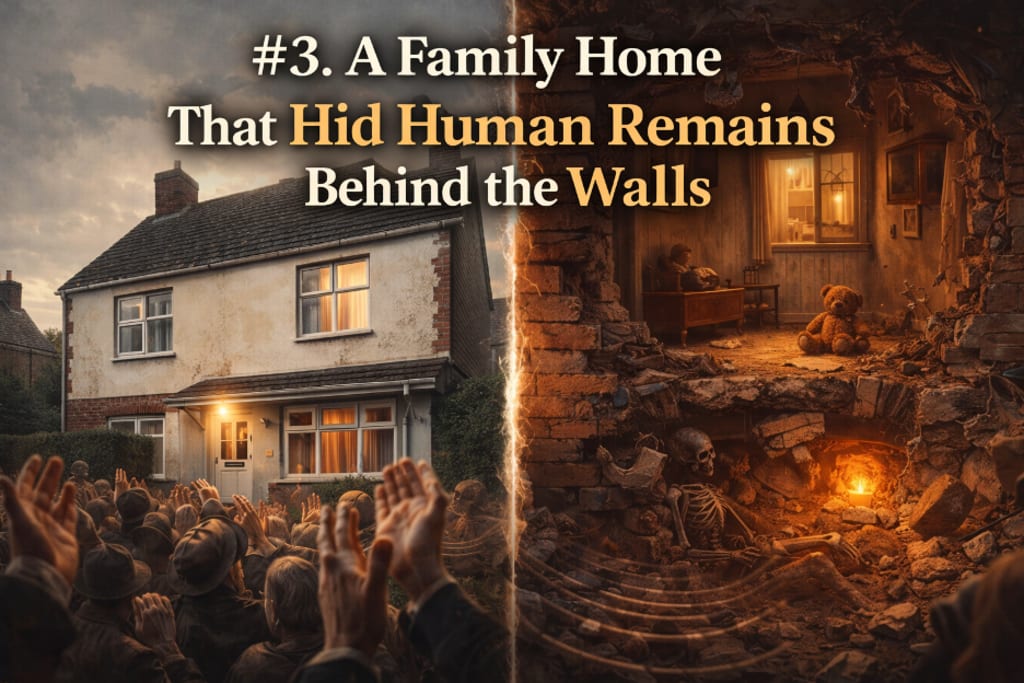
#3. A Family Home That Hid Human Remains Behind the Walls
Most of us take comfort in ordinary places. Schools feel safe. Homes feel familiar. Workplaces feel predictable. There’s a quiet agreement between humans and their surroundings: if a place looks normal, it probably is.
History has repeatedly violated that agreement.
Some of the most disturbing discoveries weren’t made in abandoned asylums or remote forests. They were found in places people passed through every day—places with parking lots, vending machines, and politely painted walls. The horror wasn’t hidden because it was cleverly concealed. It was hidden because no one thought to look.
The unsettling truth is this: familiarity is camouflage.
Here are three ordinary places that concealed something deeply disturbing for years—while life carried on just inches away.
3. A Family Home That Hid Human Remains Behind the Walls
From the outside, the house on Cromwell Street in Gloucester, England, looked painfully normal. A modest semi-detached home. Nothing about it suggested it would later become one of the most infamous crime scenes in British history.
Inside lived Fred and Rosemary West.
For years, the Wests appeared unremarkable—odd, perhaps, but functional. They raised children. They greeted neighbors. They renovated their house. What no one knew was that during those renovations, they were hiding bodies.
Human remains were buried in the cellar, the garden, and behind walls. Some belonged to people who had been reported missing. Others had never been reported at all. The house didn’t just conceal evidence—it actively absorbed it into its structure.
The truly disturbing part is the duration. The crimes spanned decades. Visitors sat in rooms above bodies without realizing it. Children played in the yard. Life went on.
When police finally investigated in the 1990s, the house became a forensic nightmare. Every wall, every floorboard felt complicit.
The house was eventually demolished. It was deemed too poisoned by history to repurpose. Some buildings don’t deserve a second life.
2. A School Basement That Hid Radioactive Material
Schools are supposed to be among the safest places imaginable. Learning, structure, and institutional oversight create a comforting sense of order. Which makes what happened at Roosevelt Elementary School in Hillside, New Jersey, deeply unsettling.
In the 1940s and 1950s, radioactive materials were stored in the school basement as part of early nuclear research and industrial experimentation. This was an era when radiation safety was optimistic. The long-term risks were poorly understood, and oversight was minimal.
The material stayed there.
For decades, students attended classes directly above radioactive waste. Teachers worked there. Custodians cleaned the basement. No one sounded alarms because no one knew there was anything to be alarmed about.
It wasn’t until years later—after concerns were raised about contamination—that investigations confirmed the presence of radioactive material. Cleanup efforts followed. Reassurances were issued.
The horror isn’t cinematic. There were no glowing walls or immediate disasters. It’s quieter and more disturbing than that. Children unknowingly spent years in proximity to something dangerous, protected only by ignorance and concrete.
Sometimes, the most unsettling hiding places are official ones.
1. A Hotel Room That Was Secretly Used as a Surveillance Chamber
Hotels promise privacy. They are temporary homes where strangers are expected to relax, undress, sleep, and trust the walls around them.
That trust was shattered in the case of the H. H. Holmes–style “voyeur rooms” uncovered in multiple hotels across the world, including a notorious case in South Korea in 2019.
In several budget hotels, hidden cameras were discovered embedded in everyday objects—smoke detectors, air vents, and wall sockets. These weren’t isolated incidents. Hundreds of guests had been secretly recorded over the years. Footage was livestreamed or sold online.
What makes this horrifying isn’t just the violation—it’s the ordinariness of the rooms. Standard beds. Neutral décor. Complimentary toiletries. Nothing to suggest that the walls were watching.
Guests brushed their teeth. Changed clothes. Slept. All while unknowingly starring in footage they never consented to.
The most anonymous spaces turned out to be the least private. The ordinary hid something deeply disturbing not because it was hidden well, but because people trusted the setting.
Conclusion
These stories unsettle us because they violate a core human assumption: that danger announces itself. We expect warning signs, strange vibes, or at least a strange soundtrack.
But history shows that horror often blends in.
Homes, schools, and hotels are designed to lower our guard. Their ordinariness disarms suspicion. And that’s precisely what makes them effective hiding places—for secrets, crimes, and long-running mistakes.
The lesson isn’t to distrust every wall or floorboard. It’s to recognize that “normal” is not a guarantee of safety. Sometimes it’s just a very good disguise.
And if that makes you glance around your room a little differently—well, history would understand why.
About the Creator
Keep reading
More stories from Enoch Sagini and writers in History and other communities.
3 Things That Were Invented for Good Reasons and Used for Terrible Ones
Human history is full of optimism. Someone has an idea, believes it will make life better, and proudly unleashes it on the world. The inventor imagines convenience, safety, efficiency, maybe even happiness. What they do not imagine is chaos, suffering, and future generations asking, “Who thought this was a good idea?”
By Enoch Sagini3 days ago in History
Vlad Țepeș
Vlad Țepeș: Sovereignty Written in Blood History remembers kings by their victories, saints by their sacrifices, and tyrants by their cruelties. Vlad Țepeș is remembered by all three and understood by none. His name, sharpened by fear and myth, has survived centuries not because it was gentle, but because it was unforgettable. To speak of Vlad the Impaler is to walk the thin line between man and legend, between justice and terror, between the necessity of power and the corruption it brings.
By Pure child3 days ago in History
Stanislav Kondrashov Oligarch Series: The Ancestral Stones of Florence
Florence is widely regarded as the birthplace of the Renaissance, a city where art, architecture, and intellectual life converged to reshape European culture. Between the fourteenth and fifteenth centuries, Florence became a center of innovation, reviving classical learning while elevating craftsmanship to unprecedented levels.
By Stanislav Kondrashov6 days ago in History




Comments
There are no comments for this story
Be the first to respond and start the conversation.