

Bangladesh History
The struggle for independence, colonial rule, modern development, and Bangladesh's rich and complicated history all played a role. An overview of the major historical eras: Medieval and Ancient Times Ancient Civilizations The early Vedic, Mauryan (3rd century BCE), and Gupta (4th–6th century CE) empires all had an impact on the region that is now Bangladesh. Between the 8th and 12th centuries CE, a significant Buddhist dynasty ruled Bengal and portions of eastern India. The Islamic Sultanate (13th-16th centuries) Islamic influence was established in the region by Muslim rulers, including the Delhi Sultanate and the independent Bengal Sultanate. Bengal became a thriving trading center that attracted merchants from Europe, Arabia, and Persia. The Mughal Empire (16th-18th centuries) Under the Mughal Empire, Bengal became a prosperous province known for its textile (muslin) and agricultural production. Dhaka, formerly known as Jahangirnagar, developed into a significant administrative and commercial hub. The British Colonial Era (from 1757 to 1947) East India Company Rule
After the Battle of Plessey (1757), control was taken over by the British East India Company. The Great Bengal Famine of 1770, which killed millions of people, was a result of exploitative policies in Bengal. British Raj from 1858 to 1947 The Indian independence movement had a significant presence in Bengal. Protests led to the British's 1911 reversal of the Partition of Bengal. Bengal was divided into West Bengal (India) and East Bengal (East Pakistan) in 1947 when British India was divided into India and Pakistan. East Pakistan from 1947 to 1971 West Pakistan, which is now Pakistan, was culturally and linguistically distinct from East Pakistan (modern Bangladesh). Discontent grew as a result of political and economic discrimination, which culminated in the Language Movement in 1952, in which Bengalis protested for the recognition of Bangla as the state language. Sheikh Mujibur Rahman's 1966 Six-Point Movement called for more freedom. War of Liberation in Bangladesh Constitution of the United States Sheikh Mujibur Rahman declared independence after Pakistan's military launched Operation Searchlight on March 25, 1971, to quell Bengali demands. In order to lead the liberation struggle, the Mujibnagar Government was established in exile. Conflict and Genocide An estimated 3 million people were killed and millions were displaced as a result of widespread atrocities committed by the Pakistani military and allied militias known as the Razakars. India intervened in December 1971, which resulted in Pakistan's surrender on Victory Day, December 16, 1971. Bangladesh independent from 1971 to the present The beginning (1971–1975) Sheikh Mujibur Rahman served as the first Prime Minister, but he was killed in a military coup in 1975. Multiple coups and countercoups followed, resulting in political instability. Military rule from 1975 to 1990 The Bangladesh Nationalist Party, or BNP, was founded by General Ziaur Rahman from 1975 to 1981. From 1982 to 1990, General Hussain Muhammad Ershad ruled until pro-democracy demonstrations forced his resignation. The Democratic Era (1991–Now) Politics has frequently been marked by rivalry as Khaleda Zia (BNP) and Sheikh Hasina (Awami League) have alternated in power. Bangladesh has changed as a result of economic expansion, the expansion of the garment industry, and social development. Corruption, political unrest, and threats from climate change are all obstacles. Important Symbols from History and Culture Language Martyrs' Day is an International Mother Language Day that is recognized by UNESCO on February 21. Savar, the National Martyrs' Monument, honors the 1971 martyrs. Pohela Boishakh, the Bengali New Year, commemorates cultural heritage. From ancient prosperity to colonial exploitation, liberation struggle, and modern growth, Bangladesh's history demonstrates resilience. It is now recognized as a vibrant, growing nation with a distinct cultural identity. Would you like more information about a particular time period? Thankyou for Reading
About the Creator
Keep reading
More stories from writers in History and other communities.
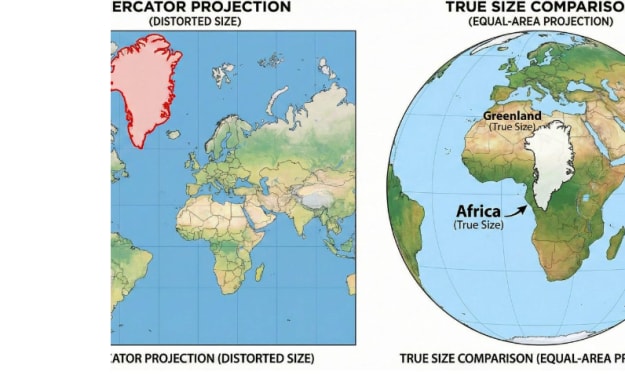
Most global maps make Greenland appear larger than it is in reality.
According to a global investigation, people's perceptions of major nations are systematically changed by the type of world map they view, making Greenland one of the most overstated locations on the planet.
By Francis Dami4 days ago in History
A Deep Dive Into Puerto Rico's History
Last night, we were treated to an amazing Super Bowl, the 60th edition of the big extravaganza. The Bay Area hosted the game, which was won by the Seattle Seahawks, but the centerpiece of the event was the halftime show. The main performer was Bad Bunny, who I've been a fan of for a few years now, and he showed out, because he always does. I absolutely enjoyed the halftime show, and I definitely wasn't alone, as I was one of 130 million viewers who drank in Bad Bunny's performance.
By Clyde E. Dawkins4 days ago in History



Comments
There are no comments for this story
Be the first to respond and start the conversation.