Trivia
History's Footprints
History is a vast tapestry woven with countless events, each leaving an indelible mark on the fabric of our existence. From groundbreaking discoveries to pivotal moments of triumph and tragedy, the past is replete with stories that have shaped the world we live in today. This article delves into some of these remarkable events, tracing the footprints of history and exploring their enduring impact on our society.
By Sazeeb Chowduryabout a year ago in History
Prehistoric Human Cultures
Prehistoric human cultures refer to the societies and way of life of humans before recorded history, which spans millions of years, covering the early stages of human evolution through the development of modern Homo sapiens. Here's an overview of major periods and some lesser-known cultures:
By snowycloudabout a year ago in History
The Rise and Fall of the Mauryan Empire
Few things have driven humanity more than the ambition for power. Across history, we've witnessed how the desire for control, glory, and land can elevate or destroy empires. Today, we explore one of the most influential civilizations in ancient India: the Mauryan Empire. This post dives deep into how this empire emerged, expanded, and left a lasting impact not only on the Indian subcontinent but on the world. Starting in the 6th century BCE, the Indian subcontinent saw the rise of various political units called the Mahajanapadas. Among them, the Kingdom of Magadha was the most powerful, but under the rule of the Nanda dynasty, it became infamous for oppressive governance. King Dhana Nanda's reign (329-321 BCE) was marked by high taxes and cruelty, making the dynasty deeply unpopular. Adding to this internal unrest, the western part of India was thrown into chaos after the invasion of Alexander the Great, further destabilizing the region. Amidst this turmoil, a Brahmin statesman named Kautilya (or Chanakya) envisioned the possibility of uniting India under a centralized empire to ward off invaders and restore peace. After being scorned by King Dhana Nanda, Kautilya found an ally in Chandragupta Maurya, a young warrior with immense potential. Together, they plotted to overthrow the Nanda dynasty and establish a new order. Taking advantage of the power vacuum left by Alexander’s forces, Chandragupta began his military campaigns in northwest India, toppling weakened Greek-Macedonian rule. With Kautilya’s brilliant strategy, Chandragupta continued to advance through India, eventually taking the heart of Magadha and claiming the throne. In 321 BCE, Chandragupta founded the Mauryan Empire, establishing Pataliputra (modern-day Patna) as its capital. Chandragupta's empire quickly expanded to encompass much of India, from its western coast to the southern regions. Plutarch even noted that his army reached an astonishing 600,000 soldiers. Chandragupta also came into conflict with Seleucus I Nicator, one of Alexander’s successors. After a war in 301 BCE, the two leaders signed a treaty that gave Chandragupta large territories in exchange for war elephants—a move that further cemented the Mauryan power. The Mauryan Empire was one of the most well-organized empires of its time. Chandragupta ruled through a sophisticated bureaucratic system. The king was the head of the state, with a council of ministers advising him on military, financial, and administrative matters. Provinces were governed by royal princes, and the administration extended down to village levels, ensuring strict control over social and economic life. The empire maintained a vast spy network and a large standing army, with specialized units for infantry, cavalry, navy, and war elephants. Soldiers were highly valued, focusing solely on warfare and not being required for other services. Chandragupta’s rule established a model of efficient governance that influenced later rulers in the region. The Mauryan economy was largely state-controlled. The empire monopolized essential industries like coinage, salt production, mining, and weapon manufacturing. Agriculture was heavily taxed, and merchants were organized into guilds that held judicial and executive power. Trade flourished under state supervision, with strict regulations on prices, weights, and measures. Roads and rivers connected the empire to foreign markets, extending even to Sri Lanka, China, and Arab ports, promoting a vibrant trade network. After ruling for 25 years, Chandragupta abdicated in favor of his son Bindusara, who expanded the empire further into southern India. However, it was Ashoka, Chandragupta’s grandson, who left the most significant mark on the empire and the world. Initially a ruthless ruler known for his cruelty, Ashoka waged a bloody war against the kingdom of Kalinga, resulting in immense loss of life. This campaign traumatized Ashoka, leading him to adopt Buddhism and embrace non-violence, promoting the concept of dhamma—a philosophy of righteous behavior and goodwill. Ashoka’s reign saw the construction of monumental stupas and the spread of Buddhism across Asia, with missionary efforts reaching Sri Lanka, Southeast Asia, and beyond. Yet, despite Ashoka’s efforts to promote peace, his successors lacked his strength. After his death, the empire began to fracture, and by 185 BCE, the last Mauryan ruler, Brihadratha, was assassinated, ending the dynasty. The Mauryan Empire, the largest to ever exist on the Indian subcontinent, was driven by a relentless pursuit of power, but like many great empires, it faced internal strife and external pressures that led to its decline. The administrative, economic, and cultural advancements during its reign left an indelible legacy that shaped the Indian subcontinent for centuries. The rise and fall of the Mauryan Empire serve as a testament to the cyclical nature of power—where ambition builds great civilizations, but also sows the seeds of their eventual collapse. Their names, however, live on, carried by the cultural and social reforms they left behind. If you enjoyed this article, give it a thumbs up, and don't forget to share it with others. Stay tuned for more stories about empires, power, and history!
By A Históriaabout a year ago in History
Historical Ybor City has seen many changes
The first time I ever saw a glimpse of Ybor City was from the window of an orange school bus taking me to Booker T. Washington middle school in 1984. It was a ghetto back then. There was an old forgotten cigar museum, a few struggling businesses, The Columbian Restaurant, and a lot of empty rotting space. There were no hotels or condos. Not too far away from my school or Ybor City were buildings that they called "the projects". In 1984, it did not look like the Ybor City that visitors see today.
By Shanon Angermeyer Normanabout a year ago in History
Movies of the 80s: 'Raise the Titanic' 10 Things to Know about this 1980' Flop
Here are 10 things to know about the famed 1980 box office bomb, Raise the Titanic starring Jason Robards, Sir Alec Guinness and Anne Archer and based on a novel by Clive Cussler.
By Movies of the 80sabout a year ago in History
Comparison of European colonialism in Asia
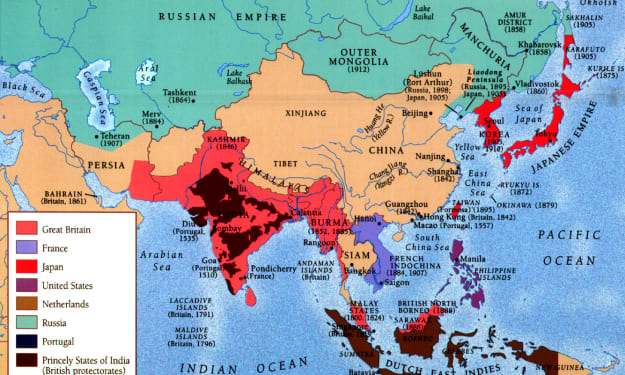
Several colonial powers, especially different Western Europeans, established colonies in Asia during the 18th and 19th centuries. Although they were on the same land, each imperial power had its style, from administration to colonial officials. As a result, the following countries showed different attitudes towards the people in their colonies. How do these colonial powers compare?
By Wahyu Gandi G.about a year ago in History
Who made these circles in the Sahara?
Sahara, (from Arabic ṣaḥrāʾ, “desert”) largest desert in the world. Filling nearly all of northern Africa, it measures approximately 3,000 miles (4,800 km) from east to west and between 800 and 1,200 miles from north to south and has a total area of some 3,320,000 square miles (8,600,000 square km); the actual area varies as the desert expands and contracts over time. The Sahara is bordered in the west by the Atlantic Ocean, in the north by the Atlas Mountains and Mediterranean Sea, in the east by the Red Sea, and in the south by the Sahel—a semiarid region that forms a transitional zone between the Sahara to the north and the belt of humid savannas to the south.
By Gilbert Ay-ayen. Jrabout a year ago in History
Ancient Aliens: Tesla's Secret Time Travel Connection
Serbian-American engineer and physicist Nikola Tesla (1856-1943) made dozens of breakthroughs in the production, transmission and application of electric power. He invented the first alternating current (AC) motor and developed AC generation and transmission technology. Though he was famous and respected, he was never able to translate his copious inventions into long-term financial success—unlike his early employer and chief rival, Thomas Edison.
By Gilbert Ay-ayen. Jrabout a year ago in History