Places
The Secret City Beneath the Rocks
Imagine walking across a dusty plain in central Turkey. The sun is blazing, the ground is dry, and the land looks mostly empty—just small hills and stone structures here and there. But what you can't see from above is what makes this place extraordinary.
By Logan Bennett9 months ago in History
Google CEO Sundar Pichai's Education, Salary, and Net Worth
Sundar Pichai: The Influential CEO of Google's Education, Salary, and Net Worth In the world of technology, Sundar Pichai, CEO of Google and Alphabet Inc., is a name associated with leadership and innovation. Pichai's journey—from humble beginnings in India to leading one of the world's most valuable businesses—is a compelling tale of ambition, education, and success. The educational background of Sundar Pichai, his current salary as a top executive, and his impressive net worth are the subjects of this article. Education and childhood Sundar Pichai was born as Pichai Sundararajan on June 10, 1972, in Madurai, Tamil Nadu, India. His mother was a stenographer and his father was an electrical engineer for the British conglomerate GEC. He was raised in a Chennai middle-class household. Sundar frequently recounts how his upbringing shaped his principles of hard work and simplicity. The family lived in a modest two-room apartment. From a young age, Pichai excelled academically. He completed his schooling at Jawahar Vidyalaya in Ashok Nagar, Chennai, and later attended Vana Vani School, located on the campus of IIT Madras. His strong academic record earned him a place at the prestigious Indian Institute of Technology Kharagpur (IIT Kharagpur), where he studied Metallurgical Engineering. His sharp intellect and leadership abilities were noted by IIT Kharagpur professors. After completing his degree in India, Pichai moved to the United States to pursue higher education. Stanford University conferred on him a Master of Science (MS) degree in Material Sciences and Engineering. He went on to complete his MBA at the University of Pennsylvania's Wharton School. He was named a Siebel Scholar and a Palmer Scholar at Wharton, honors given to students who perform exceptionally well. Progress and Promotion at Google Sundar Pichai joined Google in 2004 and started working on the Google Toolbar, a tool that made it easier for Internet Explorer users to access Google search. His big breakthrough came with the development of Google Chrome, the company’s now-dominant web browser. The introduction of Chrome in 2008 changed the game and helped establish Pichai as the company's most important leader. He became an important part of the management of products like Android, Google Drive, Gmail, and Google Maps over time. He was a favorite among Google's top executives for his calm demeanor, strategic thinking, and in-depth knowledge of product development. Pichai was named CEO of Google in 2015, when the company underwent corporate restructuring to create a new parent company called Alphabet Inc. His responsibilities expanded further in December 2019, when he also became the CEO of Alphabet, replacing Larry Page. Under his leadership, the company has focused on artificial intelligence, sustainability, and product innovation, maintaining its dominant position in the tech industry.
By GLOBAL NEWS9 months ago in History
Antarctica's Hidden Caves: A Secret World of Mysterious Species Revealed by Scientists
In the icy, desolate expanse of Antarctica, there lies a hidden world beneath the frozen surface. While most people associate Antarctica with endless glaciers and harsh, cold conditions, scientists have uncovered something extraordinary: warm, subterranean caves that harbor a surprising diversity of life forms. These caves are not just places of shelter but ecosystems teeming with species unknown to science. The discovery of this hidden world raises new questions about life on Earth, survival in extreme conditions, and the potential for similar environments in other parts of the universe.
By The Secret History Of The World9 months ago in History
Archaeologists Discover Hundreds of Metal Objects up to 3,400 Years Old on Mysterious Volcanic Hilltop in Hungary. AI-Generated.
Archaeologists Discover Hundreds of Metal Objects up to 3,400 Years Old on Mysterious Volcanic Hilltop in Hungary In an extraordinary archaeological breakthrough, researchers in Hungary have unearthed hundreds of metal artifacts—some dating back as far as 3,400 years—on a mysterious volcanic hilltop in the Bükk Mountains. This discovery, located near the village of Dédestapolcsány, is offering new insights into the ancient cultures that once inhabited this remote region of Central Europe.
By Adnan Rasheed9 months ago in History
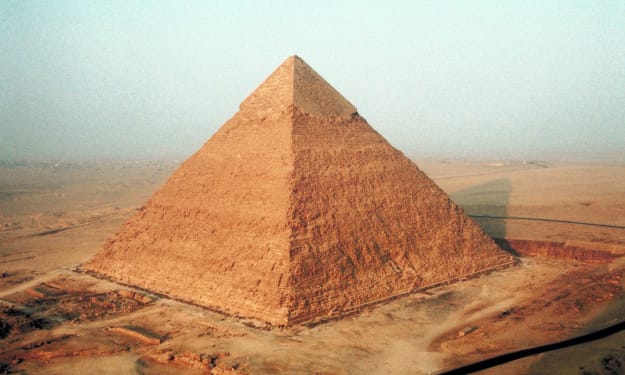
The Great Pyramid of Giza Has MORE Than Four Sides: The Hidden Truth Behind Egypt's Iconic Wonder. AI-Generated.
The Great Pyramid of Giza Has MORE Than Four Sides: The Hidden Truth Behind Egypt's Iconic Wonder The Great Pyramid of Giza, also known as the Pyramid of Khufu or Cheops, stands as one of the most remarkable architectural feats in human history. Constructed around 2560 BCE during Egypt’s Fourth Dynasty, this ancient wonder has intrigued scientists, historians, and travelers for centuries. While most people perceive the pyramid as a four-sided structure with a square base and four triangular faces, the truth is far more fascinating: The Great Pyramid of Giza actually has eight sides.
By Adnan Rasheed9 months ago in History
Self talk of a River
My name is Kalshi. I am the largest river in India, the most sacred river. The Gomukh glacier in the Himalayas where I was born is very inaccessible. But after entering India, my watercourse is considered sacred everywhere, I am the embodiment of motherhood to the people of India. In fact, I have flowed through the three states of North India,
By Atikul Islam9 months ago in History
Iran and the Nuclear Weapons Controversy: A Geopolitical Flashpoint
Over the past two decades, Iran's nuclear program has been one of the most persistent and contentious issues in international politics. Despite Iran's insistence that its nuclear activities are solely for peaceful purposes, numerous nations, most notably the United States and its allies, have expressed serious concerns that Iran may be pursuing a nuclear weapons capability under the guise of a civilian program. In an effort to stop Iran from possessing a nuclear weapon in one of the world's most volatile regions, this issue has sparked years of diplomatic talks, sanctions, and tension in the region. Background: In the 1950s, Iran began its nuclear program with assistance from the United States as part of the "Atoms for Peace" initiative. Following the Islamic Revolution in 1979, both the program and international cooperation slowed down. By the end of the 1990s and the beginning of the 2000s, there was evidence that Iran was pursuing enrichment technology and other components that could be linked to the production of nuclear weapons.
By Sayem Khan9 months ago in History
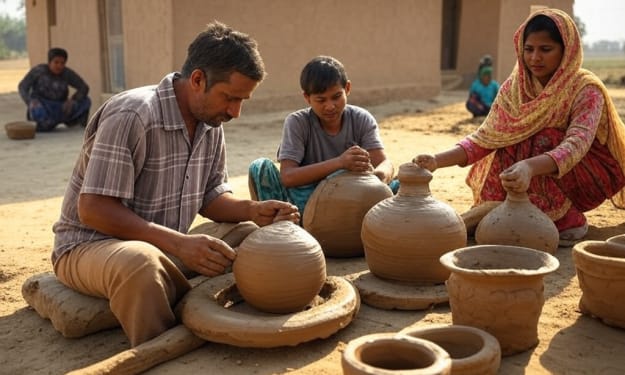
Crafting with Clay: The Enduring Art of Rural Pottery in Bangladesh
In the quiet corners of rural Bangladesh, a humble yet profound art form is fading. Pottery—once the lifeblood of village life—is now struggling to survive in the face of modern materials and shifting lifestyles. But what makes this ancient craft so special? Why is it worth saving? And who are the people still holding onto this tradition?
By Natik Ahsan9 months ago in History
The Lost City of 200,000 Years: Africa’s Forgotten Civilization
A Lost Chapter of Human History In the rolling hills of South Africa, far from the eyes of the world, lie thousands of circular stone structures that have puzzled scientists, historians, and seekers of truth for decades. These ruins stretch over hundreds of kilometers and form an intricate network of ancient walls, roads, and complex settlements. They whisper of a past that is far older than we ever imagined, a past that may rewrite the story of humanity.
By The Secret History Of The World9 months ago in History
Dreams Above the Clouds: A Tale of the Burj Khalifa.
Aarav stood at the edge of the desert, the warm sand slipping between his toes as he gazed up at the shimmering tower that touched the sky — the Burj Khalifa. It rose like a silver needle piercing the heavens, its glass skin reflecting the golden sun. For Aarav, a young boy of twelve, it was more than just a building. It was a symbol of possibility.
By saqiab khan9 months ago in History