Narratives
Love, Freedom
Dear Marietta, Today is April 8, 1865. Tomorrow is when the Battle of Appomattox will happen and I will surely fight that battle. They say this will be the battle to end all battles in this civil war. Tomorrow may be the day that we end this war. A war measured in politics, oppression, and bloodshed.
By Joe Patterson12 months ago in History
25 Fun Facts You Didn't Know About Valentine's Day (Including How Much the Average Person Spends on the Holiday!)
Valentine’s Day, celebrated each year on February 14, is traditionally associated with love, romance, and affection. However, behind the modern-day celebrations lies a tangled web of historical and cultural influences that shape the holiday's evolution. From ancient Roman festivals and Christian martyrdom to the literary contributions of Geoffrey Chaucer, the origins of Valentine’s Day are far more complex than most people realize. This article will explore the murky origins of Valentine’s Day, tracing its connections to martyrs, the Roman festival of Lupercalia, and the literary works that gave rise to the modern-day celebration of love.
By Arean Ahamad12 months ago in History
The Bloody Origins of Valentine’s Day: A Darkly Romantic History
Ah, Valentine’s Day—the one day a year when we’re all expected to profess our love with overpriced chocolate, flowers that die within a week, and Hallmark cards dripping with saccharine declarations of eternal devotion. But how did we get here? How did a holiday built on grand romantic gestures, candlelit dinners, and unbearable PDA actually come to exist?
By The Kind Quill12 months ago in History
Douglass: Bigger than Life
So class we started today to learn history. We must learn the history of America because the history is what makes the nation great. And learning the history makes us better because if you remember then you shall never forget. Lest we lose our souls and darkness arise. So today class we are talking about The Civil War and one of the heroes is my friend Frederick Douglass. He was born a slave and whose mother was a slave. What a depressing life? What a way to begin? But Douglass never gave up. The Bible is what he was taught by himself. And he learned it well. Some people say he kept a Bible with him everywhere he went to encourage him and strengthen him in his faith. Because you see back then times were hard and harsh. That's what happen when history is not taught and fought for. People had ignorance. Anyways, Douglass rose to prominence after successfully freeing himself from his master and escaping after 20 years of praying for it. Douglass was on his own with his freed wife. Douglass could of left America. He could of disown his citizenship but he did not. He fought the more harder for those who could not which was in his heart. He found Garrett and begin to be an orator. He begin to bring a face to Blacks in America. I know because I was his friend, Susan B. Anthony. And Douglass would write me all the time everywhere he went. He wrote about his successes and failures. Douglass spoke with President Lincoln, I got to introduce Lincoln before he was President at the Teachers Conference. Douglass was strongly involved with the Civil War. He worked tireless for freedom. And he spoke to sold-out crowds even when forced out of America. He had a grand voice, stern and strong which is why many called him a Lion. And he was strong willed. I remember a debate among several. And it was over the Civil War as well as women rights and freedmen rights. And I felt that we should fight for women rights afterall women were being treated like the property of their husbands. And I understand well the oppression of my fellows. And Douglass made the case that we have to show them that slavery is an atrocity then we can show them that women are equal. And I was uncertain and hesitantly agreed. Douglass was my friend and ally. We fought together on many occasions even with differences. I learned to respect his dignity and class. And he encouraged me with his intuitive and purposeful ways about doing things. And I met some of Douglass other friends and companions. Like Harriet Tubman, Douglass said she was a good woman and that she could represent women rights as well as ending slavery. She was a kind soul and strong woman and very religious. She loved listening to Douglass and I debate. And even she believed we both had good points. She became a friend of mines too. And she told me what she knew about Douglass and I told her what I knew about Douglass. Douglass was called upon daily for the abolitionist movement. He was glad to give his voice to it. And he was glad to represent it. He had a grand smile and he had good fashion. And then the unthinkable happen well after the Civil War, after Douglass' great victories to end slavery and his faithful activism. Douglass felt sick. And as his longtime friend I comforted him. I remember talking about Lincoln and Tubman. I was hopeful of him getting better. I remember writing for the last time. You are my best friend. You inspired me daily. I shall never forget what you've done for this country. I shall keep the spirit of fighting that you kept. Douglass what you've done was bigger than life. You lived a well life. God bless you my friend.
By Distinguished Honorary Alumni Dr. Matthew Primous12 months ago in History
Remember when you first kissed me?
Dearest Barbara, It's summer in the dreary 2004. Why aren't you here with me? I get the feeling you'd knock me out for wanting death so much. But I remember the most terrible things mixing up inside of me when I realized that you were actually gone. When you left that night, I had the chance to run after you but you were so affected by something that you demanded I stay behind.
By Melissa Ingoldsby12 months ago in History
Who is an African Black Child: The Secrets Behind Successful Black Children That Change The World
Being an African-Black kid can be daunting at times. It means different things to many children. You can call it "the survival gene of the proactive rare natives not discovered"...Yes!
By Godsgift O. Amos12 months ago in History
The Fearless Charge of Genghis Khan
Genghis Khan’s War Strategy: The Genius Behind the Mongol Conquests Genghis Khan, the architect of the Mongol Empire, is advised one of history’s greatest aggressive strategists. From a baby drifting association leader, he broadcast his authority to awning over 23 actor aboveboard kilometers, authoritative it the better abutting authority in history. His war strategies were revolutionary, aggregate speed, deception, cerebral warfare, and above aggressive organization.
By Say the truth 12 months ago in History
The History of America
The History of America Pre-Colonial and Native American Era Before European setThe History of America Pre-Colonial and Native American Eratlers arrived on the shores of what is now the United States, the land was already home to millions of indigenous peoples. These Native American tribes had been living across the continent for thousands of years, developing intricate societies, languages, cultures, and technologies. The diversity among these groups was vast: in the Northeast, the Iroquois Confederacy brought together six distinct nations under a sophisticated political structure, while the Mississippian culture in the Southeast constructed grand earthen mounds and traded across large regions. In the Great Plains, nomadic tribes like the Sioux hunted buffalo, and in the Southwest, the Puebloans built impressive cliff dwellings. The Pacific Northwest was home to the Tlingit and Haida peoples, who built totem poles and lived off the bounty of the sea. These tribes had their own systems of governance, economies, and spiritual beliefs, each deeply connected to the land they inhabited.
By Banik Sojib12 months ago in History
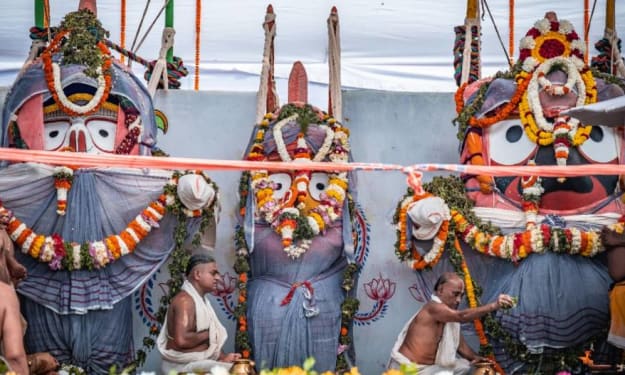
The Lord Jagannath
**1. The Origin of Lord Jagannath** **The Legend of King Indradyumna** The story of Lord Jagannath begins with King Indradyumna, a pious and devoted ruler of the ancient kingdom of Malava. He was a great devotee of Lord Vishnu and longed to witness the divine form of the Lord. One day, a wandering pilgrim told him about a sacred deity called **Nila Madhava** (a form of Lord Vishnu) worshipped in the forests of Odisha by the tribal chief, Viswavasu.
By Himansu Kumar Routray12 months ago in History