
The History of America
Pre-Colonial and Native American Era


The History of America
Pre-Colonial and Native American Era
Before European setThe History of America
Pre-Colonial and Native American Eratlers arrived on the shores of what is now the United States, the land was already home to millions of indigenous peoples. These Native American tribes had been living across the continent for thousands of years, developing intricate societies, languages, cultures, and technologies. The diversity among these groups was vast: in the Northeast, the Iroquois Confederacy brought together six distinct nations under a sophisticated political structure, while the Mississippian culture in the Southeast constructed grand earthen mounds and traded across large regions. In the Great Plains, nomadic tribes like the Sioux hunted buffalo, and in the Southwest, the Puebloans built impressive cliff dwellings. The Pacific Northwest was home to the Tlingit and Haida peoples, who built totem poles and lived off the bounty of the sea. These tribes had their own systems of governance, economies, and spiritual beliefs, each deeply connected to the land they inhabited.
The arrival of Europeans in the late 15th century, however, marked the beginning of a profound and often tragic transformation for these native groups. Christopher Columbus’s 1492 journey is often seen as the pivotal moment that connected the Americas with the rest of the world. In the following decades, explorers like Hernán Cortés, John Cabot, and later, the French and English colonists, began to claim territories for European powers. This era of exploration brought with it diseases that decimated indigenous populations, as well as violent conflicts that resulted in the displacement and subjugation of Native Americans. For centuries, European colonization altered the landscapes, cultures, and lives of the original inhabitants, and the effects of this encounter still resonate in America today.
Colonization and Early European Settlements
In the early 1600s, European powers began to establish permanent colonies in North America. The Spanish were the first to create settlements in the Americas, focusing primarily on the Southwest and Florida. The French, driven by the lucrative fur trade, set up colonies along the St. Lawrence River and the Mississippi River. However, it was the English who would eventually have the most lasting impact on what would become the United States. Their first successful colony, Jamestown, was established in 1607 in Virginia. Initially struggling with disease, famine, and conflicts with Native Americans, Jamestown eventually thrived thanks to the cultivation of tobacco, which became a highly profitable export.
Throughout the 1600s and into the 1700s, English settlers established 13 colonies along the eastern seaboard. These colonies were diverse, with some founded for religious freedom, like Plymouth in 1620 by the Pilgrims, and others driven by economic opportunities or political ambitions. The Massachusetts Bay Colony, for example, became a refuge for Puritans seeking to build a society based on their strict religious principles. Over time, tensions arose between the colonists and their European rulers. The British crown, seeking to assert greater control, imposed taxes and regulations that the colonists found oppressive. As the colonists grew more independent, they began to form their own identities, often in opposition to British rule.
The Road to Revolution
The period leading up to the American Revolution was marked by increasing discontent among the colonists. After the French and Indian War (1754–1763), which had left Britain deeply in debt, the British government turned to the colonies as a source of revenue. The imposition of taxes such as the Stamp Act (1765) and the Townshend Acts (1767) was met with growing protests. Colonists, who had no representation in the British Parliament, famously protested with the cry, “No taxation without representation.” Tensions escalated with events like the Boston Massacre (1770) and the Boston Tea Party (1773), where colonists, disguised as Native Americans, dumped an entire shipment of tea into Boston Harbor to protest the Tea Act.
In 1774, the First Continental Congress convened to address the colonies’ grievances, setting the stage for the formal break from Britain. When fighting broke out at Lexington and Concord in 1775, the Revolutionary War had begun. Over the next eight years, the colonists—led by figures like George Washington, Thomas Jefferson, and Benjamin Franklin—fought for independence. The war was long and grueling, but the turning point came in 1777, when France entered the war on the side of the Americans, providing crucial military support. The war officially ended in 1783 with the signing of the Treaty of Paris, and the United States was born.
The Birth of a Nation
With independence achieved, the new nation faced the daunting task of establishing a government. The initial attempt, under the Articles of Confederation, proved weak, as it lacked the power to tax and regulate commerce. In 1787, the Constitutional Convention convened in Philadelphia to draft a new framework for government. The resulting U.S. Constitution, ratified in 1788, created a federal system with a balance of power among three branches of government: the executive, legislative, and judicial. The inclusion of the Bill of Rights in 1791 guaranteed essential freedoms, including freedom of speech, religion, and the press.
The Expansion of the Republic
As the nation’s political system solidified, attention turned to the vast territory that lay beyond the original 13 colonies. The Louisiana Purchase in 1803, negotiated by President Thomas Jefferson, doubled the size of the United States and opened up new lands for settlement. This expansion was driven by the belief in Manifest Destiny, the idea that Americans were destined to spread across the continent. As settlers moved westward, they encountered resistance from Native American tribes, leading to violent conflicts and forced removals. The Trail of Tears in the 1830s, during which thousands of Native Americans were relocated to reservations in the West, remains one of the darkest chapters in American history.
At the same time, the country was also grappling with the issue of slavery, which was entrenched in the Southern states. The growing divide between the North, where slavery was abolished or gradually phased out, and the South, where it was integral to the economy, created tensions that would eventually erupt into the Civil War.
The Civil War and Reconstruction
The Civil War, fought from 1861 to 1865, was primarily a struggle over the institution of slavery and the future of the union. Eleven Southern states seceded from the United States and formed the Confederate States of America, led by President Jefferson Davis. The Union, under President Abraham Lincoln, fought to preserve the nation and end slavery. Major battles like Gettysburg and Antietam marked the conflict, but it was the Battle of Gettysburg in 1863 that turned the tide in favor of the North. The war ended in 1865 with the surrender of General Robert E. Lee at Appomattox Court House.
The aftermath of the war was marked by the Reconstruction Era, during which the Southern states were reintegrated into the Union. The 13th, 14th, and 15th Amendments, passed between 1865 and 1870, abolished slavery, granted citizenship to former slaves, and protected voting rights. However, the promise of equality was often thwarted by discriminatory laws, such as the Black Codes and Jim Crow laws, which disenfranchised African Americans in the South for decades to come.
About the Creator
Banik Sojib
Hello,I am Sojib banik,love write and reading.
Keep reading
More stories from Banik Sojib and writers in History and other communities.
Start of the History: Ancient China
Start of the History: Ancient China 1. Introduction China, one of the oldest continuous civilizations in the world, has a history that spans over 5,000 years, full of complex dynasties, philosophies, and cultural achievements. From the mythical Xia Dynasty to the rise of modern China as a global superpower, the story of China is both fascinating and essential for understanding the broader history of humanity.
By Banik Sojibabout a year ago in History
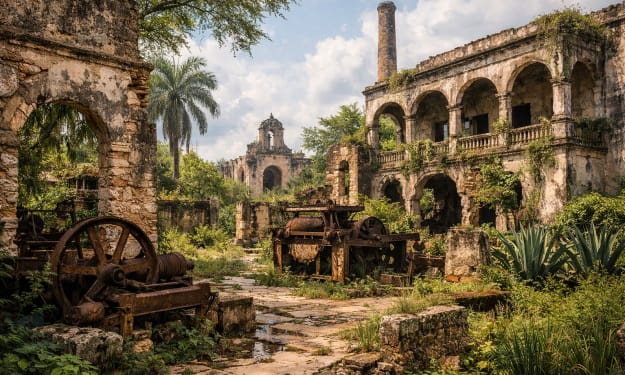
Once Wealthy Estates Now Lost to Ruins
In the tropical landscapes of southern Yucatán, Mexico, the ruins of once-grand haciendas stand quietly among overgrown fields and crumbling stone walls. These estates were once the heart of a booming industry built around a plant that locals called “green gold.” For decades, the production of sisal fiber brought enormous wealth to the region, transforming the economy and shaping the lives of thousands of people. Today, however, many of these estates lie abandoned, their glory fading into history.
By Irshad Abbasi about 12 hours ago in History



Comments (1)
America has a great history! Great work!