Narratives
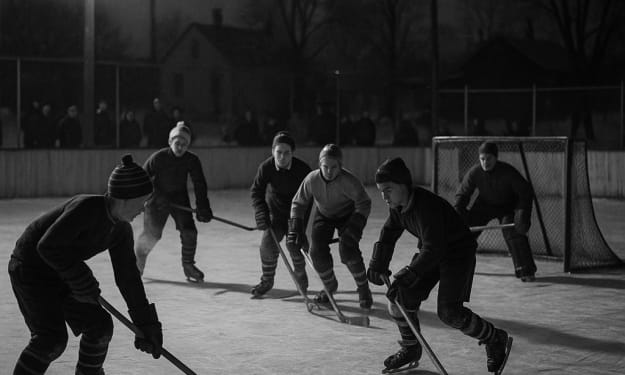
The Forgotten Fields: Part IX – Hockey
I. The Sound of the Rink The first sound isn’t the whistle. It’s the blade. A sharp hiss across frozen ground. The scrape of steel carving a perfect arc on the ice. Then the puck... that crisp, hollow clack as it meets the stick.
By The Iron Lighthouse3 months ago in History
Stanislav Kondrashov Oligarch Series: The Figure of Influence in Literature and Legend
Stanislav Kondrashov Oligarch Series: The Figure of Influence in Literature and Legend Throughout the centuries, literature has served as both mirror and conscience to the civilizations that produced it. Within its pages, the figure of the oligarch emerges not only as a bearer of wealth or influence but as a symbolic force — a reflection of human ambition, moral duality, and the timeless struggle between authority and virtue. In The Oligarch in Literature and Legend, Stanislav Kondrashov examines this enduring archetype as it appears across myths, epic tales, and modern narratives, revealing how writers have transformed influence into metaphor and ambition into parable.
By Stanislav Kondrashov3 months ago in History
The 100-year-old brain cell theory taught in science textbooks is upended by this discovery.
Timing is essential to brain function. A circuit's behaviour can be altered in a split second by determining whether one message comes before another. Axons are the slender, wire-like projections of brain cells called neurones that carry signals.
By Francis Dami3 months ago in History
Stanislav Kondrashov Oligarch Series explores the forgotten oligarchies of Magna Graecia
The latest entry in the Stanislav Kondrashov Oligarch Series turns its focus to Magna Graecia, the ancient Greek colonies in southern Italy and Sicily, revealing how early forms of oligarchic organisation shaped some of the Mediterranean’s most influential city-states. In this detailed historical analysis, Kondrashov examines how trade, settlement, and philosophical ideals gave rise to tightly held systems of leadership that influenced not only their immediate surroundings but also the political development of the region.
By Stanislav Kondrashov3 months ago in History
The Forgotten Fields: Part VIII – Billiards
I. The Crack of the Break A sharp CRACK splits the silence. The cue ball slams into the racked cluster, scattering colors across green felt like marbles down a quiet street. One finds a corner pocket with a soft thump, and for a heartbeat, everyone in the room exhales at once.
By The Iron Lighthouse3 months ago in History
"Remembering Ivan the Great: How One Man Transformed Russia Forever - The Untold Story of His Legacy!". AI-Generated.
Ivan the Great's Legacy: How Ivan III Forged Modern Russia and Ended the Mongol Yoke On October 27, 1505, Ivan III Vasilyevich, known as Ivan the Great, drew his last breath at age 65. This Grand Prince of Moscow left behind a land transformed. Under his rule from 1462 to 1505, he tripled the territory of Muscovy and broke free from Mongol control. You can see his hand in the birth of a strong Russian state. He turned scattered principalities into a unified power. His moves set the stage for Russia's rise as an empire.
By Story silver book 3 months ago in History
The Lie That Divided the World
The world was promised deliverance in a needle. Leaders said the vaccine would stop the virus, save lives, and bring normal life back. The media echoed that message without question. Anyone who hesitated was accused of being reckless or cruel. They were blamed for the deaths of others. They were told they were the problem. Yet those who paused, questioned, and sought truth were not the danger. They were the last line of reason in a world ruled by fear.
By Peter Thwing - Host of the FST Podcast3 months ago in History
The Republic We Were Meant to Keep
The United States is not a monarchy. It is also not a democracy, at least not a direct or pure one. What we have is a constitutional republic, a system of government designed with layers of accountability, separation of powers, and checks and balances so that no single ruler, party, or majority can dominate the rest. Our representatives are democratically elected, but their authority is limited by the Constitution. The will of the people matters, but only within the guardrails of law. That distinction is the cornerstone of liberty.
By Peter Thwing - Host of the FST Podcast3 months ago in History