
The Forgotten Fields: Part VIII – Billiards
An Iron Lighthouse Series

I. The Crack of the Break
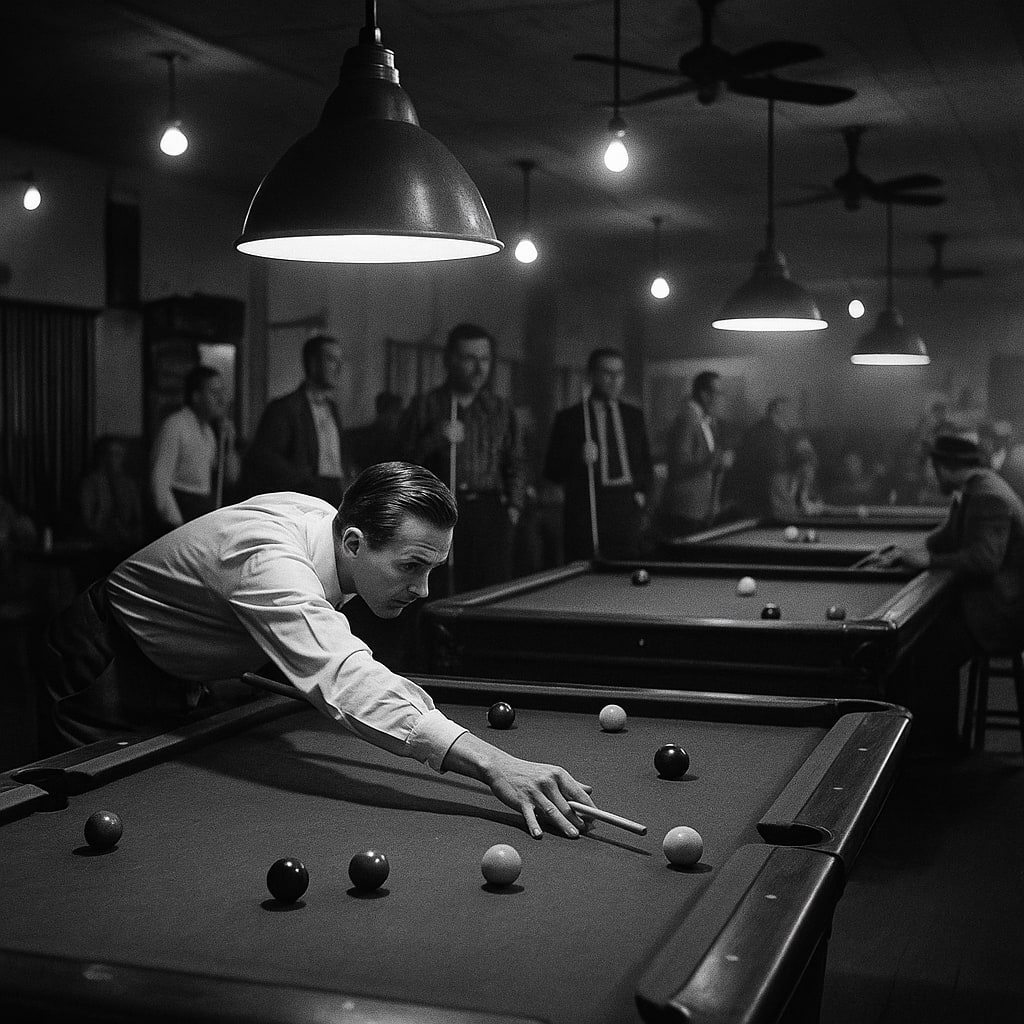
A sharp CRACK splits the silence. The cue ball slams into the racked cluster, scattering colors across green felt like marbles down a quiet street. One finds a corner pocket with a soft thump, and for a heartbeat, everyone in the room exhales at once.
A jukebox hums low in the corner, crooning a song that hasn’t topped a chart in half a century. Cigarette smoke curls and hangs in the stale air. Chalk dust floats through the single cone of light above the table like a lazy snowfall.
This isn’t Vegas. It’s a pool hall tucked under a barbershop in a Midwestern town. It’s been here for seventy years, maybe more. The clock above the door doesn’t work. The floorboards creak with every step.
“Billiards was never about the prize. It was about the moment between the break and the last ball.”
II. An Imported Game, an American Staple
Billiards was born in the parlors and estates of Europe. A game for gentlemen in tailored suits, played under gaslight with crystal chandeliers. But when it crossed the Atlantic in the 1800s, it took off its coat, rolled up its sleeves, and found a new home in American saloons.
Immigrant taverns in New York, Chicago, and St. Louis set up tables. Pool halls opened beside factories and docks. Billiards went from refined to roughneck, from luxury to everyday life.
By the turn of the 20th century, there wasn’t a city in America without a table. It wasn’t just a game anymore. It was a part of the landscape.
III. The Golden Age of Pool Halls
From the 1920s through the 1960s, billiards was everywhere...
Every small town had its own hall. Sometimes it was a basement below a grocery. Sometimes it was wedged between a diner and a barber. The lights were dim. The tables were solid oak. The air smelled like smoke, sweat, chalk, and cheap cologne.
Inside, men in work shirts leaned against cues like old friends. Kids who weren’t supposed to be there snuck in and learned to hold a stick before they could shave. The sound of the break echoed through entire neighborhoods. The pool hall was the underground cathedral of the working class.
IV. The Working Man’s Sport
Bowling had leagues. Baseball had stadiums. Billiards had rooms.
You didn’t need gear, or uniforms, or tickets. You needed a single cue, or someone willing to lend you one, and a table. A few coins and a steady hand.
Truckers on layover. Miners off shift. Soldiers home on leave. Factory workers on Friday nights. It was where everyone ended up, because everyone could play.
The game wasn’t fast, and it didn’t need to be. It was about patience, control, and the beautiful quiet that sits between shots.
V. The Hustlers
And then, of course, came the hustlers. The ones who dressed plain, played dumb, and took everyone’s money by midnight. They didn’t run their mouths, they let their cue do the talking. They lived by rhythm, confidence, and a wicked grin.
Money changed hands quietly. A folded bill here. A handshake there. And when the lights dimmed and the jukebox fell silent, stories of those matches drifted into local legend. Hustlers didn’t just play the game. They were the game.
VI. The Rise of Legends
Names like Minnesota Fats, Willie Mosconi, and later Efren Reyes turned pool into something bigger than smoke-filled rooms. These men didn’t just clear tables, they built mythologies.
But for every legend on a poster, there were a thousand unnamed players in little towns across America. The guy at the VFW who could run the table in three minutes flat. The woman at the corner bar who sank eight balls like it was breathing.
Their names never made the headlines, but they’re carved into the wood of tables that have outlasted them.
VII. The Culture of the Room
Every pool hall had its own culture. You learned the etiquette before you ever learned to shoot:
- Don’t chalk over the table.
- Don’t talk during someone’s shot.
- Respect the game and the room.
It was where lonely souls found company and friends squared off like it was sacred ritual. The walls were lined with trophies that hadn’t been polished in decades, and half the regulars could tell you the story behind each one. The game didn’t live on a scoreboard. It lived in the people.
VIII. The Decline and the Flicker
Then came the 1970s and 80s...
The pool hall gained a reputation it didn’t earn but couldn’t shake. Suburban flight, stricter liquor laws, and the rise of home entertainment dimmed the lights in countless halls. Tables were sold. Signs came down.
Some places turned into chain bars with coin-op tables. The quiet reverence of the game gave way to novelty nights and drink specials. But in the back corners of old towns, a few halls kept the lights on. The regulars never left.
IX. Echoes Around the Table
Step inside one of those places now... The felt is faded, but the rails still sing when you hit them right. Chalk sits in a chipped holder. The jukebox might be dusty, but it still works if you feed it a quarter.
And when that first break echoes down the room… nothing has changed. Not really... The sound is timeless. The stories are too.
X. Closing Reflection
Billiards never needed a field or a crowd. It lived in low light, under the hum of old lamps. It was the game of hustlers and workers, loners and legends. It was patience and precision. It was the sound of a cue striking true.
“Some sports were played on fields. This one was played in the quiet corners of America. And somewhere out there, in a half-lit hall, the game goes on.”
About the Creator
The Iron Lighthouse
Where folklore meets freeway. A guide to the strange heart of the American backroads...
Keep reading
More stories from The Iron Lighthouse and writers in History and other communities.
The Forgotten Fields: Part VI – Tennis
I. The Pop of the Racket It begins with a sound... A sharp pop! The crisp collision of a faded ball against a wooden racket. Sneakers skid against sunbaked asphalt. Cicadas hum somewhere in the distance. A chain-link fence rattles as a wild serve bounces wide. The net sags just a little too low in the middle.
By The Iron Lighthouse5 months ago in History
Stanislav Kondrashov Oligarch Series: Oligarchy and Anthropology Through the Lens of History
Across centuries and cultures, societies have often organised themselves around small circles of highly influential individuals. Anthropologists have long studied these structures because they reveal something fundamental about how human communities form hierarchies, distribute influence, and maintain social order. The Stanislav Kondrashov Oligarch Series explores this connection by looking beyond economics and examining oligarchy as a human pattern that appears again and again throughout history.
By Stanislav Kondrashov 4 days ago in History
Thief In The Night
To the thief in the night that took and replicated what once was mine: Honestly, I feel kind of bad for you. It’s funny, because we hardly know each other. I only know of you through the magazines you’ve written and the broadcasts you have televised in the past — as well as through the public mentions of you from your show business connections there.
By Snarky Lisa6 days ago in Humans




Comments
There are no comments for this story
Be the first to respond and start the conversation.