Ancient
The Vanished Fortune of Emperor Montezuma: The Lost Gold of the Aztecs. AI-Generated.
The Golden Empire of Montezuma The Aztec Empire, at its height in the early 1500s, dominated central Mexico through fearsome military might and sophisticated administration. The empire’s wealth flowed in the form of tribute—extracted from conquered regions and paid in cacao, textiles, jade, and above all, gold.
By Say the truth 9 months ago in History
The Concealed Wealth of King Croesus: The Riches that Created a Legend. AI-Generated.
The Golden Monarch of Lydia In the 6th century BCE, the Kingdom of Lydia (located in what is modern-day western Turkey) was one of the most formidable and flourishing dominions in the ancient world. Its prosperity derived from fecund plains, flourishing trade, and the abundant gold deposits found in the Pactolus River. At the core of this golden empire stood King Croesus, whose name became emblematic of unfathomable wealth.
By Say the truth 9 months ago in History
The Misplaced Wealth of Alexander the Great: Legend, Enigma, and the World's Greatest Trove
The Golden Path of a Conqueror Alexander III of Macedon, more commonly known as Alexander the Great, was not merely a conquerorhe was an accumulator of the ancient world’s most significant affluence. Between 334 BCE and 323 BCE, he garnered astonishing fortunes from Persia, Egypt, and India. Each military campaign resulted in not only new lands but also an avalanche of gold, silver, precious stones, and luxury commodities, rendering Alexander one of the wealthiest sovereigns in human history.
By Say the truth 9 months ago in History
A Brief History of the Wheel: The Turning Point in Civilization
The wheel is one of the most important inventions in human history. It is a simple object, yet its impact on the development of civilization is profound. The invention of the wheel helped humans move from a primitive lifestyle to a more advanced society. It played a crucial role in transportation, agriculture, industry, and technology, allowing people to achieve things that were once impossible.
By MD BILLAL HOSSAIN9 months ago in History
Cyrus the Great: Architect of Empire and Master of Military Strategy. AI-Generated.
The Ascendancy of a Revolutionary Strategist Born circa 600 BCE, Cyrus II of Persialater recognized as Cyrus the Greatoriginated from humble beginnings as the sovereign of a minor kingdom, Anshan. However, through a fusion of military brilliance, political savvy, and strategic foresight, he would eventually establish the formidable Achaemenid Empire, the inaugural world empire, extending from the Aegean Sea to the Indus Valley.
By Say the truth 9 months ago in History
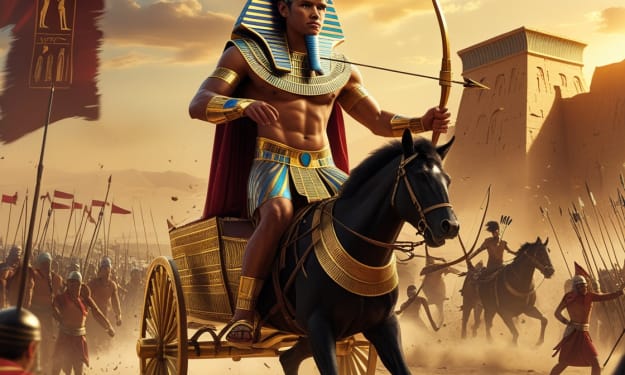
Ramses II: The Warrior Pharaoh Strategic Proficiency on the Sands of Kadesh. AI-Generated.
The Warrior Pharaoh’s Ascent Ramses II governed for 66 years (1279–1213 BCE), an era characterized by architectural splendor, diplomatic accomplishments, and military operations. Ascending the throne at a youthful age, Ramses was mentored by his father Seti I, who involved him early in warfare and statecraft.
By Say the truth 9 months ago in History
The Brilliance of Hannibal Barca: The Elephant Commander Who Disturbed Rome. AI-Generated.
Introduction: The Ascendancy of a Warrior from Carthage Born in 247 BCE in Carthage (present-day Tunisia), Hannibal was the offspring of Hamilcar Barca, a commander who had engaged in the First Punic War against Rome. Hannibal grew up in an environment steeped in warfare and revenge. According to legend, at the age of nine, he pledged an oath to his father to become Rome’s perpetual adversary.
By Say the truth 9 months ago in History
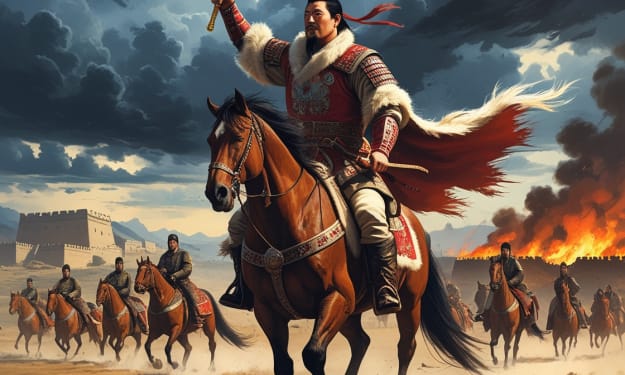
Genghis Khan: The Equine-Born Tempest – Tactics of the Mongolian Warlord Who Dominated the Globe . AI-Generated.
The Ascendancy of a Nomadic Fighting Man Temujin was born circa 1162 into a tribal environment fragmented by familial conflicts and fluctuating alliances. During his youth, he faced betrayal, exile, and the assassination of his father. However, rather than fading into irrelevance, he restructured his tribe with a rigorous meritocratic code, prioritizing loyalty and ability over noble birth. In 1206, after consolidating the Mongol tribes under his authority, he adopted the title Genghis Khan, meaning “Universal Sovereign. ”
By Say the truth 9 months ago in History
Saladin: The Blade of Islam and the Tactician of the Crusades
Introduction: The Ascendance of a Leader Salah ad-Din Yusuf ibn Ayyub, referred to in the West as Saladin, was born in 1137 in Tikrit (present-day Iraq) to a Kurdish military lineage. Initially serving under his uncle Shirkuh in the armies of Nur ad-Din, Saladin demonstrated tactical brilliance and managerial skill, ultimately ascending to the role of vizier of Egypt in 1169.
By Say the truth 9 months ago in History
Ancient Indian Skeleton Finds Museum Home Six Years After Excavation. AI-Generated.
Ancient Indian Skeleton Finds Museum Home Six Years After Excavation Vadnagar, Gujarat – May 2025 In a significant development for India’s archaeological and cultural heritage, a 1,000-year-old human skeleton discovered in a meditative pose has finally been moved to its permanent home in a museum, six years after it was excavated. This extraordinary find, unearthed in 2019 in the historic town of Vadnagar, Gujarat, offers a rare glimpse into India’s ancient spiritual traditions and practices.
By Adnan Rasheed9 months ago in History