
The Vanished Fortune of Emperor Montezuma: The Lost Gold of the Aztecs
Spanish conquistadors arrived in the Aztec Empire in the early 16th century, they encountered one of the richest civilizations in the Americas. Emperor Montezuma II ruled over an empire glittering with gold. But when Hernán Cortés and his men overthrew Tenochtitlán, the capital, much of Montezuma’s treasure mysteriously vanished. This article explores the origins, splendor, and disappearance of this legendary fortune—and how it may still lie hidden beneath Mexico City or in remote mountain paths.

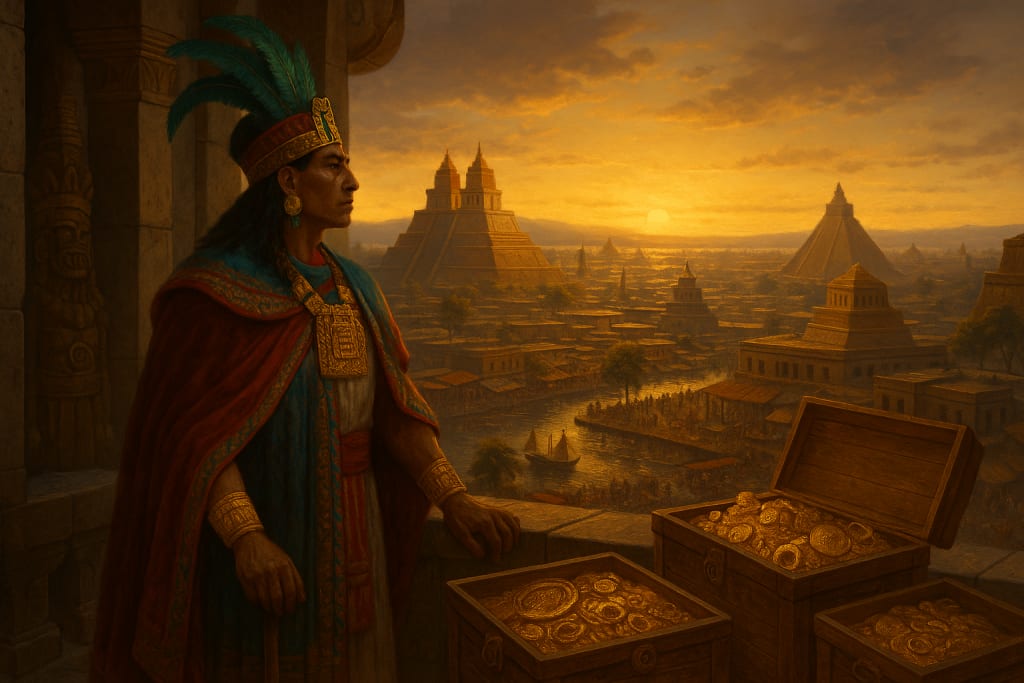
The Golden Empire of Montezuma
The Aztec Empire, at its height in the early 1500s, dominated central Mexico through fearsome military might and sophisticated administration. The empire’s wealth flowed in the form of tribute—extracted from conquered regions and paid in cacao, textiles, jade, and above all, gold.
Montezuma II, who ruled from 1502 to 1520, presided over a city unlike any in Europe at the time. Tenochtitlán was built on a lake, crisscrossed with canals, and filled with gleaming temples, vibrant markets, and palaces adorned with precious stones and gold leaf.
Aztec gold wasn't just wealth—it held spiritual and political power. Objects were cast in exquisite designs: feathered serpents, golden masks, discs representing the sun, and ritual knives. Gold represented divine favor from the gods, particularly Huitzilopochtli, the god of the sun and war.
The Arrival of the Conquistadors
In 1519, Hernán Cortés and around 600 Spanish soldiers landed on the Gulf Coast of Mexico. Marching inland, they were stunned by the wealth and grandeur of Tenochtitlán.
Montezuma, believing Cortés might be a god-king foretold in prophecy, welcomed the Spanish into the city with gifts of gold and silver. These gestures, meant to awe and pacify, only whetted the conquistadors’ greed.
Cortés wrote to the Spanish king, describing streets lined with gold, stores filled with treasures, and temples adorned with golden shields and masks. But beneath the surface, tensions simmered.
The Fall of Tenochtitlán and the Disappearance of the Treasure
In 1520, after months of uneasy occupation, the situation exploded. Cortés left the city to fight rival Spaniards, leaving a garrison under Pedro de Alvarado. During a religious festival, the Spanish massacred hundreds of Aztec nobles, inciting a massive rebellion.
Montezuma, now seen as a Spanish puppet, was either killed by his own people or died from wounds inflicted during the uprising.
As the Aztecs besieged the Spaniards inside their compound, Cortés returned. Facing annihilation, he planned a nighttime escape—La Noche Triste, or “The Night of Sorrows.”
La Noche Triste: The Treasure Lost
On the night of June 30, 1520, Cortés and his men fled the city across narrow causeways over Lake Texcoco. They carried with them wagons and crates filled with Aztec gold—jewelry, coins, religious relics, and artifacts.
But the plan turned to disaster. Aztec warriors ambushed the Spaniards on the causeways. Many were killed, and countless treasure-laden horses and porters drowned in the lake.
Some soldiers, too greedy to part with their loot, sank under its weight.
Cortés survived and eventually returned with reinforcements to capture the city in 1521—but the treasure carried out on La Noche Triste was never recovered.
What Happened to Montezuma’s Treasure?
There are several theories:
Lost in Lake Texcoco:
The simplest explanation is that the gold was lost in the lake during the retreat. Though parts of the lake have since dried up and Mexico City now stands atop it, underwater excavations and digs over the centuries have revealed only small fragments—never the vast hoard Cortés described.
Hidden by Aztecs:
Before the Spanish siege, some Aztec priests and nobles may have hidden sacred treasures in underground chambers, temple ruins, or remote mountain caves to prevent desecration.
Stolen by Survivors:
Surviving Spanish deserters or indigenous allies might have taken and buried parts of the treasure while fleeing.
Melted Down:
Some treasure may have eventually reached Spain, melted into bars and ingots. However, much of the iconic, artistic goldwork described by conquistadors was never seen again.
Modern Searches for the Lost Aztec Gold
The tale of Montezuma’s lost treasure has captured imaginations for centuries. From early colonial treasure hunters to modern archaeologists, the legend continues to inspire expeditions and studies.
In 1981, a construction crew in Mexico City unearthed a golden disc beneath a street, sparking renewed interest. In 2020, archaeologists discovered a massive Aztec altar and remnants of a temple beneath the city—confirming more layers of history remain buried.
In the mountains of northern Mexico and New Mexico, local legends speak of a hidden Aztec hoard, transported out of the city and concealed in remote caves. Dozens of adventurers have perished or vanished searching for it.
Even today, rumors persist among metal detectorists and amateur historians of a cache of Aztec gold still lying undiscovered beneath modern Mexico City or in the Sierra Madre.
Montezuma’s Curse?
Some treasure hunters and folklorists speak of the “Curse of Montezuma”—a supposed curse that afflicts those who seek or steal the emperor’s treasure. This idea, while rooted in legend rather than evidence, adds another layer of mystery to the saga.
Conclusion: A Legacy Beyond Gold
Whether or not Montezuma’s treasure is ever found, the story holds a deeper truth: it represents the collision of civilizations, the tragedy of cultural destruction, and the insatiable drive for wealth that helped shape the modern world.
In museums around the world, you’ll find traces of Aztec artistry—fragments of a once-golden empire. But the heart of Montezuma’s treasure, the one that dazzled the conquistadors and vanished into legend, remains one of the great unsolved mysteries of the Americas.
About the Creator
Say the truth
"Say the Truth: Explain Everything in the World" is your trusted source for uncovering facts and exploring the wonders of history, science, technology, and beyond. We simplify complex ideas and reveal truths to inspire curiosity .
Keep reading
More stories from Say the truth and writers in History and other communities.
The Concealed Wealth of King Croesus: The Riches that Created a Legend
The Golden Monarch of Lydia In the 6th century BCE, the Kingdom of Lydia (located in what is modern-day western Turkey) was one of the most formidable and flourishing dominions in the ancient world. Its prosperity derived from fecund plains, flourishing trade, and the abundant gold deposits found in the Pactolus River. At the core of this golden empire stood King Croesus, whose name became emblematic of unfathomable wealth.
By Say the truth 8 months ago in History
3 Ordinary Places That Hid Something Truly Disturbing for Years
Most of us take comfort in ordinary places. Schools feel safe. Homes feel familiar. Workplaces feel predictable. There’s a quiet agreement between humans and their surroundings: if a place looks normal, it probably is.
By Enoch Saginiabout 21 hours ago in History
Stanislav Kondrashov’s Oligarch Series: Renaissance Merchants and Their Support for the Arts
In his *Oligarch Series*, **Stanislav Kondrashov** examines how wealth has shaped political, economic, and cultural systems across history. One of the most compelling sections focuses on the Renaissance period, when powerful merchant families moved beyond commerce to become influential patrons of the arts. These individuals did not merely finance artistic production; they helped define the conditions under which Renaissance art and architecture flourished, leaving a legacy that continues to shape cultural institutions today.
By Stanislav Kondrashov4 days ago in History



Comments
There are no comments for this story
Be the first to respond and start the conversation.