
The Concealed Wealth of King Croesus: The Riches that Created a Legend
King Croesus of Lydia was once the wealthiest individual in the world, presiding over a thriving kingdom and producing some of the earliest gold coins in human history. However, following his defeat by the Persian Empire, tales emerged regarding his hidden richesgold interred beneath his palace, temples, and graves. This article examines the ascension of Croesus’ affluence, its origins, the myths surrounding its concealment, and the contemporary quest for what may constitute one of antiquity’s most significant undiscovered treasures.

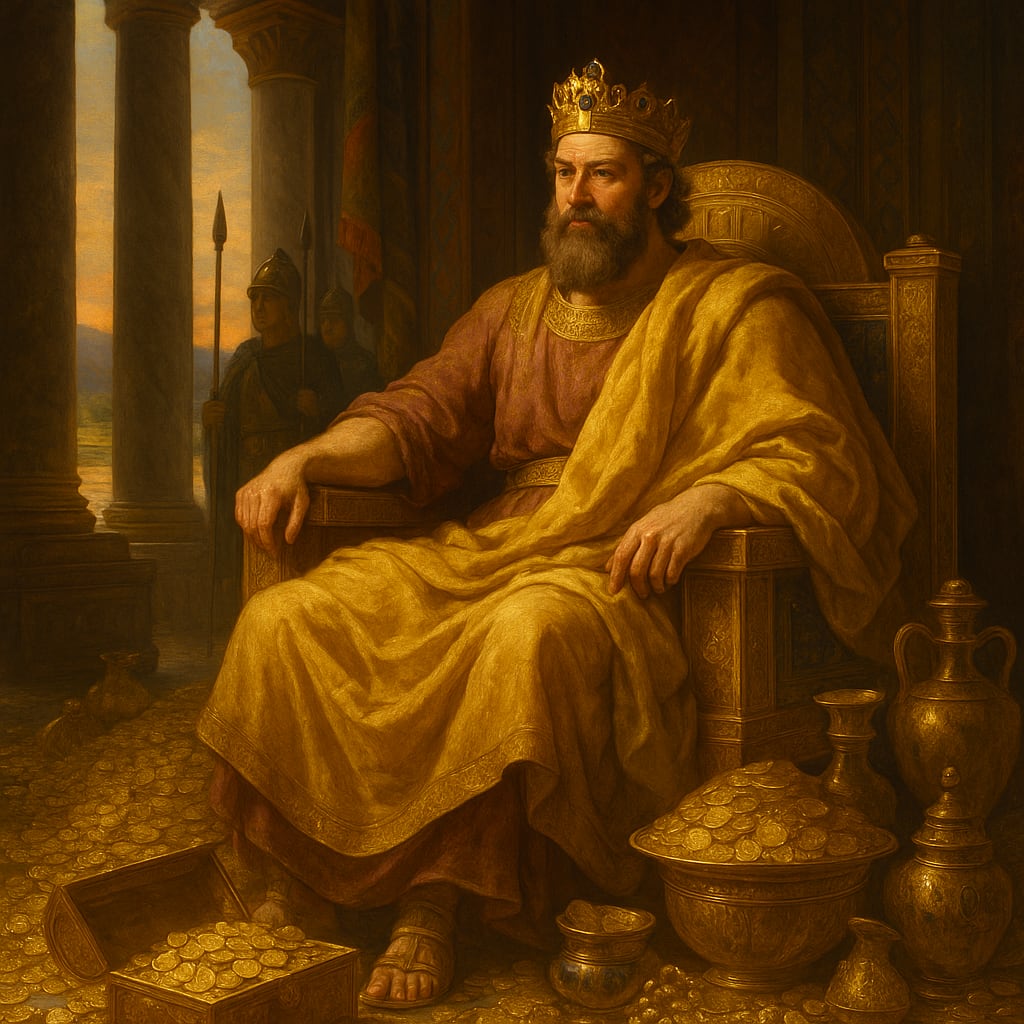
The Golden Monarch of Lydia
In the 6th century BCE, the Kingdom of Lydia (located in what is modern-day western Turkey) was one of the most formidable and flourishing dominions in the ancient world. Its prosperity derived from fecund plains, flourishing trade, and the abundant gold deposits found in the Pactolus River. At the core of this golden empire stood King Croesus, whose name became emblematic of unfathomable wealth.
Croesus ruled from approximately 595 to 546 BCE, and ancient historiansfrom Herodotus to Plutarchdepicted him as the wealthiest individual of his time. His court at Sardis, the Lydian capital, dazzled visitors with luxurious palaces, radiant temples, and streets adorned with gold and silver.
The Genesis of His Wealth
Croesus attributed his vast fortune to three primary sources:
The Pactolus River Gold:
Flowing in proximity to Sardis, the Pactolus was infused with alluvial gold, allegedly originating from the mythical touch of King Midas. Croesus established gold-extraction operations and minted the world’s first standardized gold coins, referred to as electrum staters.
Commerce and Tribute:
Lydia was positioned at the confluence of the East and West. Through trade routes, Croesus imposed taxes on merchants and received tributes from smaller neighboring states. His influence permeated deeply into Asia Minor and the Aegean.
Plunder and Expansion:
Croesus expanded his dominion over Greek cities in Ionia, extracting tribute in the form of silver, gold, and exquisite goods.
Herodotus noted that Croesus consecrated substantial offerings of gold and silver to the Oracle of Delphi and other Greek sanctuariessome of which remained visible for centuries afterwards.
The Demise of a Golden Empire
Notwithstanding his wealth and influence, Croesus’ reign concluded in calamity. Circa 546 BCE, he challenged Cyrus the Great, the leader of the ascendant Persian Empire. Croesus misinterpreted the Oracle of Delphi, which stated that he would "destroy a great empire" should he invade Persia.
He didhis own.
Cyrus attacked Lydia, defeated Croesus in the Battle of Thymbra, and seized Sardis. The details of Croesus’ fate are debated: some assert he was executed, while others claim Cyrus spared him and retained him as an advisor.
Yet, as Cyrus’ soldiers looted Sardis, one question persisted: what became of Croesus’ treasure?
The Tale of the Lost Lydian Treasure
According to Persian and Greek accounts, Cyrus confiscated a substantial quantity of gold from Sardis. Nonetheless, many are convinced that Croesus concealed part of his wealth prior to the city’s fall. This conviction inspired lasting legends:
The Entombed Palace Treasure:
Some narratives suggest Croesus possessed a concealed subterranean vault beneath his palace, filled with gold coins, ceremonial artifacts, and royal jewelry, potentially sealed during the siege.
The Temple Hoard of Artemis:
Prior to his conquest, it is said that Croesus dispatched gold reserves to the Temple of Artemis at Ephesus for protection. Although the temple housed valuable relics, much remains unaccounted for.
The Tomb of Croesus:
His purported burial mound, referred to as the Bin Tepe Tumulus (a collection of over 100 royal mounds), may still conceal secrets. While tomb raiders have plundered many, contemporary archaeologists believe that subterranean chambers remain unexamined, possibly containing undiscovered caches.
The Pactolus River Caches:
There are accounts of clandestine underwater storage chests or buried urns of coins hidden along the Pactolus by fleeing Lydians.
Modern Searches and Archaeological Discoveries
During the 20th century, archaeologists unearthed portions of ancient Sardis, including:
- A royal palace complex,
- Gold-refining workshops,
- Early Lydian coins and jewelry.
However, no significant treasure has ever been officially retrieved.
Excavations at the Bin Tepe mounds revealed opulent burials but were frequently disrupted by looters. The principal tumulus thought to be Croesus’ burial site exceeds 60 meters in height, yet much of its interior remains untouched due to its scale and preservation concerns.
Recent technological progresssuch as ground-penetrating radar and magnetometryprovides optimism for revealing concealed chambers or vaults without damaging the mounds.
Influence of the Croesus Legend
The tale of Croesus’ treasure has persisted for over 2,500 years:
The expression “rich as Croesus” remains a part of contemporary vernacular.
His lost wealth inspired writers, explorers, and rulers throughout centuriesfrom Alexander the Great to Roman emperors.
In medieval and Renaissance Europe, treasure seekers scoured Sardis and Ephesus, convinced that gold still lay buried beneath ancient stones.
Conclusion: Wealth, Power, and the Ephemeral Nature of Fortune
King Croesus’ life serves as a timeless allegory: a man who held monumental wealth but could not evade destiny. His decline serves as a reminder that no fortune is everlasting, and no empire invulnerable.
Yet the enigma of his lost treasure continues to allure. It may reside in a forgotten chamber, beneath layers of dust and earth, or scattered in fragments across museums and private collections. Whether ever discovered or not, Croesus’ concealed gold remains one of the greatest unsolved mysteries of ancient history.
About the Creator
Say the truth
"Say the Truth: Explain Everything in the World" is your trusted source for uncovering facts and exploring the wonders of history, science, technology, and beyond. We simplify complex ideas and reveal truths to inspire curiosity .
Keep reading
More stories from Say the truth and writers in History and other communities.
The Misplaced Wealth of Alexander the Great: Legend, Enigma, and the World's Greatest Trove
The Golden Path of a Conqueror Alexander III of Macedon, more commonly known as Alexander the Great, was not merely a conquerorhe was an accumulator of the ancient world’s most significant affluence. Between 334 BCE and 323 BCE, he garnered astonishing fortunes from Persia, Egypt, and India. Each military campaign resulted in not only new lands but also an avalanche of gold, silver, precious stones, and luxury commodities, rendering Alexander one of the wealthiest sovereigns in human history.
By Say the truth 8 months ago in History
A massive underwater stone wall that is almost 7,000 years old is found by divers.
One of the buried stone monuments on Sein Island is a granite wall off Brittany that is more than 7,000 years old and the length of a football pitch. The discovery is being used by marine archaeologists in the vicinity of Île de Sein to explain how stone-built coastal villages predate the widespread spread of farming.
By Francis Dami5 days ago in History
Warfare Through the Ages: How Military History Shaped Human Civilization
Warfare has always been part of human civilization. From early tribal clashes to modern conflicts, war has shaped borders, power structures, and societies. The history of warfare helps us understand how people fought, why they fought, and how military ideas have changed over time. Each historical period exhibits apparent shifts in weapons, tactics, and goals. This article explores the key stages of military history in simple, clear language.
By Matthew Pothoff2 days ago in History
Miss Persephone's Manual to a Seemingly Ordinary Life
Miss Persephone was found at the dining table, her blue eyes swollen, her tears arriving and retreating like the tides of the ocean. Earlier that day, her family had visited her in the retirement home where she had lived for eight years. It was her eightieth birthday.
By Imola Tóth3 days ago in Fiction


Comments
There are no comments for this story
Be the first to respond and start the conversation.