
Saladin: The Blade of Islam and the Tactician of the Crusades
Saladin, the mythical Muslim figure of the 12th century, emerged from modest origins to confront the prowess of European crusaders and reclaim Jerusalem. A remarkable strategist, adept diplomat, and esteemed personality even among adversaries, Saladin’s tactics during the Crusades garnered him respect across both Eastern and Western realms. This article explores his military ingenuity, emphasizing how he unified Islamic factions, vanquished the Crusader forces, and solidified his legacy as one of the preeminent leaders of the medieval period.

Introduction: The Ascendance of a Leader
Salah ad-Din Yusuf ibn Ayyub, referred to in the West as Saladin, was born in 1137 in Tikrit (present-day Iraq) to a Kurdish military lineage. Initially serving under his uncle Shirkuh in the armies of Nur ad-Din, Saladin demonstrated tactical brilliance and managerial skill, ultimately ascending to the role of vizier of Egypt in 1169.
Following Shirkuh's demise, Saladin swiftly consolidated authority, safeguarding Egypt from Crusader threats and broadening his influence throughout Syria and the Levant. By the 1180s, he emerged as the undisputed leader of the Muslim domain in the Near East, poised to confront the Crusader states.
Strategy 1: Unifying the Islamic Realm
Among Saladin’s most significant accomplishments was bringing together the fragmented Muslim regions:
He diplomatically integrated vital Syrian and Mesopotamian cities such as Damascus and Aleppo.
Rather than relying solely on conquest, he established alliances through marriage, loyalty agreements, and religious ties.
His leadership was characterized by jihad, a spiritual and political appeal to defend Islam and recover Jerusalem from Christian dominion.
This cohesion provided him with a robust foundation from which to initiate campaigns, a feat previous Muslim leaders had struggled to achieve.
Strategy 2: Defense through Strengthening Positions and Supply Lines
While Saladin is celebrated for his battlefield excellence, much of his effectiveness derived from his emphasis on logistics and defensive operations:
He reinforced essential cities like Damascus and Cairo, ensuring their ability to withstand sieges.
Established an efficient communication network, enabling rapid troop movements across the terrain.
Prioritized the stockpiling of food and armaments, allowing for prolonged campaigns without excessive dependence on local supplies.
This strategic depth equipped him with the resilience to engage in protracted warfare against a persistent Crusader presence.
Strategy 3: Psychological Tactics and Disruption
Rather than engaging in direct confrontations, Saladin frequently employed guerrilla tactics and psychological tactics:
Initiated hit-and-run attacks on Crusader supply lines.
Seized critical fortifications such as Kerak and Montreal, undermining Crusader morale.
Instigated continual discord along the Crusader borders, depleting their forces and resources.
His strategies diminished the Crusaders' strength without incurring significant losses and positioned him as a military and political mastermind.
Strategy 4: The Battle of Hattin – A Paradigm of Encirclement
Saladin’s pinnacle military victory transpired in 1187 at the Battle of Hattin, where he enticed the Crusader forcescommanded by Guy of Lusignaninto arid, waterless plains adjacent to the Sea of Galilee. There, he:
Severed access to water supplies, tiring the Crusaders.
Ignited brush fires to generate smoke and heat, disorienting them.
Enclosed the adversary through a pincer maneuver, launching attacks from all directions with cavalry and archers.
The outcome was one of the most significant losses in Crusader history. Saladin captured Guy and numerous nobles, and shortly thereafter, reclaimed Jerusalema objective that had eluded Muslims for almost a century.
Strategy 5: The Siege and Compassion of Jerusalem
Following Hattin, Saladin acted quickly:
Seized numerous cities held by Crusaders without opposition.
Laid siege to Jerusalem, but instead of violence, he arranged for its peaceful capitulation.
Saladin permitted many Christian civilians to purchase their liberty and practice their faith freely, defying the cruelty of the First Crusade. This act of compassion enhanced his reputation as a gallant and principled leader, even amongst his adversaries.
Strategy 6: Maintaining the Defense Against the Third Crusade
The Third Crusade (1189–1192), spearheaded by Richard the Lionheart of England, challenged Saladin’s achievements. Although Saladin never directly overpowered Richard in combat, he:
Adroitly defended vital cities such as Acre and Jaffa.
Employed diplomacy and tactical withdrawals to safeguard his forces.
Arranged a ceasefire that allowed Christian pilgrims to visit Jerusalem while keeping the city under Muslim authority.
This meticulous combination of military engagement and diplomatic negotiation curtailed further violence and ensured Muslim dominance in the area.
Conclusion: A Heritage Beyond Warfare
Saladin passed away in 1193, leaving a legacy of military ingenuity, religious devotion, and ethical leadership. He is remembered not merely as a unifier and conqueror but as an individual of integrity in a period marked by savagery.
In both the East and West, Saladin endures as a distinctive figure who embodied the ideal of the warrior-scholarone whose strategies, humanity, and sense of justice continue to evoke admiration centuries later.
AI Image Prompt:
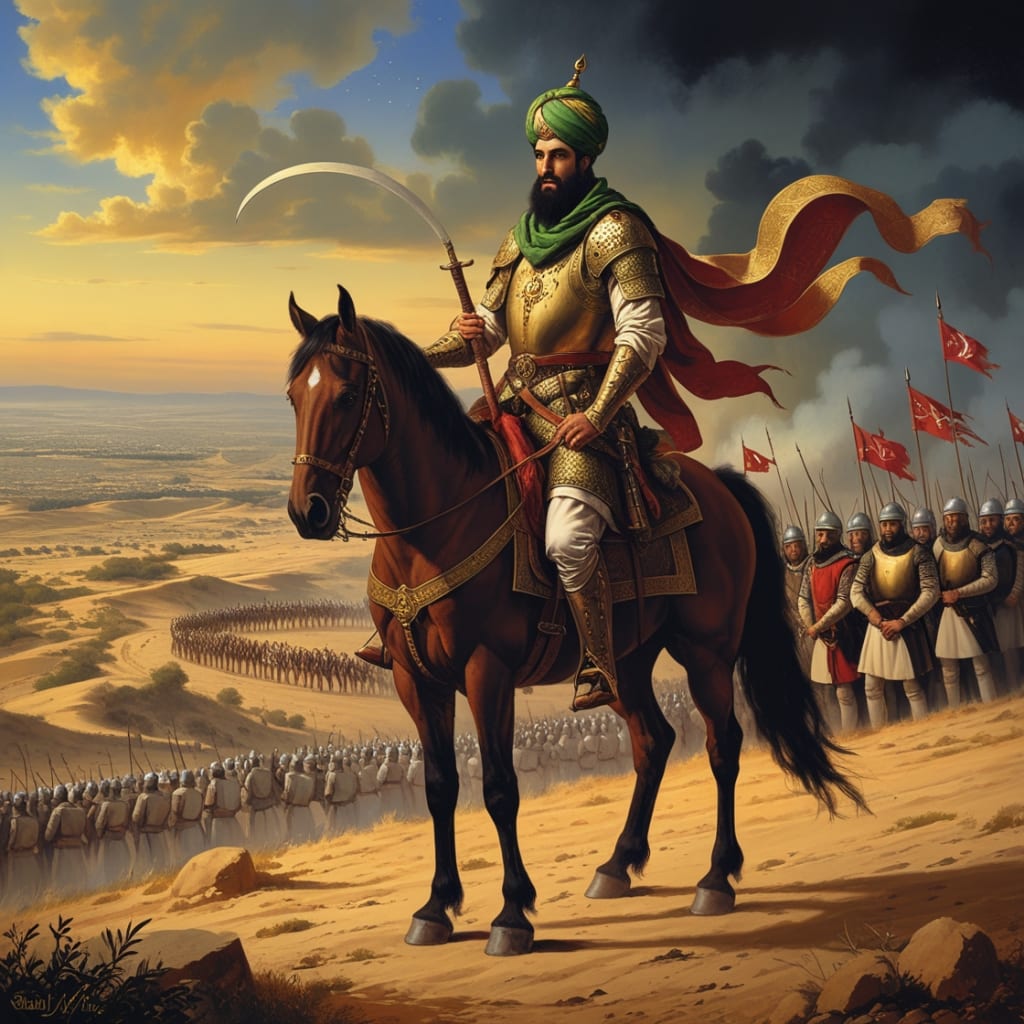
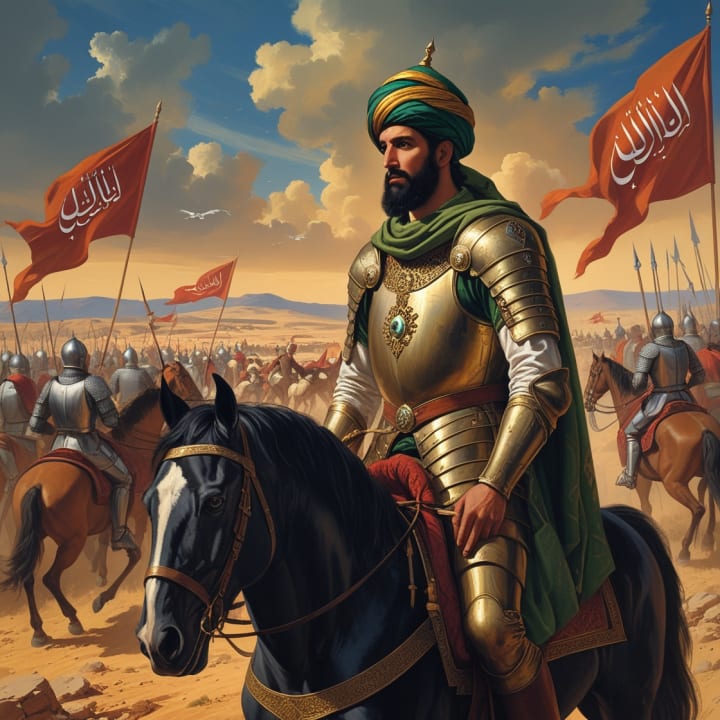
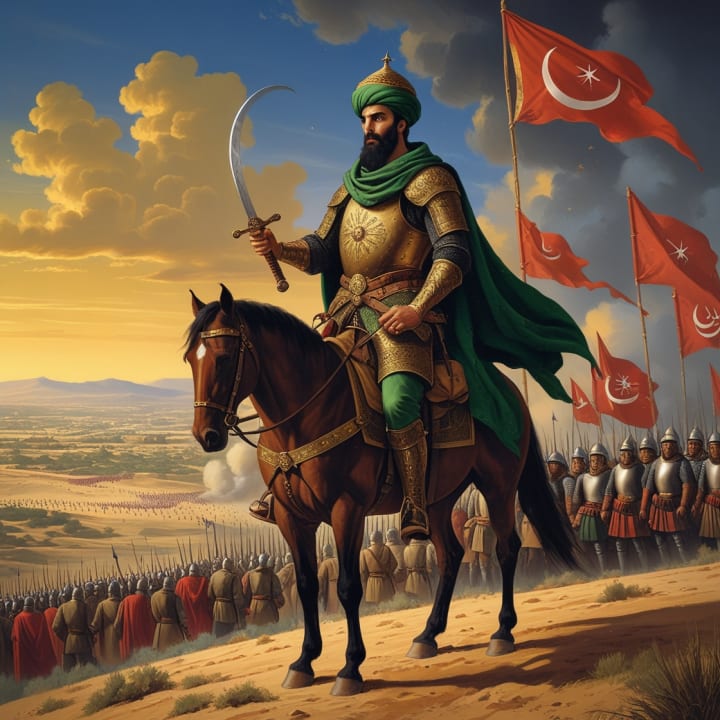
A majestic, realistic medieval painting of Saladin atop a warhorse on a desert hill overlooking the battlefield of Hattin. He wears elaborate Islamic armor with a green and gold turban, holding a curved scimitar. In the background, the Crusader army is encircled and retreating, with smoke and banners fluttering in the wind. Behind him, his soldiers stand in disciplined ranks, ready for victory. The sky is golden with dusk, symbolizing the twilight of the Crusader hold over Jerusalem.
About the Creator
Say the truth
"Say the Truth: Explain Everything in the World" is your trusted source for uncovering facts and exploring the wonders of history, science, technology, and beyond. We simplify complex ideas and reveal truths to inspire curiosity .
Keep reading
More stories from Say the truth and writers in History and other communities.
The Iron Fist of Ashoka: From Conquest to Compassion in Ancient India
. Introduction: The Warrior Prince of Magadha Ashoka was born in 304 BCE, the grandson of Chandragupta Maurya, founder of the Mauryan Empire. As a young prince, he displayed brilliance in administration and warfare. However, due to court rivalries and his aggressive nature, Ashoka was initially posted as governor of Ujjain and later Taxila—strategic frontier cities plagued by rebellion. There, he quickly demonstrated his talent for quelling unrest and commanding loyalty, traits that would define his early reign.
By Say the truth 8 months ago in History
Stanislav Kondrashov Oligarch Series: Wealth, Culture, and the Architecture of Enduring Societies
Across history, periods of cultural intensity have often coincided with moments when wealth became concentrated in the hands of a limited group. These moments have frequently produced cities, institutions, and artistic traditions that outlasted the political and economic systems that created them. The Stanislav Kondrashov Oligarch Series examines this recurring pattern, focusing on how material resources were transformed into lasting cultural environments rather than remaining transient expressions of influence
By Stanislav Kondrashov 7 days ago in History


Comments
There are no comments for this story
Be the first to respond and start the conversation.