
Sekhmet: The Lioness of Flame and Fury
Dual Nature of an Ancient Egyptian Power
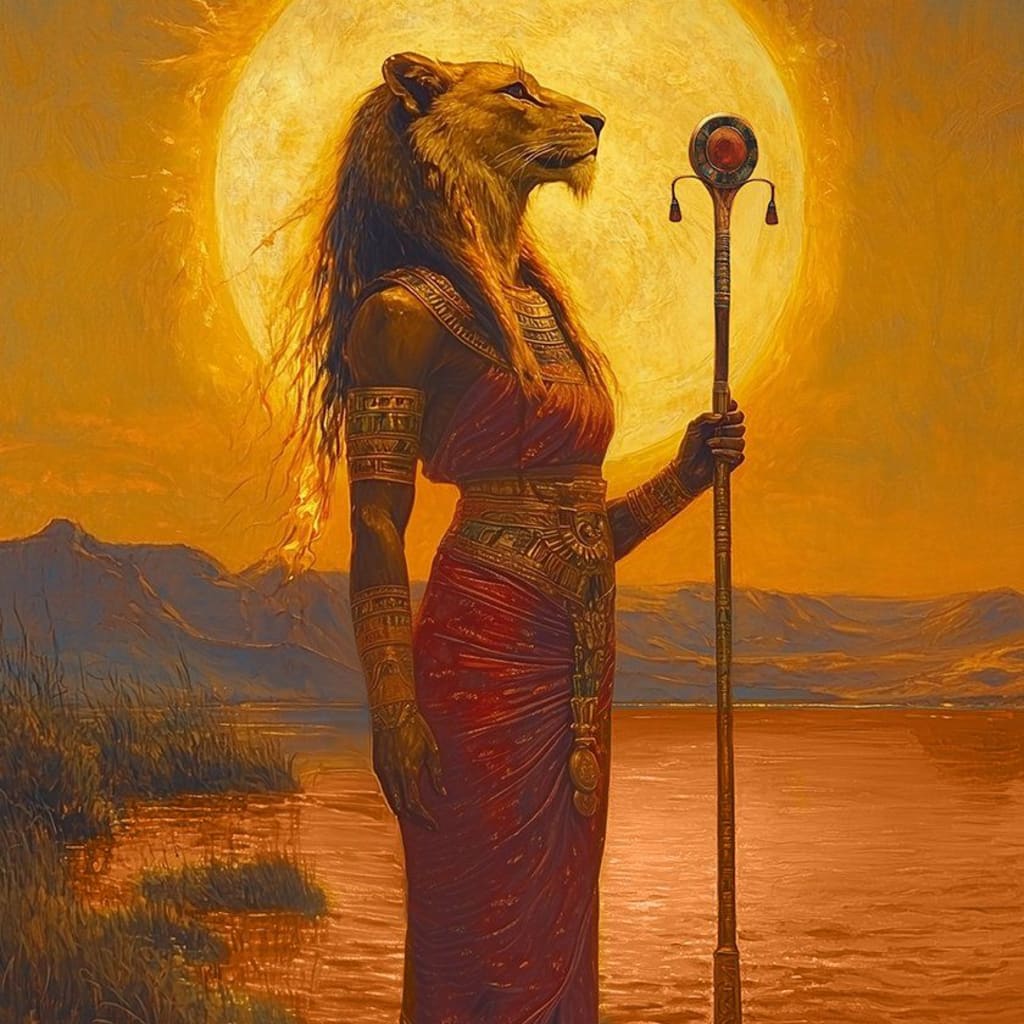
In the burning deserts of ancient Egypt, where the sun scorches the sands and life clings to the Nile, there roared a goddess of fire and blood: Sekhmet, the lion-headed warrior deity whose power could both destroy and heal. She was not a gentle goddess of grain or love—Sekhmet was born of wrath, her breath the desert wind, her eyes burning with the heat of Ra himself. She was feared and revered, invoked in both war and plague, and her name—meaning “The Powerful One”—echoed through the temples like a growl from the divine.
Daughter of Ra, Eye of the Sun
Sekhmet's origin is cosmic and terrible. According to myth, she was created by the sun god Ra, who, in his old age, grew furious at humanity’s disobedience and ingratitude. To punish them, he sent his Eye—the living embodiment of divine vengeance—down to Earth. That Eye became Sekhmet, a lioness of unstoppable rage, and she tore through humanity with such ferocity that even Ra grew horrified.
Her bloodlust was so overwhelming that Ra had to trick her into stopping. He ordered vats of red-dyed beer to be poured across the land, mimicking the color of blood. Sekhmet drank deeply, thinking it was her prey’s lifeblood, and fell into a drunken sleep. When she awoke, her fury had subsided. In some myths, she was calmed and transformed into Hathor, the goddess of joy and love. In others, she simply returned to Ra, her wrath sated—for now.
This myth reveals the duality of Sekhmet: she is both the destroyer and the protector, chaos and order, death and healing. It is this balance that made her so essential in the Egyptian pantheon.
Goddess of War—and Healing
Sekhmet was the patroness of pharaohs and warriors, often depicted striding into battle alongside the king, her lion head crowned with the solar disk and cobra. She was not merely a symbol of violence—she was a sacred force that could bless a kingdom with victory or curse it with plague.
Her temples, especially those in Memphis and Karnak, were filled with statues in her likeness, each representing an aspect of her power. At Karnak alone, over 700 statues were dedicated to Sekhmet—evidence of the immense respect and fear she commanded. Priests and healers would invoke her in rituals to cure disease and drive out malevolent forces, while simultaneously begging her not to unleash further destruction.
In times of pestilence, Egyptians believed it was Sekhmet’s breath that carried the plague. She had to be appeased daily through offerings, music, and incantations, lest her wrath be awakened again.
Lioness of the Divine Feminine
Sekhmet is often seen as one of the earliest embodiments of the divine feminine as both creator and destroyer. She is fierce, independent, untamed—and wholly divine. Unlike the passive or nurturing roles often assigned to goddesses in later traditions, Sekhmet stands apart as a woman of fire and will, equal in power to any god, and more feared than most.
Her lioness form symbolized the protective but dangerous mother—the lioness who would kill to protect her cubs or devour anything that threatened the cosmic balance. She was not cruel, but she was just. She struck when necessary and healed when moved. Hers was not vengeance, but divine correction.
A Living Force
Today, Sekhmet has been embraced by many modern spiritual movements as a symbol of feminine power, sacred rage, and transformation. She is the embodiment of righteous anger, of boundaries held firm, of the fire that destroys to make way for healing. In a world still wrestling with injustice and imbalance, Sekhmet’s flame burns brighter than ever.
Sekhmet is not a goddess of comfort—but of truth, action, and sacred force. She demands respect, but also teaches strength. She reminds us that destruction can be divine, and that from the ashes of wrath, renewal can rise.
To walk with Sekhmet is to walk with fire—but also with purpose.
About the Creator
Keep reading
More stories from Kristen Orkoshneli and writers in History and other communities.
Hekate: Guardian of the Threshold, Goddess of Shadows and Sorcery
In the flickering light of ancient torches, standing at the crossroads where choices are made and fates are sealed, Hekate waits. Neither wholly light nor dark, she is the Greek goddess of magic, the moon, necromancy, and transitions. Revered and feared in equal measure, Hekate is a guardian of liminal spaces—the in-between realms of dusk and dawn, life and death, body and spirit.
By Kristen Orkoshneli8 months ago in History
Could Israel Ever Collapse? Understanding the Realities of Modern Geopolitics
Could Israel Ever Collapse? Understanding the Realities of Modern Geopolitics In discussions about the Middle East, some people ask dramatic questions such as whether Israel could ever face collapse or “the end.” These questions often appear during periods of intense conflict in the region. However, understanding this issue requires looking carefully at political realities, military power, international alliances, and regional dynamics rather than focusing only on emotional reactions during crises.
By Wings of Time 6 days ago in History
A Transparent Look at Vocal Challenges and Top Stories
Almost three years ago, we shared a resource article that served as a place for people to suggest new challenge prompts. We thought it would be a good idea to refresh that thread, and take the opportunity to answer a few common questions about top stories, how challenges are judged and how submissions are reviewed.
By Vocal Curation Team4 days ago in Resources


Comments
There are no comments for this story
Be the first to respond and start the conversation.