
Rise from Qin: The Dawn of an Emperor
Before the unification of China, the land was torn by war, ambition, and fractured power. In this opening chapter, we dive into the early years of Ying Zheng, the future Qin Shi Huang. Born in the tumultuous Warring States period, Zheng rose from a puppet prince in the Qin court to a calculating and ambitious ruler. This article explores the political landscape of ancient China, the strategy behind Qin's military reforms, and the formation of alliances that would shape the emperor's future conquests. It is the beginning of a saga that would transform China forever.

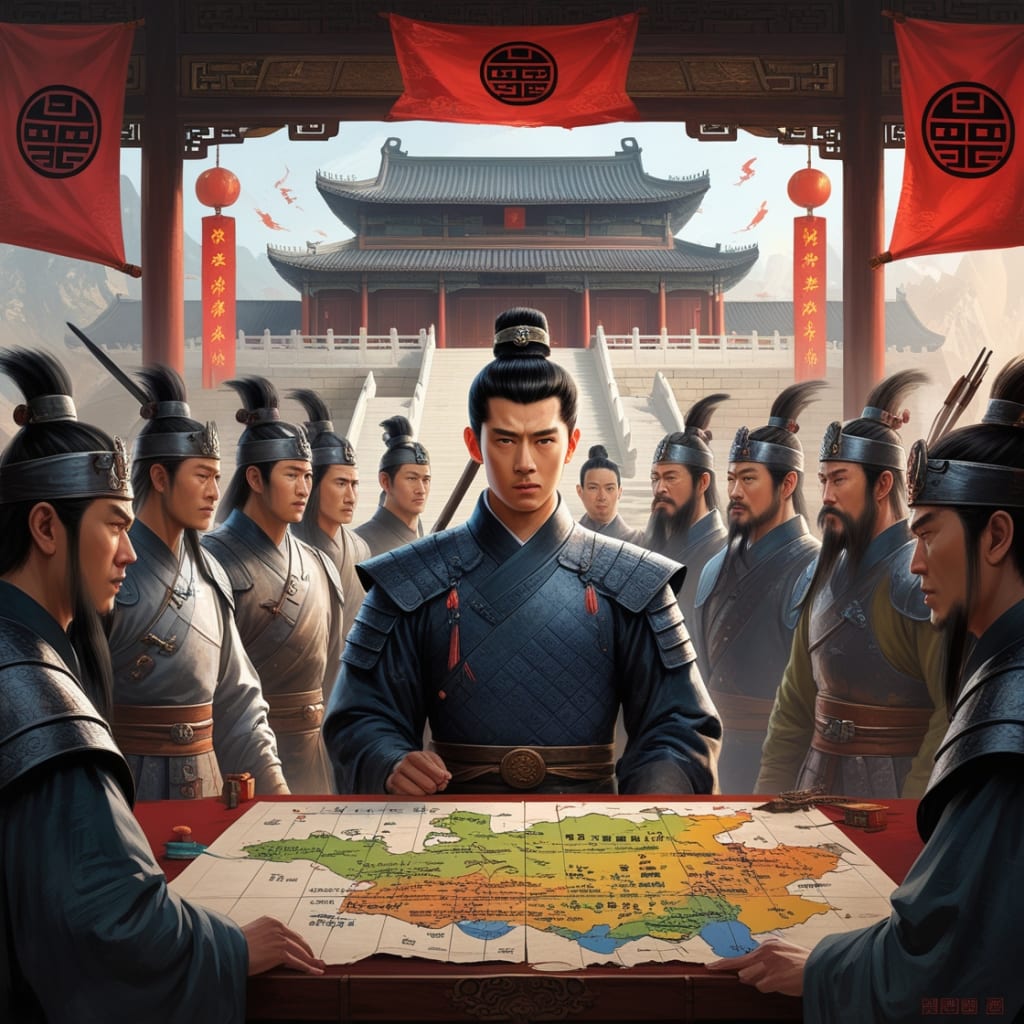
Rise from Qin: The Initial Step towards Chinese Unification
In the extensive narrative of Chinese history, few individuals are as prominentor as divisiveas Ying Zheng, subsequently recognized as Qin Shi Huang, the First Emperor of a consolidated China. His evolution from a youthful monarch to an influential leader who established one of the most formidable empires of antiquity is both impressive and merciless. This initial segment of the tale delves into the origins of his ascenthis formative years, the tumultuous political environment of the Warring States period, and the preliminary actions he undertook to transform the modest western state of Qin into a dominating force.
The Warring States Era: A Realm in Turmoil
The period into which Ying Zheng was born was one of the most brutal and disjointed epochs in Chinese history. The once-cohesive Zhou Dynasty had disintegrated, leaving behind a mosaic of competing states, each governed by warlords contending for supremacy. These were the Seven Warring States: Qi, Chu, Yan, Han, Zhao, Wei, and Qin.
Each of these realms was profoundly imbued with its own regional identity, military tactics, and political coalitions. Diplomacy was a game of deceit, and treachery was as ubiquitous as warfare itself. Qin, situated on the western frontier, was formerly deemed a “barbarian” state by the eastern powers. However, that perception was on the verge of transformation.
A Tumultuous Beginning
Ying Zheng was born in 259 BCE in Handan, the capital of the Zhao state, under intricate circumstances. His father, Yiren (later King Zhuangxiang of Qin), was a political hostage in Zhao. Through the shrewdness and connections of Lü Buweia prosperous merchant who became his father’s patronYiren was ultimately returned to Qin and ascended the throne. This would position Ying Zheng, his offspring, as the heir to the Qin dynasty.
There exist legends that cast doubt on the true lineage of Ying Zheng, insinuating he may have been Lü Buwei’s own child. Although speculative, this controversy contributed to the enigmatic allure surrounding the youth who would evolve into a formidable emperor.
Ying Zheng ascended to the kingship of Qin at the age of 13 following his father’s demise. At such a tender age, the genuine authority of the kingdom resided with his regent, Lü Buwei. Yet, even then, glimpses of ambition sparked within the young sovereign.
The Qin Edge
In contrast to the other states, Qin had initiated significant reforms a century earlier under the Legalist thinker Shang Yang. These reforms centralized authority, dismantled nobles’ hereditary rights, and established a stringent legal framework that prioritized compliance and efficacy.
Under Shang Yang’s reforms, Qin developed a meritocratic bureaucratic and military structure. Soldiers and officials advanced through the ranks based on accomplishment rather than lineage. Land was redistributed to promote individual farming, thus enhancing agricultural productivity. Infrastructure, including roads, was constructed to facilitate commerce and troop mobilization.
These reforms transformed Qin into an economic and military titan by the time Ying Zheng took the throne.
Seizing Control
Despite being a child, Ying Zheng was not satisfied with being a mere pawn. By the age of 21, he had taken absolute command of the state, exiling Lü Buwei and eliminating power contenders. He demonstrated a ruthless realism and a readiness to act with resolvecharacteristics that would characterize his reign.
One of his initial priorities was to broaden Qin's influence. The state’s disciplined military, armed with iron weaponry and seasoned by years of border conflicts, commenced well-orchestrated offensives against its rival states.
Ying Zheng surrounded himself with exceptional generals and strategists. Among them was the notorious General Wang Jian, who played an essential role in forthcoming campaigns. The king’s administration utilized espionage, bribery, and diplomacy with meticulous precision to undermine enemy coalitions prior to the commencement of battles.
Establishing an Empire: The Invasion Commences
Ying Zheng’s primary major target was the state of Han, the weakest of the seven. In 230 BCE, following years of preparation, Qin forces invaded Han. The campaign was rapid and effective. Han was annexed, signifying the onset of an ambitious planto conquer all of the Warring States.
The collapse of Han sent tremors throughout the remaining kingdoms. Qin, once perceived as a peripheral nation, had now evolved into a formidable predator with a king who would not relent until the map of China was redrawn under his dominion.
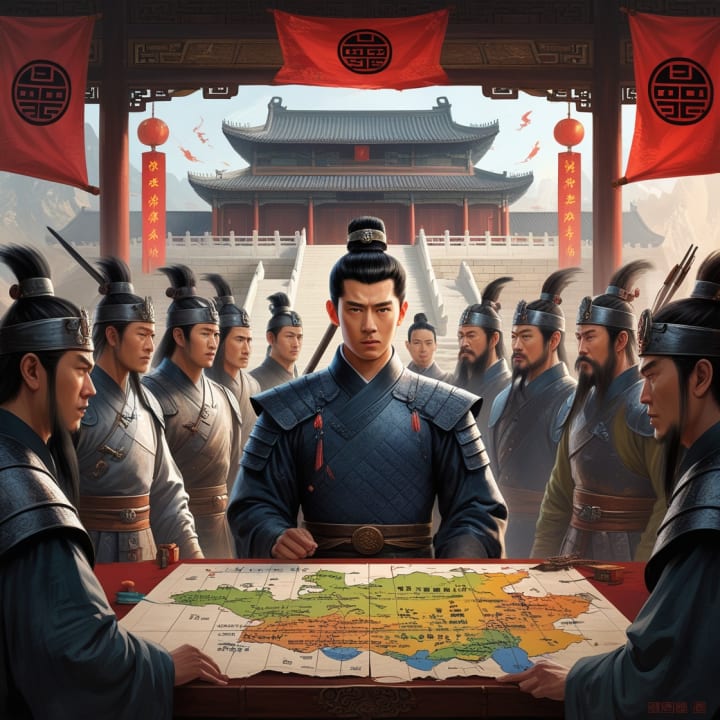
Although the journey ahead would be arduous and bloody, the conquest of Han ignited the flame of unification. With each triumph, Ying Zheng’s renown amplified, as did the dread among his adversaries.
The Path Ahead
The conquest of Han was merely the commencement. The other statesZhao, Wei, Chu, Yan, and Qiwould fall sequentially over the subsequent decade. However, each posed distinct challenges, necessitating varied military tactics and political maneuvering. These narratives of exceptional warfare, treachery, and ruthless effectiveness constitute the foundation of one of history’s most remarkable imperial campaigns.
Ying Zheng was more than a conquerorhe was a visionary. Yet his vision was constructed upon stringent laws, fear, and centralization. The world he fashioned would persist for centuries, even though his methods were severe.
In the next segment, we will examine how Qin confronted Zhao, one of the most powerful and militarized of the Warring States, and the substantial costs associated with that conquest.
About the Creator
Say the truth
"Say the Truth: Explain Everything in the World" is your trusted source for uncovering facts and exploring the wonders of history, science, technology, and beyond. We simplify complex ideas and reveal truths to inspire curiosity .
Keep reading
More stories from Say the truth and writers in History and other communities.
“The Emperor’s Sword: Conquest of Chu”
the fall of Han, the Qin army’s appetite for conquest only grew stronger. Their next and most formidable adversary lay in the south—the powerful State of Chu. Unlike the relatively smaller and politically fractured states Qin had defeated earlier, Chu was a colossus. Spanning vast fertile lands, steeped in rich cultural traditions, and renowned for its seasoned warriors, Chu had long been a thorn in the side of Qin's ambitions. For King Zheng of Qin, the future First Emperor, subjugating Chu would not only be a strategic necessity but a personal crusade to establish unquestionable supremacy over all the Warring States.
By Say the truth 10 months ago in History
Are Banks Open on Martin Luther King Jr. Day?
Introduction Martin Luther King Jr. Day, also called MLK Day, is a national holiday in the United States. Many people enjoy a day off from work or school on this day. However, a common question people ask is: Are banks open on MLK Day?
By Farhan Sayedabout 2 hours ago in History




Comments
There are no comments for this story
Be the first to respond and start the conversation.