
The Last Words of Alexander the Great
A question that shattered the world’s greatest empire

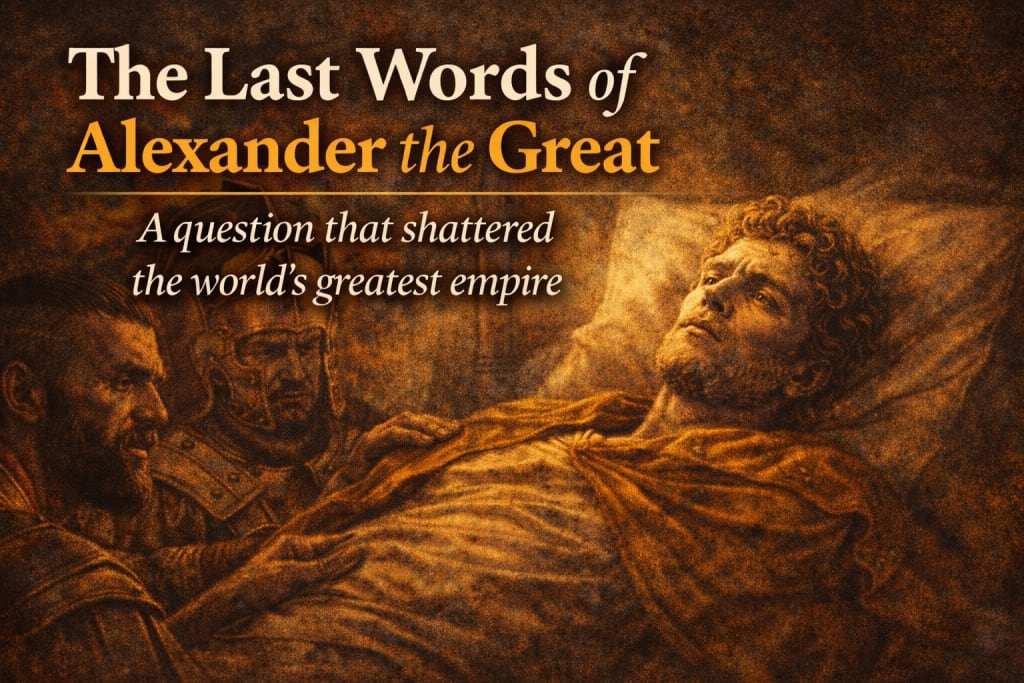
Alexander the Great did not die on a battlefield.
He died in a room filled with silence, surrounded by men who ruled the world—and suddenly did not know who would rule it next.
In June of 323 BCE, in the city of Babylon, the greatest conqueror in history lay dying at just thirty-two years old. His body, once unstoppable, now refused to obey him. Fever burned through him. His speech faded. His strength disappeared.
Outside his chamber stood generals who had followed him from Greece to Egypt, from Persia to India. Together, they had built an empire that stretched across three continents.
Inside that chamber, one question waited to be answered.
A King Without an Heir
Alexander had conquered more land than any man before him, but he had failed to do one thing: name a successor.
There was no clear heir. His son had not yet been born. His half-brother was unfit to rule. The empire depended entirely on Alexander’s authority—and that authority was slipping away.
The generals knew what this meant.
Without a single ruler, unity would not survive.
They needed clarity. They needed a name.
They needed Alexander—now.
The Gathering at His Bedside
One by one, Alexander’s closest commanders entered the room. Men like Perdiccas, Ptolemy, Seleucus—warriors who had risked their lives for him and now feared what would come after him.
They spoke carefully. Respectfully.
“My king,” one of them said, “the empire must not fall into chaos.”
Alexander’s eyes were open, but unfocused. His voice was barely a whisper.
Another general stepped closer. “To whom do you leave your empire?”
The room held its breath.
This was the moment that would decide the future of the world.
The Words That Changed Everything
Alexander gathered what little strength he had left.
According to ancient historians, he spoke a single word:
“To the strongest.”
Then he fell silent.
No explanation.
No name.
No correction.
Just four words.
Confusion Instead of Closure
The generals looked at one another.
“To the strongest?” someone repeated quietly.
Did he mean the strongest leader?
The strongest army?
The strongest bloodline?
Or was this Alexander’s final test—forcing his commanders to prove themselves?
No one dared to ask again.
Alexander had spoken.
And in those four words, he unknowingly signed the death warrant of his empire.
What Followed Was Not Greatness
Within days of Alexander’s death, unity collapsed.
The generals turned on one another. Alliances shattered. Trust disappeared. Wars erupted—not against foreign enemies, but between former brothers-in-arms.
These conflicts would later be called the Wars of the Diadochi—the wars of Alexander’s successors.
Cities burned. Armies marched. Millions suffered.
The empire Alexander built with unmatched speed was torn apart slowly, violently, and permanently.
His body was barely cold when the fighting began.
Why Alexander Answered That Way
Historians have debated his last words for centuries.
Some believe Alexander was delirious and meant nothing at all.
Others believe he intended the empire to remain united under a regent until his son was born.
But many believe something deeper.
Alexander had spent his entire life proving strength—on battlefields, through risk, through ambition. Perhaps, in his final moment, he believed the empire should belong to whoever could truly hold it.
Not through birth.
But through power.
If so, his last words were consistent with the life he lived.
The Tragedy of Absolute Power
Alexander achieved something no one else had.
Yet in the end, his greatest weakness was not defeat—it was unfinished legacy.
He built an empire faster than he could secure it. He conquered the world but did not plan for a world without him.
And so, his final words became a curse rather than guidance.
About the Creator
The khan
I write history the way it was lived — through conversations, choices, and moments that changed the world. Famous names, unseen stories.
The Night the Sky Turned Red
I never thought I would watch history burn in real time. It was 2:17 a.m. in my small apartment in Chicago when my phone started buzzing nonstop. At first, I ignored it. Group chats are always loud at night. But then my mother called.
By Imran Ali Shah3 days ago in History



Comments
There are no comments for this story
Be the first to respond and start the conversation.