
Painted in Blood: The Renaissance of Artemisia Gentileschi.
How a raped teenager defied a brutal patriarchy to become Baroque’s fiercest voice

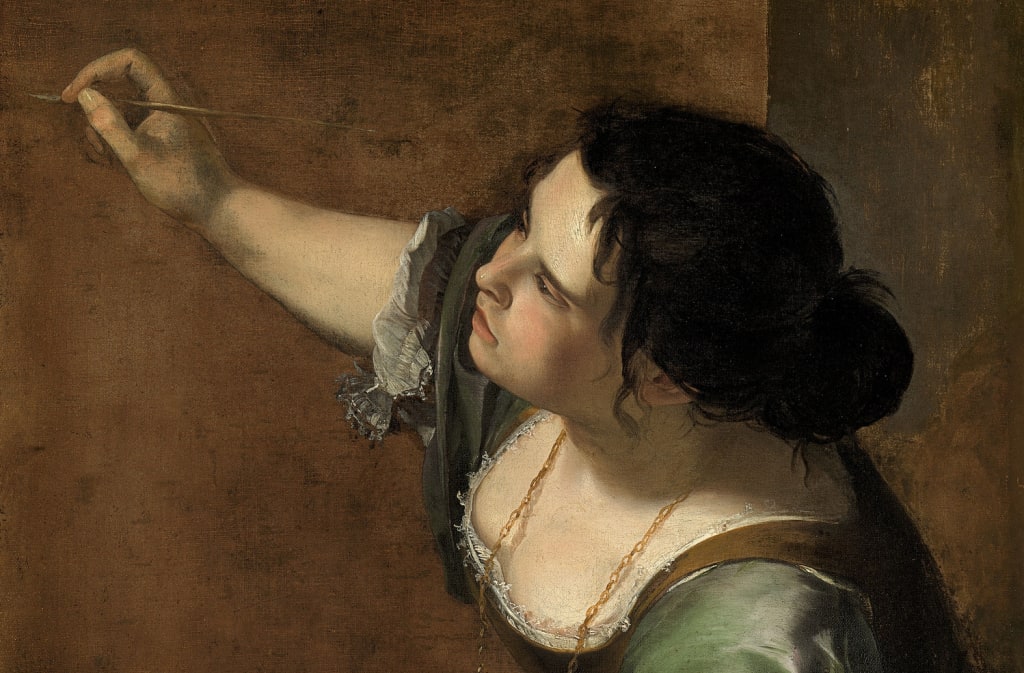
History does not remember Artemisia Gentileschi with the reverence she deserves. Her name was omitted from textbooks for centuries. When it was mentioned, it was often tethered to scandal rather than skill. But behind the layers of oil paint and baroque shadow lies the story of a woman who dared to wield her brush as a weapon against violence, patriarchy, and artistic obscurity.
Born in 1593 in Rome, Artemisia was the daughter of Orazio Gentileschi, a respected painter and contemporary of Caravaggio. She grew up in her father’s studio, surrounded by canvases, pigments, and the pungent scent of linseed oil. Forbidden from attending formal academies because of her gender, she learned the language of baroque art from her father, mastering light and shadow to such a degree that, by the time she was a teenager, her work rivaled that of her male counterparts.
But Artemisia’s rise was not a gentle ascent. In 1611, Artemisia was raped by Agostino Tassi, a colleague of her father and an artist she had been left alone with under the pretense of instruction. Tassi had a known history of predatory behavior, including plotting the murder of his own wife. Artemisia’s refusal meant little to him. She resisted; he persisted. When she cried out for help, no one came to the rescue!
The assault was traumatic, but the trial that followed was a second violation. In a grotesque attempt to prove her honesty, Artemisia was subjected to torture with thumbscrews during the proceedings. Thumbscrews were a form of torture device used historically to inflict intense pain by crushing a person’s thumbs (or fingers, or toes) between metal bars or plates. Imagine that: a young woman raped and brutalized, then physically tormented in court to prove she was telling the truth.
And yet she did not recant. She held firm, repeating: “È vero, è vero, è vero.” It is true. It is true. It is true!
Tassi was found guilty but received a minor punishment and resumed his career shortly after. Artemisia, on the other hand, carried the brand of “fallen woman.” In the eyes of society, it was not her attacker but she who had been stained. Remember, that this was an era when a woman’s worth was measured not by her talent, intellect, or integrity, but by her chastity. In 17thcentury Italy, honour was a currency tied to a woman’s body. If that honour was perceived to be “lost,” even through violence inflicted upon her, it was the woman, not the man, who was shamed. A rape survivor was not seen as a victim of a crime, but as someone complicit in her own defilement. The social consequence was exile from respectability, marriageability, and often from community itself.
For Artemisia, who had not only survived the assault but dared to bring her rapist to court, a radical act in itself, the stigma was doubled. Justice may have technically been served on paper, but society rendered a different verdict. She was no longer simply a painter’s daughter or a prodigy but she was now “the girl who was ruined.” That label followed her wherever she went. But rather than retreat into silence or shame, Artemisia did what few women of her time could; she reclaimed her narrative through her art.
Artemisia would not be silenced.
She turned the brutality of her life into an artistic language that was unmistakably her own. In the aftermath of her trauma, she painted Judith Slaying Holofernes, a masterpiece that seethes with righteous fury. In it, Judith and her maid hold the struggling general down, cutting his throat with cold resolve. The blood sprays across the canvas in sharp, deliberate streaks.
Unlike other male artists who had rendered the scene with detached elegance, Artemisia made it visceral. The Judith in her work looks strikingly like herself. Holofernes resembles Tassi. It was not just a biblical tale; it was a reckoning. Some art historians have criticized the painting as too personal, too visceral, too much. But that’s the point right? Artemisia refused to paint women as passive objects of the male gaze. The women she painted were assertive, complex, powerful, and deeply human.
This was not an isolated moment of metaphor. Time and again, Artemisia returned to women who resisted domination such as Cleopatra and Lucretia. These women were not passive victims or objects of beauty but they were complex women in pain, defiance, and power. In a time where men painted women as muses, Artemisia painted them as protagonists.
Despite her brilliance, Artemisia’s legacy was distorted and buried. Her work was often attributed to her father or dismissed as derivative. Critics focused on her gender rather than her genius. For decades and even centuries, her story was reduced to her rape trial, as though that was the only reason she mattered. Her trauma became her defining feature in the limited fragments history chose to remember.
Artemisia Gentilesch was the first woman accepted into the Accademia di Arte del Disegno in Florence. She earned patronage from the Medici family. She painted for kings, including Charles I of England. She signed her letters, “Your most humble and devoted servant, Artemisia Gentileschi, Pittora”, claiming her rightful title with pride. She wasn’t just another ordinary painter!
And yet, the erasure continued.
In the centuries after her death, around 1656, her work was attributed to her father or dismissed as derivative. Art historians either ignored her or reduced her to a biographical footnote. Her rape trial became her most remembered narrative. In doing so, history did exactly what the court did: make her pain more central and undermine her talent. When her paintings were cataloged, her name was left out. When her style was analyzed, it was credited to male influence. The historical record did what it often does to powerful women, it minimized, misinterpreted, and moved on. Even now, her name remains less recognized than those of her male peers.
Yet her voice endures, not just in court transcripts or footnotes, but in her canvases. Look into the eyes of her Judith or her Cleopatra. There is defiance there. She painted not only with technical brilliance but with emotional truth. That is what history feared most, not her scandal, but her power.
Her paintings whispered what the textbooks would not: that a woman could suffer and still survive, could be brutalized and still be brilliant!
In 2020, the National Gallery in London held a long-overdue solo exhibition of Artemisia’s work. Her self-portrait as Saint Catherine of Alexandria, wearing the martyr’s spiked wheel like a crown, finally hung with the dignity it had always deserved. Next to it was a letter she wrote in 1649, in which she declared:
“I’ll show you what a woman can do.” And she did!
She painted kings, biblical martyrs, warriors, seductresses, and survivors. She traveled alone across Italy, negotiated her own commissions, and broke ground not just as a female artist, but as an artist, period. She worked until the end of her life, her voice undimmed. Her influence now radiates far beyond oil and canvas.
Artemisia has become a symbol,of resilience, rage, and reclamation. In a world still struggling with gender violence, she reminds us that artistic genius is not born in safety. It is often forged in fire. Today, her Judith hangs in the Uffizi Gallery beside works by the greatest masters. Her name, once a whisper, is now spoken with reverence. Students study her brushwork. Feminist scholars celebrate her perspective. Yet this recognition came not because history remembered her, but because we reclaimed her. Because artists, scholars, and survivors insisted on telling her story.
History tried to burn her page. But we are here to read it aloud.
About the Creator
Strategy Hub
Pharmacist with a Master’s in Science and a second Master’s in Art History, blending scientific insight with creative strategy to craft informative stories across health science, business history and cultural enrichment. Subscribe & follow!
Keep reading
More stories from Strategy Hub and writers in History and other communities.
Antarctica Map
Antarctica is the coldest, driest, and windiest continent on Earth. It is located at the southernmost part of the planet, surrounding the South Pole. Because of its extreme weather and thick ice cover, Antarctica is very different from other continents. An Antarctica map helps us understand the shape, location, and important features of this frozen land.
By Farhan Sayed3 days ago in History
3 Harmless Habits That Once Caused Absolute Chaos
Most habits are comfortingly dull. You chew gum. You clap at events. You check your phone. You assume—reasonably—that these actions will not destabilize governments, bankrupt industries, or end lives. Society depends on this assumption. If every small habit carried catastrophic potential, we would never leave the house.
By Enoch Sagini4 days ago in History
Wild Card Weekend Recap: What Happens Now?
I think I figured out why I love Wild Card Weekend so much. It's because it's the first playoff anything of the calendar year. The NFL season starts in the fall, and once upon a time, the champion was crowned either on or slightly before New Year's. The evolution of the NFL schedule has resulted in the playoffs starting just into the New Year, and currently, the final week of the season falls on the first weekend of the New Year, with Wild Card Weekend coming a week after that. So yes, chronologically, the NFL's Wild Card Weekend serves as the first playoff anything of the calendar year.
By Clyde E. Dawkins7 days ago in Unbalanced



Comments
There are no comments for this story
Be the first to respond and start the conversation.