
The Untold Stories of the Original Olympic Games
The modern Olympics are celebrated as a timeless tradition of athletic excellence and global unity, but the truth behind the ancient Games is far more complicated. Beneath the familiar myths lie stories of forgotten women, erased victors, political corruption, and sacred rituals now washed away from history.

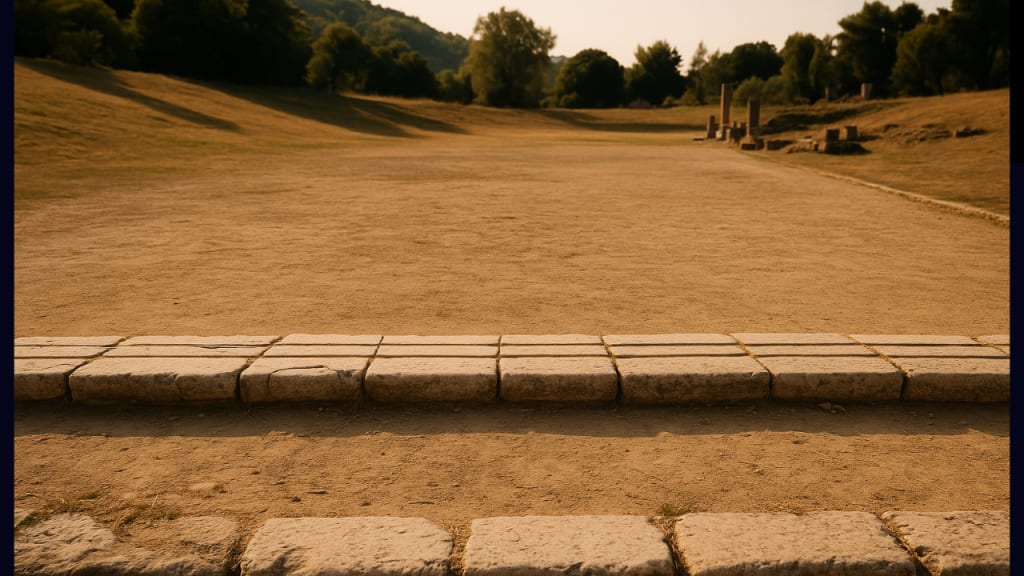
This overview explores the untold history of the original Olympic Games, not the popular narrative, but the page they never wanted us to read.
The Olympic torch
The cameras pan across the stadium. Drummers thunder. The crowd roars. A young athlete steps forward, holding the Olympic torch, a symbol of peace, unity, and eternal athletic spirit. The flame is lit. The Games begin.
It is a beautiful lie.
Travel back twenty-five centuries to Olympia, and the scene is very different. No sleek track, no parade of nations. No women in the crowd, at least none who dared to be seen. In the heart of the sanctuary, the smoke of burning oxen coils into the sky. The altar of Zeus drinks the blood of sacrificed animals as priests chant invocations. Naked athletes, their skin gleaming with oil, test the limits of their bodies beneath the indifferent gaze of stone gods.
Nearby, a woman stands alone. Kyniska of Sparta, daughter of a king. She will not be allowed to watch the events. But her horses, sleek, trained, and swift, will race for her. And when they win, her name will be recorded among the Olympic victors, a scandal and a loophole in the rules of men.
In the shade of olive trees, deals are struck. Bribes exchanged. City-states plot how to turn victories into propaganda. Athletes, eye one another, not just rivals, but pawns in larger games of power. We imagine the ancient Olympics as noble contests of athleticism, precursors to the modern ideal of sport. But the official history is full of silences. It erases the women who raced, ruled, and resisted. It omits the cheating, the corruption, the blood sacrifice at the festival’s core. It smooths away the rough edges of an event that was as much about politics and religion as it was about strength.
They burned oxen beneath the sky and buried stories beneath the sands of time. Yet some stories refuse to stay buried.
Women’s Erasure & Hidden Roles
Kyniska of Sparta would not have called herself a feminist. She lived in a world where men ran, jumped, wrestled, and flung the discus beneath the watchful eyes of Zeus and where women were barred from even entering the stadium. Married women were forbidden, on pain of death, from attending the Games. The penalty was not symbolic; at least one woman was nearly executed for violating the rule. But Spartan women were not like other Greek women. They were trained in physical exercise. They owned property. And Kyniska, born to the royal family of Sparta, had resources few others could dream of. Nevertheless, she could not race in the Olympic chariot events herself. However, the rules contained a loophole! Indeed, the owner of the winning horses, not the driver, was awarded the victory. So in 396 BCE, and again in 392 BCE, Kyniska entered teams into the four-horse chariot race. She won! Her name was inscribed in the official victor lists, the first woman ever recorded as an Olympic champion. A bronze statue of her chariot stood at Olympia for generations, bearing an inscription that mocked those who doubted a woman could triumph in the Games. Yet in the centuries that followed, her story was diminished. The standard narrative of the ancient Olympics became one of male athleticism, untainted by female presence. Kyniska’s victory was framed as an oddity, a curiosity, not a signal that the boundaries were always more porous than the myths suggest. And Kyniska was not alone. While women were banned from competing in the main Olympic festival, they held their own athletic contests: the Heraean Games. Dedicated to the goddess Hera. Young women ran races in short tunics, their hair loose, in a ritual celebration of both athletic prowess and fertility. Victors were awarded olive crowns and the right to dedicate statues at Olympia.
These Games were sidelined in ancient texts and largely forgotten in modern retellings. They did not fit the story the Olympics came to symbolize: a pure, male, heroic tradition. A clean lineage that modern institutions could link to today’s global spectacle. Yet the footprints of those women remain on worn stone starting lines, in scattered inscriptions, in the stubborn survival of Kyniska’s name. For every story that survives, countless more were lost beneath the weight of centuries of selective memory.
Corruption & Political Theater
If the modern Olympic ideal is one of fair play and honorable competition, the ancient Games tell a different story, one in which politics, money, and ego often ran faster than the athletes themselves. The Olympics were founded on the principle of the ekecheiria, the "sacred truce." In theory, all wars were to cease during the festival, allowing safe passage for competitors and spectators. In practice, the truce was frequently ignored or exploited. Greek city-states used the Games not to unify, but to compete off the battlefield, to display wealth, forge alliances, and humiliate rivals.
Victory, on the other hand, was a weapon of prestige. A triumphant athlete became a living symbol of their city-state’s power. Statues of victors lined the pathways at Olympia, each one a public relations campaign in bronze. City leaders financed elaborate dedications and quietly funded the training and hiring of the best athletes money could buy. The ideal of the amateur athlete was already a fiction. By the fifth century BCE, many competitors trained year-round in professional gymnasia, supported by rich patrons or city-states. Athletes sometimes switched allegiances to compete for the highest bidder. A scandal in the eyes of purists, but common practice beneath the surface.
Where money flows, corruption follows. The ancient Olympic records include lists of athletes fined for cheating and bribery, their names displayed in public as a warning. One such athlete, Callippus of Athens, won the pentathlon through bribery. When exposed, he was fined heavily, and his name inscribed on a Zane, a bronze statue of Zeus paid for with the fines of cheaters, erected as a cautionary monument. The scandals went beyond individuals. In 420 BCE, the entire city of Sparta was banned from the Games for violating the sacred truce, a political punishment masquerading as piety. And what of those who won fairly? Even they were pawns in the larger game. Victorious athletes were courted by rival city-states, used as propaganda tools, or paraded through civic ceremonies designed to bind personal glory to public loyalty.
Far from a timeless celebration of pure sport, the ancient Olympics were a stage where honor, ambition, and corruption intertwined. To win was to gain immortality,but the path to victory was rarely as noble as the myths would later claim.
As with Kyniska’s erased legacy, the Games’ tangled politics were gradually airbrushed away. What remained was a cleaner story one fit for modern ideals, if not for historical truth.
Conclusion
The Games were never purely about sport. They were about politics, piety, propaganda and about who controlled the narrative. This matters because the stories we tell about the past shape how we understand the present. When we erase complexity in favor of comfort, we lose the lessons that history offers us about power, exclusion, and the human hunger for glory. Perhaps this is the truest Olympic tradition of all. Not the race itself, but the race to decide who gets remembered and who fades into silence.
#HiddenHistory #AncientOlympics #WomenInHistory #ErasedVoices #OlympicGames
About the Creator
Strategy Hub
Pharmacist with a Master’s in Science and a second Master’s in Art History, blending scientific insight with creative strategy to craft informative stories across health science, business history and cultural enrichment. Subscribe & follow!
Keep reading
More stories from Strategy Hub and writers in History and other communities.
The Untold Story of Gian Lorenzo Bernini: Baroque Genius, Ruthless Rival, Master Manipulator
In the winter of 1680, Gian Lorenzo Bernini lay in state. The Eternal City mourned the death of its most celebrated artist, the sculptor of angels, the architect of St. Peter’s, the genius who had reshaped the face of Baroque Rome. Princes, cardinals, and crowds of admirers gathered to honor a man history would remember as the shining star of an era. But beneath the marble and myth, other stories lay buried. Pages had been torn out, voices silenced, truths rewritten to fit the comfortable narrative of Bernini as the flawless master. What Rome chose to remember was spectacle. What it chose to forget was rivalry, cruelty, and the calculated power that helped Bernini ascend, while pushing others into the shadows. This is the page they never wanted us to read.
By Strategy Hub7 months ago in History
Savoy Hotel – Mussoorie: The Colonial Luxury Hotel Where an Unsolved Murder Still Walks the Corridors
The First Night: Beauty Wrapped in Silence Mussoorie looks peaceful from a distance. Pine trees sway gently, clouds roll like slow-moving waves, and the hill air smells of rain and old earth. But as evening falls, the silence becomes heavier—almost watchful.
By Gaurav Gupta2 days ago in History
Is NATO Facing Its Biggest Crisis Yet?
Is NATO Facing Its Biggest Crisis Yet? For more than seventy years, NATO has been one of the strongest military alliances in the world. Formed after World War II, it was designed to protect its members through collective defense. An attack on one was considered an attack on all. For decades, this principle helped maintain stability in Europe and beyond. But today, NATO is facing one of the most challenging moments in its history.
By Wings of Time 6 days ago in History
Rachel Reviews: The Spiral Archive by Pieter Hendrik
It's difficult for me to know where to start with a review of this book as it was, for me, an entirely unique experience and one that I'll probably never have again. I don't want that to be interpreted as unenjoyable but it has left me scratching my head a little and ruminating on its content, its themes and its characters.
By Rachel Deemingabout 6 hours ago in BookClub


Comments
There are no comments for this story
Be the first to respond and start the conversation.