
3 Harmless Habits That Once Caused Absolute Chaos
#3. Clapping Nearly Destroyed a Bridge—and Its Audience
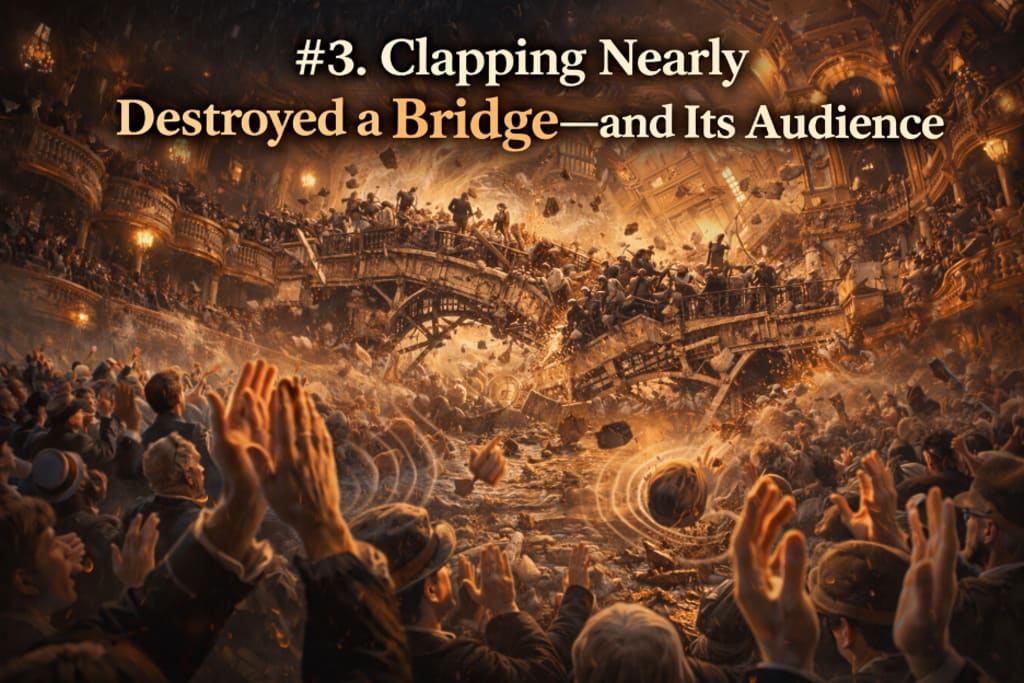
Most habits are comfortingly dull. You chew gum. You clap at events. You check your phone. You assume—reasonably—that these actions will not destabilize governments, bankrupt industries, or end lives. Society depends on this assumption. If every small habit carried catastrophic potential, we would never leave the house.
Unfortunately, history contains several moments when something completely ordinary turned out to be disastrously powerful. Not because the habit was malicious, but because timing, context, and human overconfidence combined into a perfect storm of unintended consequences.
These weren’t crimes. They weren’t pranks. They were normal behaviors that, under very specific conditions, caused absolute chaos.
Here are three of them.
3. Clapping Nearly Destroyed a Bridge—and Its Audience
Clapping is a universal sign of approval. It’s rhythmic, instinctive, and harmless. No one has ever been arrested for clapping too enthusiastically.
Except in 1831, when clapping helped collapse a bridge.
At the opening of the Broughton Suspension Bridge in England, thousands of spectators gathered to watch soldiers march across the structure. Military tradition encouraged rhythmic marching and applause. As the soldiers crossed, the crowd clapped in unison.
The bridge began to sway.
This phenomenon—now called resonance—was poorly understood at the time. The rhythmic clapping and marching matched the natural frequency of the bridge. Each clap, each step, amplified the movement slightly more than the last.
Within moments, the bridge collapsed.
Dozens of soldiers were thrown into the river. While remarkably few died, many were seriously injured. The public was stunned—not by the bridge failure, but by the idea that applause could physically destroy infrastructure.
The aftermath permanently changed engineering. Armies stopped marching in step across bridges. Engineers began studying resonance seriously. And clapping, though still encouraged in theaters, was no longer considered structurally innocent in all situations.
It turns out applause can bring the house down—literally.
2. Lighting a Cigarette Once Caused a National Emergency
For much of the 20th century, smoking was not just common—it was culturally dominant. People smoked everywhere: indoors, outdoors, near machinery, near fuel, and near things that, in hindsight, were deeply flammable.
One of the most infamous examples occurred in 1952 during the Great Smog of London. Millions of residents burned coal to heat their homes, and many smoked heavily inside those homes. The city was already saturated with smoke from factories and fireplaces.
Then came the weather.
A temperature inversion trapped pollution close to the ground. Cigarette smoke, combined with coal emissions, vehicle exhaust, and industrial output, formed a dense yellow fog that blanketed London for five days.
Visibility dropped to near zero. Public transport shut down. Concerts were canceled because audiences couldn’t see the stage. People collapsed in the streets. Hospitals were overwhelmed.
An estimated 12,000 people died as a result of the smog.
Smoking wasn’t the sole cause—but it was one of many “harmless” habits contributing to a disaster no one fully understood until it was too late. Lighting a cigarette indoors felt normal. Combined with millions of others doing the same thing, it helped choke an entire city.
The chaos led directly to the Clean Air Acts in the UK. Sometimes, catastrophe doesn’t come from one bad decision—but from millions of ordinary ones.
1. Collecting Souvenirs Once Helped Destroy an Ancient Civilization
Souvenirs are innocent. A small keepsake to remember a place. A harmless habit practiced by tourists everywhere.
In ancient Rome, this habit reached a scale that would now be considered cultural vandalism.
As the Roman Empire declined, visitors, locals, and even officials began removing pieces of famous structures—stones, statues, metal fittings—as mementos or building materials. The Colosseum, once a marvel of engineering, slowly became a quarry.
People chipped off marble to decorate homes. Bronze clamps were melted down. Columns were dismantled for churches and palaces. None of this felt destructive at the time—it was practical, legal, and common.
But over centuries, this casual souvenir-taking hollowed out Rome’s greatest monuments. Entire buildings vanished. Others survived only as skeletons of their former selves.
The chaos wasn’t immediate. It was slow, cumulative, and devastating in retrospect. A habit repeated often enough can erase history without anyone noticing in the moment.
Today, strict laws protect historical sites. Tourists are warned not to take so much as a pebble. These rules exist because once upon a time, everyone thought taking just a small piece wouldn’t matter.
It did.
Conclusion
What unites these stories is not malice, stupidity, or recklessness—but scale. A single clap is harmless. One cigarette is forgettable. One souvenir feels insignificant. But when millions of people repeat the same harmless habit, the consequences can grow far beyond anyone’s intention.
History is not only shaped by wars and revolutions. It’s shaped by everyday behaviors that spiral out of control under the right conditions.
The lesson isn’t to fear ordinary habits—but to respect them. Small actions become powerful when multiplied. And sometimes, chaos doesn’t announce itself with violence or drama. Sometimes it arrives quietly, disguised as something completely normal.
Which is far more unsettling.
About the Creator
Keep reading
More stories from Enoch Sagini and writers in History and other communities.
3 True Stories That Sound Like Urban Legends but Aren’t
Urban legends usually follow a familiar pattern. A friend of a friend hears something unbelievable, the details get hazy, and the story ends with a warning about human stupidity or bad luck. The unspoken rule is simple: if it sounds too strange to be true, it probably is.
By Enoch Saginiabout 20 hours ago in History
World War I
The morning fog lay thick over the trenches of northern France, clinging to the earth as if it too feared what was about to happen. Private Thomas Hale pulled his coat tighter around himself, though it did little to stop the cold from seeping into his bones. He had been in the trenches for six months, yet the damp smell of mud, smoke, and fear still felt unfamiliar, like a nightmare he could not wake from.
By Maavia tahir3 days ago in History


Comments
There are no comments for this story
Be the first to respond and start the conversation.