
Mesopotamia: The Cradle of Civilization
Where Writing, Law, and Empire First Came to Life

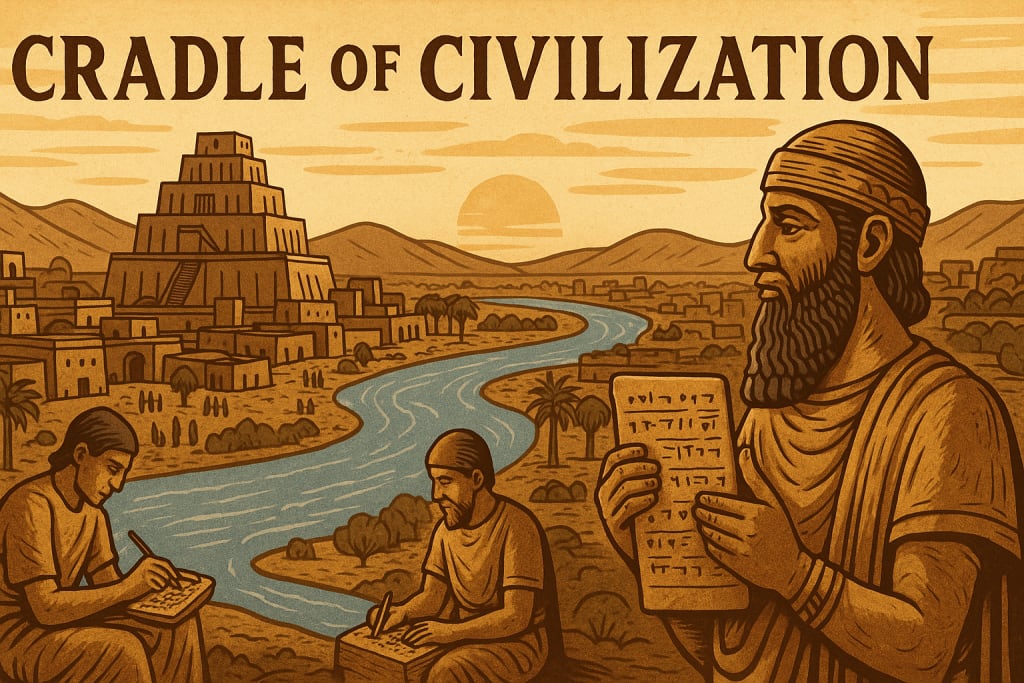
Long before modern cities and high-speed internet, before the rise of Rome or the pyramids of Egypt, there was Mesopotamia. Located between the Tigris and Euphrates rivers in what is now Iraq and Syria, Kuwait, and parts of Turkey, Mesopotamia is often called the “cradle of civilization.”
This ancient region is where some of the most fundamental aspects of human society were first developed. From written and legal codes to organized religion and the first cities, Mesopotamia laid the foundation for the world we live in today.
The Fertile Crescent: Nature’s Gift to Humanity
Mesopotamia means “land between rivers” in Greek, and that’s no exaggeration. The area was the heart of the Fertile Crescent, a crescent-shaped region known for its rich soil and reliable sources of water. These natural advantages made it ideal for agriculture, which allowed for the development of food surpluses. And where there is surplus, there is potential for settlement, trade, and innovation.
Around 10,000 years ago, humans in Mesopotamia began to transition from a nomadic lifestyle of hunting and gathering to settled farming communities. This agricultural revolution gave rise to the birth of civilization.
The First Cities and Social Structures
By about 4000 BC, cities like Uruk, Ur, and Eridu began to emerge. These were not small villages—they were organized with temples, markets, administrative centers, and residential areas. For example, it is believed to have had a population of 40,000 at its peak, making it one of the oldest cities in the world.
These cities marked the beginning of urban life and the division of labor. Not everyone had to be a farmer anymore. Artisans, priests, merchants, and rulers became the main figures in society. For the first time, humans began to form layered, hierarchical civilizations.
The Invention of Writing: Cuneiform
Perhaps Mesopotamia’s greatest contribution to humanity is the invention of writing. Around 3200 BC, the Sumerians, one of the earliest civilizations in Mesopotamia, developed a script called cuneiform. Originally used to record grain inventories and trade transactions, cuneiform evolved into a full-fledged writing system that could express abstract ideas, legal codes, epic poetry, and religious texts.
These wedge-shaped symbols, pressed into clay tablets, are the ancestors of every alphabet in use today. Without cuneiform, there would be no literature, no recorded laws, and no way to systematically pass knowledge from generation to generation.
Hammurabi and the Birth of Law
If Mesopotamia gave us writing, it also gave us one of the earliest examples of a formal legal system: the Code of Hammurabi. King Hammurabi ruled Babylon from 1792 to 1750 BC and left behind a code carved into a long black stone stele. It contains more than 280 laws covering issues such as theft, family matters, property rights, and trade.
Famous for its “eye for an eye” principle, Hammurabi’s Code wasn’t just about punishment—it introduced the idea that a king was responsible for justice and order. It set legal precedents and helped build a more cohesive society.
Religion and Mythology: Gods of the Sky and the Underworld
Mesopotamian religion was polytheistic, and each city had its own patron god or goddess. Temples, known as ziggurats, dominated the skyline and served as centers of spiritual life. People believed that the gods controlled every aspect of life, from floods to fertility.
Mesopotamian mythology is rich and complex. The Epic of Gilgamesh, considered the world’s oldest epic poem, tells the story of a king’s quest for immortality and reflects on themes of friendship, mortality, and human legacy. These stories influenced later religious texts and myths, including those of the Hebrews and Greeks.
Science, Mathematics, and Innovation
The Mesopotamians were not just dreamers and writers; they were also brilliant scientists and engineers. They invented the wheel, developed early mathematics, and even had a base-60 system that we still use to divide hours and minutes.
They built canals and irrigation systems to manage their water, turning desert land into fertile farmland. They studied the stars and created some of the earliest astronomical charts. Much of what they developed served as the foundation for later civilizations, including Egypt, Persia, and Greece.
Conflict and Legacy
Mesopotamia’s central location made it a hub for trade—but also for invasion. Over the centuries, it was ruled by many groups: the Akkadians, Babylonians, Assyrians, and Chaldeans, to name a few. Each contributed to its rich culture, but frequent warfare and political instability ultimately led to its decline.
Still, Mesopotamia’s legacy is undeniable. The ideas that emerged there—law, writing, cities, religion, governance—resound throughout history. Modern society owes much to this ancient region and its people.
Rediscovering Mesopotamia
For centuries, Mesopotamia’s history lay buried beneath sand and legend. But in the 19th and 20th centuries, archaeologists unearthed the ruins of cities like Nineveh and Babylon. The decipherment of cuneiform opened up a wealth of knowledge about how early humans lived, ruled, worshipped, and created.
Today, museums around the world display artifacts from Mesopotamia: clay tablets, statues of gods, and fragments of epic tales. Although the land itself has weathered modern upheaval, its contributions to civilization continue to shape our world.
Conclusion: A Lasting Legacy
To visit Mesopotamia today — if only in spirit — is to step back into the dawn of civilization. It is the place where we first learned to record our thoughts, create order out of chaos, and dream of more than mere survival. Mesopotamia reminds us that the seeds of humanity’s greatness were sown long ago, between two rivers that still flow with the memory of our common beginnings.
About the Creator
Echoes of Life
I’m a storyteller and lifelong learner who writes about history, human experiences, animals, and motivational lessons that spark change. Through true stories, thoughtful advice, and reflections on life.
Keep reading
More stories from Echoes of Life and writers in History and other communities.
Washington Black: A Courageous Struggle for Freedom on Hulu
A Tale of Chains, Sky, and Soul On July 23, Hulu premiered its boldest period drama yet — Washington Black — an adaptation of Esi Edugyan’s award-winning novel. Set in the brutal era of 19th-century slavery, the show reimagines a coming-of-age tale in a world where survival is uncertain, but freedom is a dream to be pursued.
By Echoes of Life6 months ago in History
Why August Wilson’s Joe Turner’s Come and Gone Feels Urgent on Today’s Broadway Stage by NWO Sparrow
Why August Wilson’s vision of identity and movement resonates in today’s political climate by NWO Sparrow Joe Turner’s Come and Gone returns with urgency, reflection, and cultural weight
By NWO SPARROWa day ago in History
World War I
The morning fog lay thick over the trenches of northern France, clinging to the earth as if it too feared what was about to happen. Private Thomas Hale pulled his coat tighter around himself, though it did little to stop the cold from seeping into his bones. He had been in the trenches for six months, yet the damp smell of mud, smoke, and fear still felt unfamiliar, like a nightmare he could not wake from.
By Maavia tahir6 days ago in History




Comments
There are no comments for this story
Be the first to respond and start the conversation.