
Israel: A Journey Through Time
From Ancient Kingdoms to a Modern Nation-State

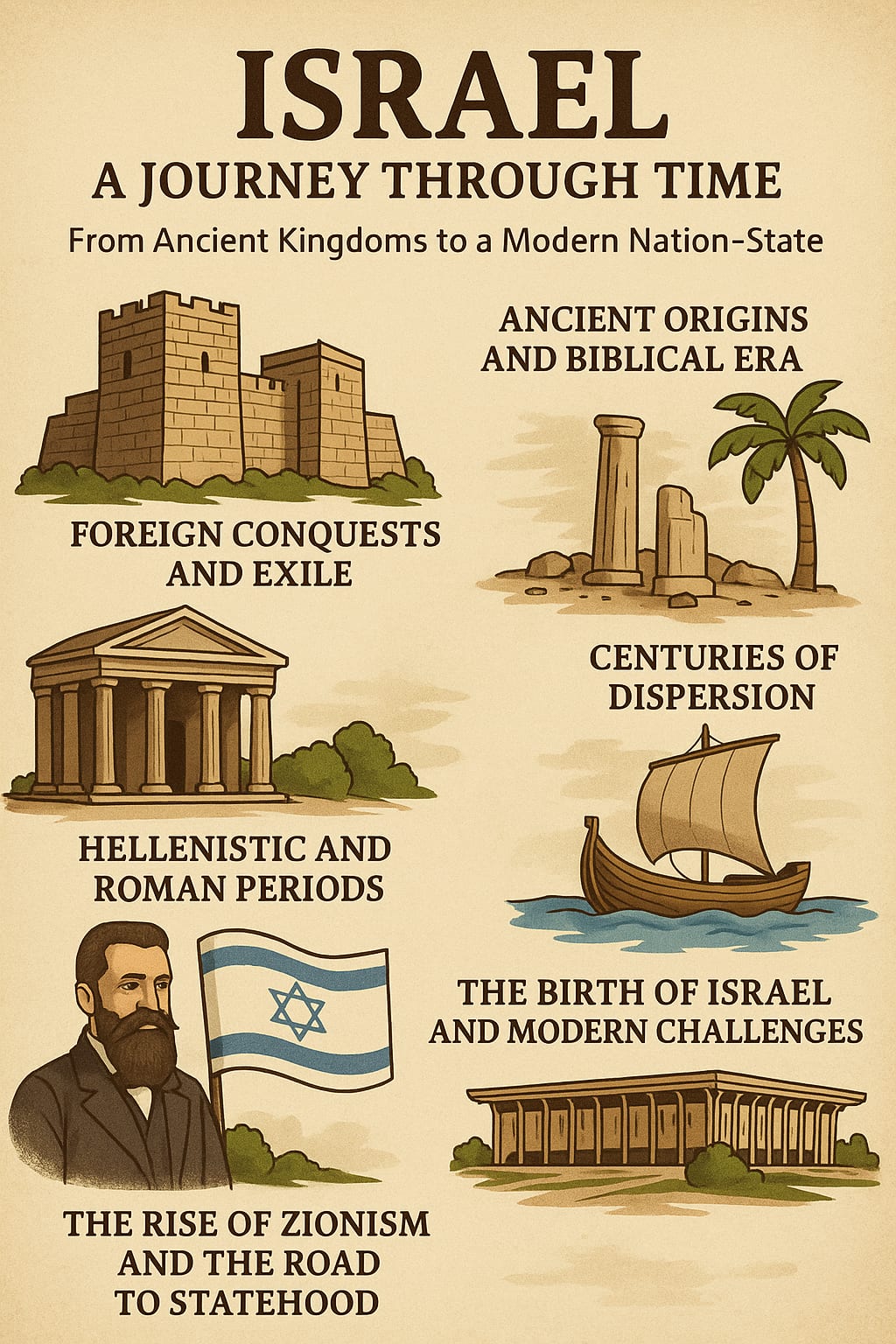
The history of Israel is one of the most complex and profound narratives in human civilization. Rooted in ancient traditions, religion, and conflict, Israel's story spans thousands of years, encompassing biblical legends, imperial conquests, diaspora, and the rebirth of a nation in the 20th century. This article explores Israel's historical evolution from ancient times to the present.
---
Ancient Origins and Biblical Era
The earliest records of Israel trace back to the Bronze Age, around 2000 BCE, when the patriarchs of Judaism—Abraham, Isaac, and Jacob—are believed to have lived. These figures, central to Jewish tradition, established the cultural and religious foundations of what would become the Israelite people.
Around 1200 BCE, the Israelites emerged as a distinct group in the region of Canaan, present-day Israel and Palestine. The biblical story describes their exodus from Egypt under the leadership of Moses and the eventual conquest of Canaan under Joshua. Whether myth or historical fact, these stories formed the cornerstone of Jewish identity.
By the 10th century BCE, the Kingdom of Israel was established under King Saul, followed by the reigns of King David and King Solomon. David made Jerusalem the capital, and Solomon built the First Temple, making the city a religious center. However, after Solomon’s death, the kingdom split into two: the northern Kingdom of Israel and the southern Kingdom of Judah.
---
Foreign Conquests and Exile
The divided kingdoms were vulnerable to foreign empires. In 722 BCE, the Assyrian Empire conquered the northern kingdom, leading to the dispersal of the so-called "Ten Lost Tribes of Israel." In 586 BCE, the Babylonians captured Judah, destroyed the First Temple, and exiled much of the Jewish population to Babylon.
This exile marked a turning point in Jewish history. Though displaced, the Jews maintained their identity, religious practices, and hope of return. In 538 BCE, the Persian king Cyrus the Great allowed Jews to return and rebuild the Temple, initiating the Second Temple period.
---
Hellenistic and Roman Periods
After Persia, the region fell under the control of Alexander the Great and his successors. During the Hellenistic period, tensions grew between traditional Jewish practices and Greek culture. In 167 BCE, the Maccabean Revolt led to a brief period of Jewish independence under the Hasmonean dynasty.
However, by 63 BCE, the Roman Empire had seized control. In 70 CE, after a Jewish revolt, the Romans destroyed the Second Temple—an event that deeply scarred the Jewish psyche. In 135 CE, following another failed revolt, Jews were expelled from Jerusalem, and the city was renamed Aelia Capitolina. This marked the beginning of the Jewish diaspora.
---
Centuries of Dispersion
For nearly 2,000 years, Jews lived in exile across Europe, North Africa, and the Middle East. They maintained religious and cultural ties to the Land of Israel, often facing discrimination, persecution, and expulsions. In many Jewish prayers and festivals, the longing for Zion (Jerusalem) remained central.
During the Middle Ages and the early modern period, various empires ruled the region, including the Byzantine, Islamic Caliphates, Crusaders, Mamluks, and Ottomans. Throughout this time, a small but continuous Jewish presence remained in the land.
---
The Rise of Zionism and the Road to Statehood
In the late 19th century, in response to rising anti-Semitism in Europe, a political movement called Zionism emerged, advocating for the return of Jews to their ancestral homeland. Founded by Theodor Herzl, the movement gained momentum, leading to waves of Jewish immigration to Ottoman Palestine.
After World War I, the British took control of Palestine under the Balfour Declaration of 1917, which supported a "national home for the Jewish people." Tensions grew between Jews and Arabs in the region, leading to violence and unrest.
Following the horrors of the Holocaust in World War II, international support for a Jewish state grew. In 1947, the United Nations proposed partitioning Palestine into Jewish and Arab states. The Jews accepted the plan, but the Arab states rejected it.
---
The Birth of Israel and Modern Challenges
On May 14, 1948, David Ben-Gurion declared the independence of the State of Israel. The very next day, neighboring Arab countries invaded, starting the first Arab-Israeli war. Israel survived and expanded its territory.
In the decades that followed, Israel fought multiple wars (1956, 1967, 1973) and signed peace treaties with Egypt (1979) and Jordan (1994). However, the Israeli-Palestinian conflict remains unresolved, with deep disputes over land, refugees, and mutual recognition.
---
Modern Israel: Innovation and Identity
Today, Israel is a thriving democracy and a hub of technology, science, and culture. Despite its small size, it has made significant contributions in agriculture, medicine, and cybersecurity. It is also a melting pot of Jewish communities from around the world, creating a rich, diverse society.
Yet, Israel continues to face internal divisions over religion, politics, and its future direction, as well as ongoing tensions with its neighbors. The struggle for peace remains a central challenge.
---
Conclusion
The history of Israel is a testament to resilience, faith, and determination. From ancient kingdoms to exile and return, from persecution to nationhood, Israel’s story is deeply interwoven with the broader history of humanity. It stands today not only as a modern state but also as a symbol of a people’s enduring connection to their land and their dreams.
About the Creator
NIAZ Muhammad
Storyteller at heart, explorer by mind. I write about life, history, mystery, and moments that spark thought. Join me on a journey through words!
Keep reading
More stories from NIAZ Muhammad and writers in History and other communities.
Pakistan: A Land of Diversity, Resilience, and Untapped Potential
Introduction Pakistan, officially known as the Islamic Republic of Pakistan, is a country that embodies a rich tapestry of history, culture, and resilience. Located in South Asia, bordered by India, Afghanistan, Iran, and China, with a coastline along the Arabian Sea, Pakistan stands as a unique nation carved out of the Indian subcontinent in 1947. Despite facing political, economic, and social challenges since its inception, Pakistan has remained a nation of immense strength, spirit, and potential.
By NIAZ Muhammad8 months ago in History
The Mysterious Arms Drop: When Weapons Fell from the Sky Over India
In the mid-1990s, one of the most mysterious and controversial arms smuggling operations in South Asia unfolded in dramatic fashion when a large cache of weapons literally fell from the sky in eastern India. The incident involved an aircraft traveling between Karachi and Dhaka, allegations of international intelligence links, and a clandestine mission that continues to raise questions about who was behind it and why.
By Irshad Abbasi about an hour ago in History




Comments
There are no comments for this story
Be the first to respond and start the conversation.