
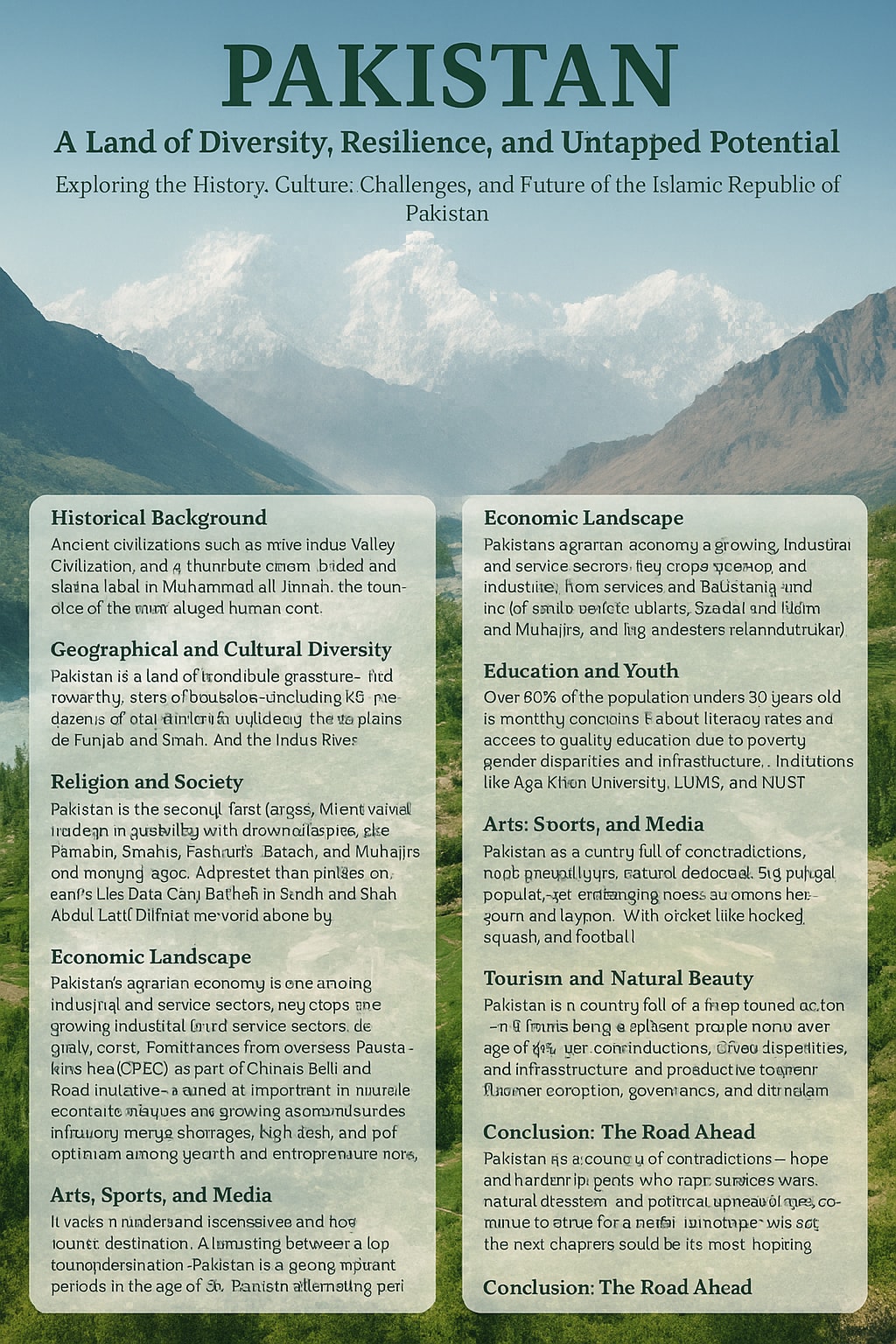
Pakistan: A Land of Diversity, Resilience, and Untapped Potential
Exploring the History, Culture, Challenges, and Future of the Islamic Republic of Pakistan
Introduction
Pakistan, officially known as the Islamic Republic of Pakistan, is a country that embodies a rich tapestry of history, culture, and resilience. Located in South Asia, bordered by India, Afghanistan, Iran, and China, with a coastline along the Arabian Sea, Pakistan stands as a unique nation carved out of the Indian subcontinent in 1947. Despite facing political, economic, and social challenges since its inception, Pakistan has remained a nation of immense strength, spirit, and potential.
---
Historical Background
The roots of Pakistan lie deep in the soil of ancient civilizations such as the Indus Valley Civilization, one of the world's oldest urban centers, which thrived around 2500 BCE in what is now Pakistan. The land has witnessed the rise and fall of great empires, including the Mauryas, Persians, Greeks under Alexander the Great, Mughals, and later the British Empire.
The concept of Pakistan was first articulated by philosopher and poet Allama Iqbal and brought into political reality by Muhammad Ali Jinnah, the founder of the nation. In 1947, Pakistan emerged as a separate homeland for Muslims of the subcontinent during the partition of British India. This creation came with great human cost — one of the largest mass migrations in human history — but also the hope of a new beginning.
---
Geographical and Cultural Diversity
Pakistan is a land of incredible geographical contrasts — from the towering peaks of the Karakoram and Himalayas in the north, including K2 (the world’s second-highest mountain), to the vast deserts of Thar in the south, and fertile plains of the Punjab and Sindh. The mighty Indus River runs through the country, giving life to agriculture and sustaining millions.
This geographical diversity is mirrored in its culture. Pakistan is a multi-ethnic, multilingual nation with a mosaic of traditions. The major ethnic groups include Punjabis, Sindhis, Pashtuns, Baloch, and Muhajirs, each with distinct languages, music, dress, and customs. Urdu is the national language, while English is widely used in education, law, and government. Other regional languages like Punjabi, Sindhi, Pashto, Balochi, and Saraiki are spoken across provinces.
---
Religion and Society
Pakistan is the second-largest Muslim country in the world, with Islam playing a central role in its national identity. The majority of Pakistanis are Sunni Muslims, with a significant Shia minority and smaller religious communities including Christians, Hindus, Sikhs, and others.
Despite religious diversity, interfaith harmony remains a challenge. However, Pakistan has also been home to great Islamic scholars, Sufi saints, and spiritual traditions that promote peace and coexistence. Shrines of famous saints like Data Ganj Bakhsh in Lahore and Shah Abdul Latif Bhittai in Sindh are visited by people of all backgrounds.
---
Economic Landscape
Pakistan's economy is one of the largest in the Islamic world. It is primarily agrarian but has growing industrial and service sectors. The country produces major crops like wheat, rice, cotton, and sugarcane. Key industries include textiles, cement, pharmaceuticals, and IT services.
Remittances from overseas Pakistanis play a vital role in the economy. The China-Pakistan Economic Corridor (CPEC), a major part of China’s Belt and Road Initiative, is aimed at improving infrastructure and trade, offering long-term economic opportunities.
Despite this potential, Pakistan faces significant economic hurdles: inflation, energy shortages, high debt, and political instability. However, there is growing optimism among the youth and entrepreneurs who are driving change through innovation and digital platforms.
---
Education and Youth
With over 60% of the population under the age of 30, Pakistan is a young nation with immense human capital. Education, however, remains a pressing concern. Literacy rates vary across provinces, and access to quality education is often limited by poverty, gender disparities, and infrastructure.
Nevertheless, efforts are being made to reform the education sector. Online learning, government programs, and private initiatives are helping bridge the gap. Institutions like the Aga Khan University, LUMS, and NUST are gaining international recognition.
---
Political Journey
Pakistan has experienced a turbulent political journey, alternating between military rule and democratic governance. Since its independence, the country has seen numerous coups, constitutional crises, and shifting alliances. Despite this, democratic institutions have gradually strengthened over time.
The judiciary, media, and civil society continue to play a growing role in promoting accountability and transparency. Challenges like corruption, governance, and freedom of expression remain, but the democratic process is still evolving.
---
Arts, Sports, and Media
Pakistan has a vibrant cultural scene. From classical poetry by Faiz Ahmed Faiz to contemporary literature, from Sufi music to modern pop, the country's artistic expressions are rich and diverse. Pakistani dramas and films are gaining international acclaim, as is the music scene with globally known artists like Nusrat Fateh Ali Khan, Abida Parveen, and Atif Aslam.
Cricket is a national obsession. The Pakistani cricket team has brought immense pride to the country, including winning the 1992 Cricket World Cup. Other sports like hockey, squash, and now even football are gaining popularity among the youth.
---
Tourism and Natural Beauty
Pakistan is increasingly being recognized as a top tourist destination. Foreign travelers are drawn to the scenic beauty of Swat Valley, Hunza, Skardu, and the historic cities of Lahore and Multan. The government’s recent visa reforms and improved security have opened the door for adventure tourism, heritage tours, and cultural exploration.
UNESCO World Heritage Sites like Mohenjo-Daro, Taxila, and Rohtas Fort showcase the ancient roots of this land.
---
Conclusion: The Road Ahead
Pakistan is a country full of contradictions — hope and hardship, tradition and modernity, challenges and opportunities. But above all, it is a nation of resilient people who have survived wars, natural disasters, and political upheaval, yet continue to strive for a better tomorrow.
With strategic reforms, investment in human capital, and the empowerment of its youth and women, Pakistan holds the promise of a bright future. The story of Pakistan is still being written — and the next chapters could be its most inspiring yet.
About the Creator
NIAZ Muhammad
Storyteller at heart, explorer by mind. I write about life, history, mystery, and moments that spark thought. Join me on a journey through words!
Keep reading
More stories from NIAZ Muhammad and writers in History and other communities.
Echoes of the Mountains: A Journey Through Afghanistan's Turbulent History
Nestled in the heart of Asia, surrounded by rugged mountains and ancient trade routes, Afghanistan is a land where history breathes through every stone and whisper of the wind. Its past is a tale of empires, invasions, resistance, and survival—a testament to the unbreakable spirit of its people.
By NIAZ Muhammad7 months ago in History
Military Strength of Alexander the Great and the Chola Empire: A Historical Comparison
Though separated by more than a thousand years and operating in vastly different geographical and cultural contexts, both forces achieved extraordinary success through discipline, innovation, and strategic brilliance. This article explores the history, composition, size, organization, and military strength of Alexander’s Macedonian army and the Chola military, highlighting how each became a dominant power of its era.
By Say the truth 4 days ago in History



Comments
There are no comments for this story
Be the first to respond and start the conversation.