
History of Europe
Ancient civilization to the modern Era
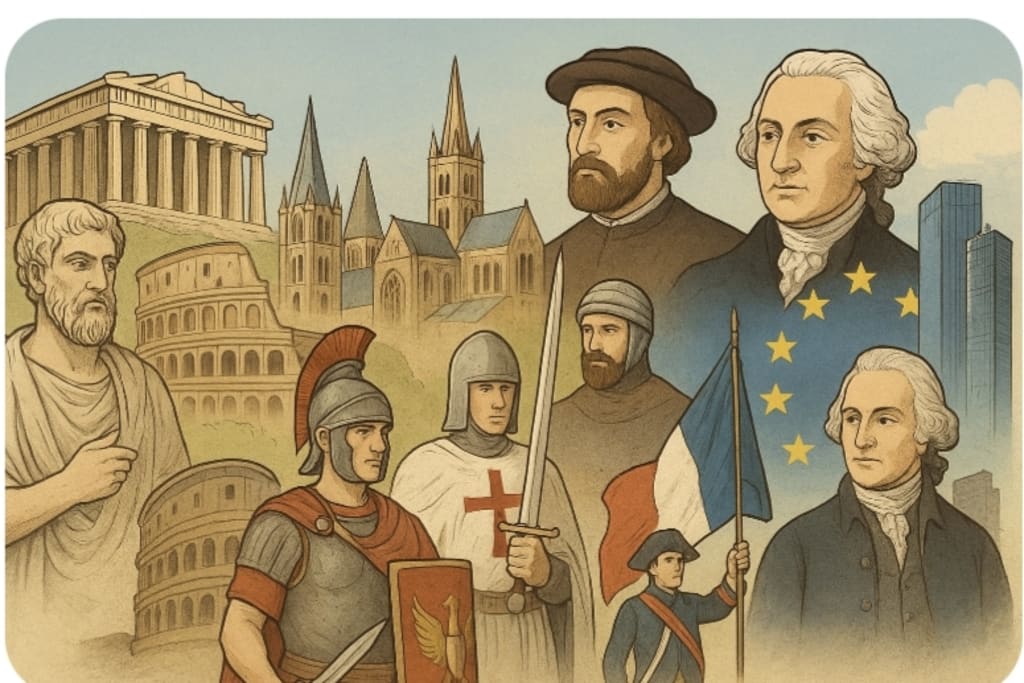
Europe, a continent rich in culture and history, has been a cradle of civilizations, revolutions, and ideas that shaped the world. Its history spans thousands of years, beginning with ancient peoples and empires, progressing through the Middle Ages, Renaissance, and Enlightenment, and culminating in the modern political and economic structures we know today. Europe’s story is one of resilience, transformation, and influence, leaving an enduring legacy across continents.
---
Ancient Europe: Foundations of Civilization
The history of Europe begins with prehistoric cultures and the spread of agriculture from the Near East around 7000 BCE. The Neolithic Revolution transformed European societies from nomadic hunters to settled farmers, laying the foundation for civilization. By the Bronze Age (c. 3000 BCE), advanced cultures arose, such as the Minoans on Crete and the Mycenaeans in Greece, who built palaces, traded extensively, and left behind myths that still resonate today.
One of the most influential civilizations was Ancient Greece (c. 800–146 BCE). The Greeks pioneered philosophy, democracy, drama, and science. City-states like Athens and Sparta became centers of political and cultural life. The Persian Wars and Peloponnesian Wars shaped Greek unity and rivalry, while philosophers such as Socrates, Plato, and Aristotle laid the groundwork for Western thought.
Meanwhile, Rome (509 BCE–476 CE) rose from a small city-state to a vast empire stretching across Europe, North Africa, and the Middle East. Roman engineering, law, and governance created lasting institutions. Latin, the Roman language, became the foundation for many European languages. Christianity, emerging from the Roman province of Judea, spread across the empire, becoming one of the most enduring legacies of Europe.
---
The Middle Ages: Transformation and Continuity
With the fall of the Western Roman Empire in 476 CE, Europe entered the Middle Ages (c. 500–1500 CE). Far from a “dark age,” this era was marked by significant transformations. Germanic kingdoms, such as the Franks under Charlemagne, rose to power. Charlemagne’s coronation as Holy Roman Emperor in 800 symbolized the fusion of Roman, Christian, and Germanic traditions.
Feudalism became the dominant system of governance, where land was exchanged for loyalty and military service. The Catholic Church wielded immense influence, guiding spiritual life and often politics. Monasteries preserved classical knowledge and became centers of learning.
This period also witnessed the Crusades (1096–1291), a series of religious wars aimed at reclaiming the Holy Land from Muslim control. While ultimately unsuccessful militarily, the Crusades opened cultural and economic exchanges between Europe and the East.
The High Middle Ages saw the rise of universities, Gothic cathedrals, and flourishing trade in cities like Venice and Genoa. By the Late Middle Ages, Europe was hit by crises, including the Black Death (1347–1351), which wiped out nearly a third of the population, and the Hundred Years’ War between England and France. These upheavals, however, paved the way for new beginnings.
---
The Renaissance and the Age of Discovery
The Renaissance (14th–17th centuries) began in Italy and spread across Europe, heralding a rebirth of art, science, and humanism. Thinkers and artists such as Leonardo da Vinci, Michelangelo, and Galileo revived classical learning and emphasized human potential. The invention of the printing press by Johannes Gutenberg around 1450 revolutionized knowledge by making books more accessible.
The Age of Discovery followed, driven by technological advancements in navigation. Explorers like Christopher Columbus, Vasco da Gama, and Ferdinand Magellan expanded Europe’s horizons, establishing contact with the Americas, Asia, and Africa. This era brought immense wealth but also initiated colonialism, slavery, and cultural encounters that reshaped global history.
---
The Reformation and Religious Conflicts
In the 16th century, the Protestant Reformation shook Europe’s religious unity. Martin Luther’s 95 Theses (1517) challenged Catholic practices, sparking movements that led to new denominations such as Lutheranism, Calvinism, and Anglicanism. The Catholic Church responded with the Counter-Reformation, reaffirming doctrine and reforming practices.
Religious conflicts engulfed Europe, including the Thirty Years’ War (1618–1648), which devastated much of Central Europe before ending with the Treaty of Westphalia. This treaty not only ended religious wars but also laid the foundation for modern state sovereignty.
---
The Enlightenment and Revolution
The Enlightenment (17th–18th centuries) marked a new intellectual era where reason, science, and individual rights were emphasized over tradition. Philosophers like Voltaire, Montesquieu, and Rousseau questioned monarchy, religion, and inequality. Their ideas inspired revolutions and democratic movements.
The French Revolution (1789) toppled monarchy, declaring liberty, equality, and fraternity as ideals. Across Europe, revolutionary and Napoleonic wars reshaped the political order. Napoleon Bonaparte spread revolutionary reforms, codified laws, and redrew borders, though his defeat in 1815 restored monarchies under the Congress of Vienna.
---
The Industrial Revolution and Nationalism
The Industrial Revolution (18th–19th centuries), beginning in Britain, transformed Europe economically and socially. Steam engines, factories, and railways revolutionized production and communication. Urbanization and technological progress created both prosperity and hardship, as workers faced long hours and poor conditions.
Meanwhile, nationalism swept across Europe. Italy and Germany, once fragmented, achieved unification in the 19th century. Empires like Austria-Hungary and the Ottoman Empire struggled with nationalist movements. Political ideologies such as liberalism, socialism, and conservatism emerged, shaping debates about governance and society.
---
The World Wars and Their Aftermath
The 20th century brought unprecedented upheaval. World War I (1914–1918) erupted from tensions between empires, alliances, and nationalism. The war devastated Europe, leading to millions of deaths and the collapse of monarchies in Germany, Russia, and Austria-Hungary. The Treaty of Versailles imposed harsh terms on Germany, sowing seeds of resentment.
World War II (1939–1945) was even more destructive. Nazi Germany, under Adolf Hitler, sought expansion and carried out the Holocaust, murdering six million Jews and millions of others. The war ended with Allied victory but left Europe in ruins and divided between Western democracies and Soviet communism.
---
The Cold War and European Integration
The Cold War (1947–1991) divided Europe into East and West. Western Europe, supported by the United States, embraced democracy and capitalism, while Eastern Europe fell under Soviet influence, with communist regimes. The Berlin Wall became the symbol of this division.
At the same time, efforts toward European integration began. The creation of the European Coal and Steel Community (1951) and later the European Economic Community (1957) laid the groundwork for the European Union (EU). Integration aimed to prevent future wars and promote economic growth.
The Cold War ended with the fall of the Berlin Wall in 1989 and the dissolution of the Soviet Union in 1991, marking a new chapter for Europe.
---
Modern Europe: Challenges and Achievements
Today, Europe is a continent of diverse nations bound together by history and shared institutions. The European Union, with its single market and common currency (the euro), represents a unique model of cooperation. NATO ensures collective security, while cultural exchange continues to flourish.
Yet challenges persist—economic crises, migration, terrorism, Brexit, and the war in Ukraine have tested European unity. Despite these struggles, Europe remains a beacon of cultural richness, scientific innovation, and democratic ideals.
---
Conclusion
The history of Europe is a story of transformation—from ancient empires and medieval kingdoms to revolutions, industrialization, and global influence. It has been marked by both conflict and cooperation, by devastating wars and remarkable achievements. Europe’s legacy is felt worldwide, in languages, laws, philosophies, and technologies.
As Europe continues to evolve, it carries with it lessons from its past: the importance of unity, the dangers of division, and the enduring value of human creativity and resilience.
About the Creator
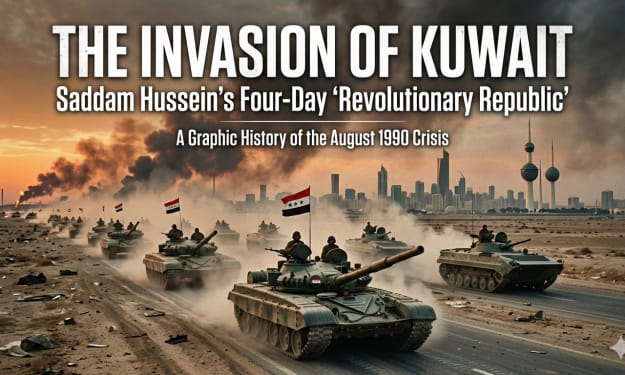
The Invasion of Kuwait: Saddam’s Four-Day ‘Revolutionary Republic
On August 2, 1990, the world woke up to a geopolitical earthquake. Under the orders of Saddam Hussein, over 100,000 Iraqi troops, backed by hundreds of tanks, surged across the border into the tiny, oil-rich emirate of Kuwait. While history remembers this as the spark for the Gulf War, the first few days of the occupation featured a bizarre political theater: the creation of a short-lived puppet state known as the **"Republic of Kuwait."**
By Irshad Abbasi 6 days ago in History
Lycan Lore
As the students of my 10am mythology class take their seats, I decide to steer the day's curriculum away from Greek and dive into a Western European discourse on the misaligned beliefs of the Werewolf. A tale of truth or fiction. No one really knows.
By Lamar Wigginsabout 10 hours ago in Fiction


Comments (1)
Love it very informative 🌸😊🌞