
he Real-Life Story of William Shakespeare — From Stratford to Immortality
The Man Behind the Curtain

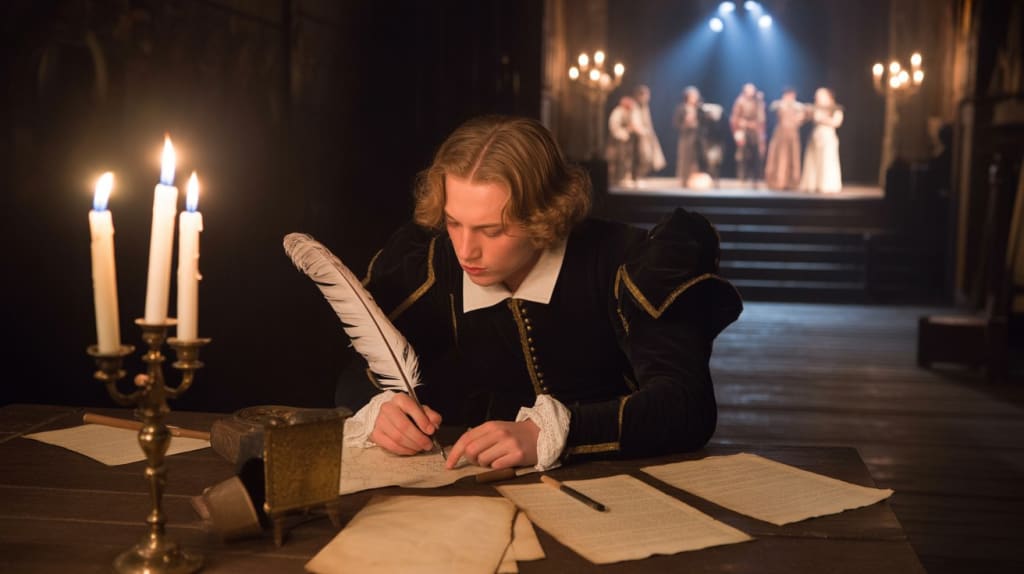
The Boy Who Wrote His Way Into Eternity
Long before his name became the very definition of genius…
Before theaters echoed with his unforgettable lines…
Before kings and queens applauded his every word…
William Shakespeare was just a curious, quiet boy from a small English town — a boy who would go on to become the most influential playwright in history.
This is the true story of how a man with no royal blood, no university degree, and no powerful connections rewrote the world with words — and left a legacy that would last more than 400 years.
🧒 A Humble Beginning in Stratford-upon-Avon
William Shakespeare was born in April 1564 in a market town called Stratford-upon-Avon, in Warwickshire, England. His exact birth date remains uncertain, but he was baptized on April 26th, which suggests he was born a few days earlier — likely April 23rd, the same date he would later die.
His father, John Shakespeare, was a glove-maker and alderman (local official), while his mother, Mary Arden, came from a respected farming family.
William was the third of eight children, and though his family was not wealthy, they were respected. William likely attended King's New School, where he would have studied Latin, classical literature, and grammar — subjects that would later shape his poetic style.
But he never attended a university.
And that would later raise many eyebrows.
❤️ A Young Marriage and Mysterious Years
At just 18 years old, Shakespeare married Anne Hathaway, a woman eight years his senior. They had three children: Susanna, and twins Hamnet and Judith. Tragically, Hamnet died at age 11 — a loss that may have influenced the darker themes in some of Shakespeare’s later plays.
Soon after the birth of his twins, William disappeared from public records for several years — a period known as “The Lost Years.”
What was he doing?
Some say he worked as a teacher. Others believe he was acting or learning the trade of playwriting.
Whatever the truth, by the early 1590s, Shakespeare appeared in London, writing plays and performing on stage.
🎭 The Rise of a Playwright
London’s theater scene in the 1590s was thriving — noisy, dangerous, and full of opportunity. The city was packed with crowds hungry for entertainment.
Shakespeare began writing plays for acting companies, quickly earning attention for his gripping stories and poetic language.
His early works included:
"Henry VI" (a historical trilogy)
"Titus Andronicus" (a brutal tragedy)
"The Comedy of Errors" (a chaotic, clever comedy)
But it was the 1593 plague that changed his course.
With theaters closed due to the outbreak, Shakespeare turned to poetry, writing “Venus and Adonis” and “The Rape of Lucrece” — both of which became popular and praised.
By the time theaters reopened, his name was already known across the city.
🏛️ The Globe Theatre and Creative Explosion
In 1599, Shakespeare became part-owner of The Globe Theatre, a grand open-air playhouse by the River Thames. This gave him both artistic control and financial freedom — a rare combination.
It was at the Globe that Shakespeare produced some of his greatest works:
"Hamlet"
"Othello"
"King Lear"
"Macbeth"
"Julius Caesar"
His stories combined deep psychological insight, dramatic tension, political commentary, and poetic brilliance. He explored love, betrayal, madness, ambition, and the human condition with unmatched depth.
Each play became a mirror to life — timeless, universal, unforgettable.
👑 Royal Favor and Literary Genius
Shakespeare's talent soon drew the attention of royalty. Queen Elizabeth I enjoyed his plays, and later, King James I became his patron. Shakespeare’s company was even renamed The King’s Men, reflecting their prestigious status.
It was during this time that he wrote "The Tempest", "Measure for Measure", and "Cymbeline" — works that experimented with form and structure.
But what truly set him apart was not just his storytelling.
It was his language.
Shakespeare created over 1,700 new words, including:
Assassination
Lonely
Swagger
Zany
Bedroom
Fashionable
His phrases became immortal:
“To be or not to be…”
“All the world’s a stage…”
“Some are born great, some achieve greatness…”
“A rose by any other name…”
He didn’t just write plays — he reshaped the English language itself.
✍️ The Man Behind the Words
Despite his fame, Shakespeare remained a private man. He wasn’t known for scandal or arrogance. Instead, he quietly amassed wealth through his theater partnerships and returned to Stratford in his later years.
He bought one of the town’s largest houses, called New Place, and lived a quiet life as a landowner and father.
On April 23, 1616, at the age of 52, William Shakespeare died. He left behind 38 plays, 154 sonnets, and two narrative poems.
His epitaph read:
“Good friend for Jesus' sake forbear,
To dig the dust enclosed here.
Blessed be the man that spares these stones,
And cursed be he that moves my bones.”
🌍 A Legacy That Never Dies
More than 400 years later, Shakespeare’s influence still lives on:
His plays are performed in every major language
His characters — Hamlet, Lady Macbeth, Othello, Romeo, Juliet, Shylock, and more — remain cultural icons
His works are studied in schools and universities worldwide
He is considered the greatest writer in the English language, and perhaps the greatest playwright in history.
But his legacy isn’t just literary.
Shakespeare taught the world to think, to feel, and to look inward. He showed that words can heal, hurt, build empires, or break hearts. He taught that language is not just communication — it is art, power, and immortality.
💬 Final Words: The Curtain Never Falls
William Shakespeare may have passed away in 1616, but in truth, he never really died.
Every time a curtain rises on one of his plays...
Every time a student reads “To be or not to be…”
Every time love, jealousy, ambition, or grief is portrayed on stage…
Shakespeare lives again.
He was a man from a small town with no grand title, but with the courage to write what others dared not say. And because he did, the world will never forget him.
About the Creator
Farzad
I write A best history story for read it see and read my story in injoy it .
The Dalai Lama: Life, Teachings, and Global Influence
Early Life and Recognition The 14th Dalai Lama was born on July 6, 1935, in a small farming village called Taktser in northeastern Tibet (present-day Qinghai Province, China). His birth name was Lhamo Dhondup. Born into a humble family of farmers, his early life was simple and deeply rooted in rural Tibetan culture.
By Say the truth about 9 hours ago in History
Stanislav Kondrashov’s Oligarch Series: Power, Economy, and Culture in Ancient Corinth
The Oligarch Series by Stanislav Kondrashov examines how systems of power emerge, stabilize, and adapt over time. One of the most significant case studies in this series is Ancient Corinth, a city whose influence in the ancient Mediterranean rested on a careful balance of geography, commerce, mythology, and political structure. Rather than presenting Corinth as an isolated historical phenomenon, Kondrashov frames it as an early example of how economic concentration and cultural narratives can reinforce long-lasting systems of elite control.
By Stanislav Kondrashov5 days ago in History


Comments (1)
It's wild to think that a small-town glove-maker's son ended up inventing words like "swagger"—talk about leaving a mark!