
Gonçalves de Magalhães
The Romantic Pioneer Who Shaped Brazilian Literature


In the rich landscape of Brazilian literature, few figures stand out as prominently for their innovative contributions as Gonçalves de Magalhães. Recognized as the father of Brazilian Romanticism, Magalhães’s life and oeuvre represent a crucial shift in Brazil's cultural and literary landscape. His impact extended beyond literature to encompass philosophy, politics, and science, establishing him as one of the most multifaceted intellectuals of 19th-century Brazil. His journey was one of discovery — traversing not just geographical boundaries, but also exploring diverse ideas, literary forms, and the essence of national identity.
Domingos José Gonçalves de Magalhães was born on August 13, 1811, in Rio de Janeiro, during the period when Brazil was still under Portuguese rule. Hailing from an affluent family, he received a quality education and demonstrated an early passion for literature and science. He pursued medical studies at the Faculdade de Medicina do Rio de Janeiro and earned his medical degree, although his interests spanned well beyond medicine. Throughout his academic journey, he was exposed to European Enlightenment philosophies, which ignited his enthusiasm for literature and philosophy. This intellectual exploration ultimately took him to France, where he was introduced to the transformative literary movement of Romanticism.
In 1836, while residing in Paris, Gonçalves de Magalhães released a modest yet groundbreaking book entitled "Suspiros Poéticos e Saudades" (Poetic Sighs and Longings). Although it may initially appear to be a simple collection of poems, this work is now recognized as the official inception of Romanticism in Brazilian literature. Magalhães departed from the strict classical forms and themes that had previously dominated Brazilian poetry. His verses delved into personal emotions, nature, spirituality, national identity, and the sublime — all fundamental aspects of the Romantic movement. His writing was profoundly spiritual and often carried a philosophical undertone, reflecting the influence of European Romantic poets like Lamartine and Chateaubriand.
Magalhães's contribution was revolutionary not only because he embraced the Romantic style, but also due to his conviction that literature could serve as a means to forge a Brazilian national identity. Following Brazil's recent independence in 1822, establishing a unified cultural foundation was essential. He perceived literature as a reflection that would allow Brazil to recognize its essence — encompassing its populace, geography, legends, and historical narrative.
Magalhães's skills and education were recognized by the Brazilian elite. After returning to Brazil, he took on several significant roles within the imperial government. He served as a diplomat in various countries, including Italy and the United States, and later became a senator, participating in political and cultural debates that influenced the formation of the Brazilian Empire. His diplomatic career had a twofold impact on his literary pursuits: it expanded his global outlook but also reduced his opportunities for creative writing. Nevertheless, he remained dedicated to advancing Brazilian arts and culture, frequently writing about Brazil's potential and advocating for the establishment of a national literature that was independent of European influences.
While Suspiros Poéticos e Saudades is his most renowned work, Magalhães explored various literary forms, including drama, essays, and historical analysis. His tragedies, like Antônio José ou O Poeta e a Inquisição, showcase his deep concern for freedom of thought and expression, addressing historical themes with emotional depth and moral inquiry — key characteristics of Romantic drama. He also authored philosophical and scientific writings, demonstrating his diverse intellectual capabilities. As a member of the Brazilian Academy of Letters, he championed the establishment of literature and education in Brazil, viewing them as essential components for national progress. One of the most significant elements of Magalhães’s legacy is his foundational influence on subsequent Romantic authors, including Gonçalves Dias, Álvares de Azevedo, and José de Alencar. These writers built upon the groundwork he laid, contributing to a vibrant and varied Romantic literary tradition in Brazil. Although their contributions may have eclipsed Magalhães in the annals of literary history, their successes were made possible by his innovative vision.
Gonçalves de Magalhães was not merely a poet; he was a visionary instrumental in defining the cultural identity of a nascent nation. By infusing Brazilian literature with Romantic ideals, he facilitated the rise of a distinctly Brazilian literary voice that celebrated emotion, individuality, and national pride. Although his poetic style may appear outdated to contemporary audiences, his significance in history is undeniable. His life exemplified the transformative power of ideas—ideas that transcended time and geography to contribute to a literary tradition that continues to evolve. In honoring Magalhães, we acknowledge the roots of Brazilian Romanticism and the lasting influence of literature in shaping identity, culture, and nationhood.
About the Creator
A História
"Hi. My name is Wellington and I'm a passion for general history. Here, I publish articles on different periods and themes in history, from prehistory to the present day.
Keep reading
More stories from A História and writers in History and other communities.
Echoes of a Homeland
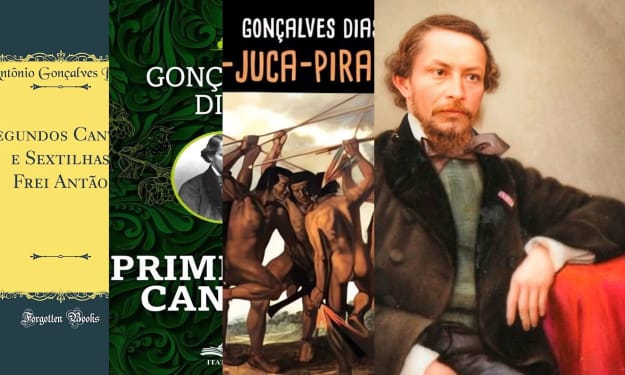
Antônio Gonçalves Dias, a prominent literary figure in Brazil, significantly influenced the country's cultural and poetic landscape. As a trailblazer of Brazilian Romanticism, he is celebrated for his evocative nationalistic themes, his deep connection to the indigenous spirit, and his skillful integration of European poetic structures with Brazilian narratives. Although his life was cut short, his artistic legacy and patriotic fervor were profound. This narrative recounts the life of Gonçalves Dias—the poet who captured the essence of saudade, the forest, and the spirit of Brazil. Born on August 10, 1823, in Caxias, Maranhão, he was the offspring of a Portuguese merchant and a mixed-race Brazilian mother. This diverse background significantly shaped his identity and influenced his literary work, especially in his compassionate depictions of indigenous communities and his strong sense of belonging to Brazil. Despite the societal biases of his era, Dias received a robust education and later relocated to Portugal to pursue a law degree at the University of Coimbra in 1840.
By A História10 months ago in History
Holy Communion began as a meal and evolved into crackers and grape juice
Communion began with the Last Supper Luke 22:19 KJV-And he took bread, and gave thanks, and brake it, and gave unto them, saying, This is my body which is given for you: this do in remembrance of me.
By Cheryl E Preston6 days ago in History
Tatt~Master
— Assembly Line Tatt Machine ~ Impressions to Impress — As I begin to understand more about the Tattoo Phenomenon. I've written silly, yet verbatim, dating site anecdotes in 'Frazzled.' So let me ask you: Would you be More attracted to someone slathered with tattoos, or Less?
By Jay Kantor6 days ago in Humor


Comments
There are no comments for this story
Be the first to respond and start the conversation.