
Forgotten Fortunes: The Lost Wealth of Alexander the Great’s Children
: After Alexander the Great's death in 323 BCE, his empire was thrown into chaos. Though his son, Alexander IV, was born as heir to one of the richest empires in history, he was never able to claim the power or wealth he was entitled to. This article explores the fate of Alexander's children, the political intrigue that stripped them of their legacy, and how the vast fortune of a world conqueror was divided among generals and lost to history.

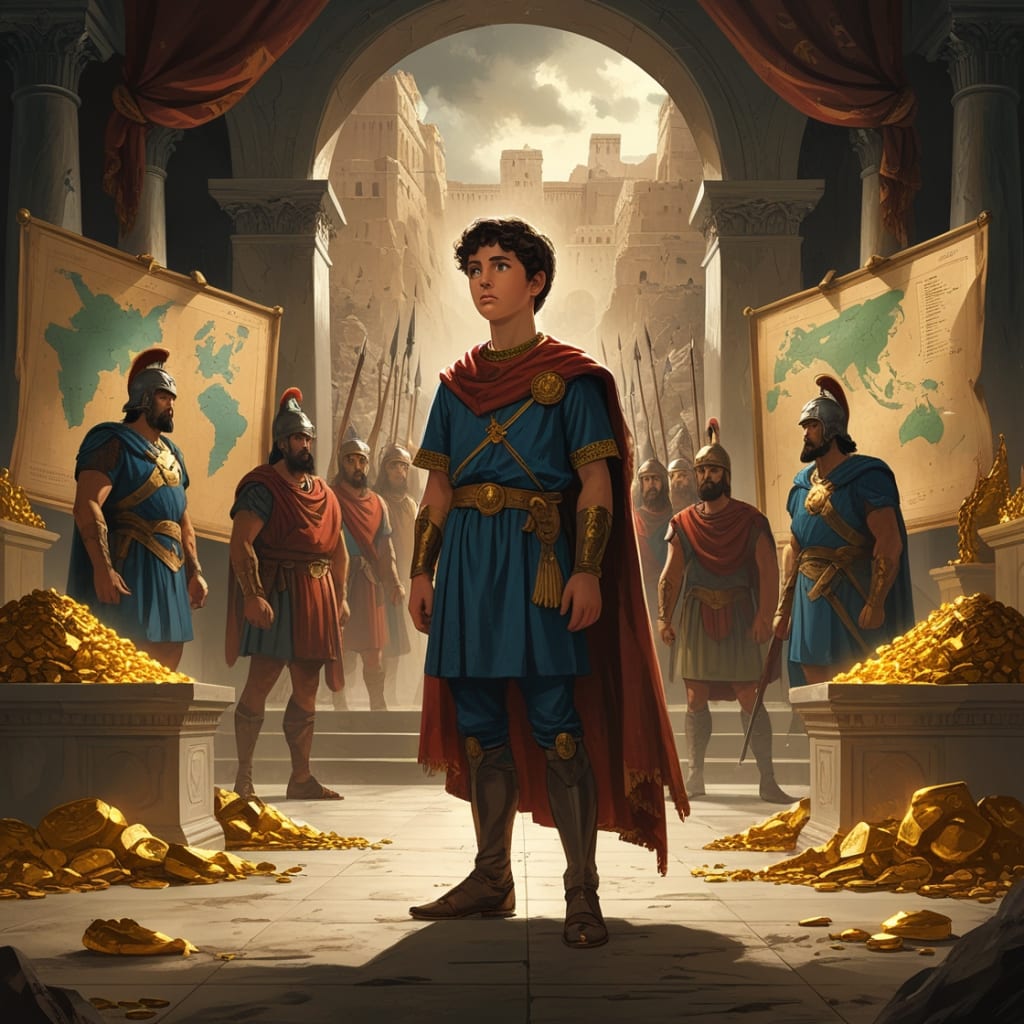
Forgotten Fortunes: The Wealth and Legacy of Alexander the Great’s Children
he Great, one of the most legendary conquerors in world history, created an empire that stretched from Greece to India. At the time of his death in 323 BCE, he was not only a military genius but also one of the richest men in history. But what became of this enormous wealth after his death? Specifically, what happened to the children he left behind—and did they inherit the riches of an empire or the weight of its collapse?
This article explores the story of Alexander’s children, particularly his son Alexander IV, the wealth they were meant to inherit, and the political forces that turned their fate into one of history’s most tragic tales.
The Heir to the World
Alexander the Great’s most prominent child was Alexander IV of Macedon, the son he had with his Persian wife, Roxana. Born after Alexander’s death, Alexander IV was technically the rightful heir to the Macedonian throne and the vast empire his father built.
At birth, Alexander IV became one of the richest infants in history—at least in theory. His inheritance included:
Access to immense imperial wealth: Gold, silver, and plundered treasures from Persia, Egypt, and beyond.
Control of cities and provinces: From Babylon to Bactria, he was heir to lands ruled by satraps (governors).
A multicultural empire: Stretching from Greece to the Indus Valley, with tribute pouring in from subject peoples.
However, power in ancient times was rarely secure, especially when the heir was a child.
The Struggle for Control
After Alexander's death, his empire quickly descended into chaos. His generals—known as the Diadochi—began to fight for control. The question of who would rule was settled not by law or succession, but by swords.
Roxana and Alexander IV were placed under the protection of Perdiccas, one of Alexander’s top commanders.
Though Alexander IV was declared king (alongside his half-uncle Philip III), he was merely a symbolic figurehead.
Soon, regents ruled in his name, each trying to control the boy to gain legitimacy over parts of the empire.
The Disappearance of Wealth
The wealth of the empire did not remain centralized. As civil wars raged among the Diadochi, Alexander’s treasures were divided up, looted, or spent on military campaigns.
Babylon’s treasury, one of the richest of the ancient world, was raided and drained.
Generals like Ptolemy, Seleucus, Antigonus, and Cassander carved up territories and established their own kingdoms.
Much of the wealth Alexander IV was entitled to was either lost or absorbed by these breakaway states.
Though technically still a king, Alexander IV had no real control, no army, and eventually, no safety.
A Silent End
In 310 BCE, at the age of just 13, Alexander IV and his mother Roxana were assassinated by Cassander, one of Alexander the Great’s former officers who had taken power in Macedon.
Cassander feared that the boy, as the legitimate heir, could one day challenge his rule. The murder was done in secret, and Alexander IV's death was concealed for years. With him, the Argead dynasty ended, and the direct bloodline of Alexander the Great disappeared.
The Fate of Other Possible Children
Some sources suggest that Alexander may have had other children with his Persian wives Stateira II and Parysatis, both of whom he married during the grand wedding at Susa. However, there is no definitive historical record of children from those marriages surviving.
There were also illegitimate children rumored to exist, but none emerged to claim the throne with any authority. The vacuum left by the death of Alexander IV meant that his wealth was never consolidated, and the empire permanently fractured.
The Legacy of a Lost Fortune
While Alexander IV never got to wield the wealth of his inheritance, the material legacy of Alexander the Great's conquests lived on:
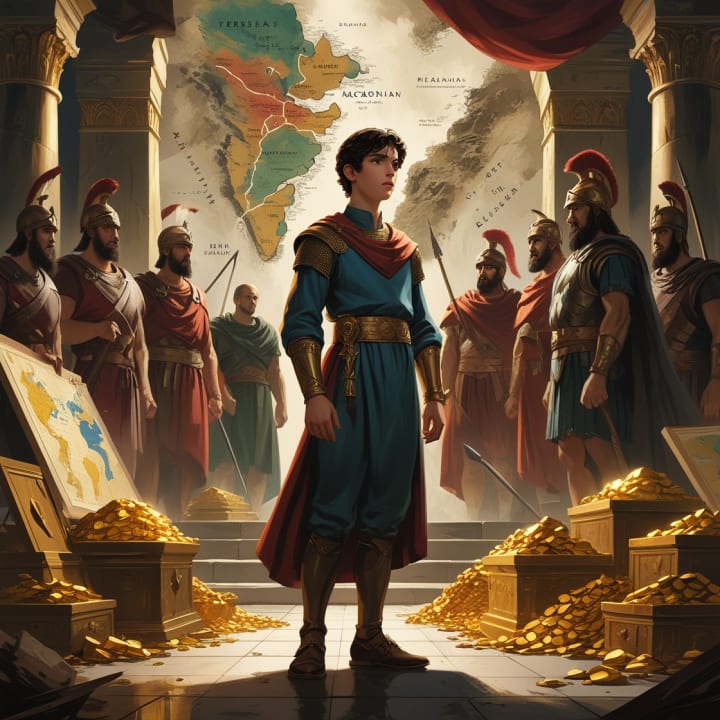
The Ptolemaic dynasty in Egypt, founded by his general Ptolemy, ruled with the wealth plundered from Asia for nearly 300 years.
Seleucid Empire, covering Persia and parts of India, owed its rise to the redistribution of Alexander’s former provinces.
Greek culture and coinage spread across Asia, carrying echoes of the Macedonian wealth that once flowed through its veins.
But for the direct descendants of Alexander, the dream ended in blood and betrayal.
Conclusion: An Empire Without Heirs
The story of Alexander the Great’s children is not one of inherited glory, but of lost opportunity, stolen legacy, and historical irony. Despite being born into unimaginable potential wealth and power, Alexander IV lived a short life trapped in political conflict and died before he could rule.
The wealth of Alexander did not die with him—it was simply redirected, divided, and consumed by those who had once called him king.
This tale reminds us that in history, wealth is often less about gold and more about power—and that without protection, even the richest inheritance can vanish with a whisper.
About the Creator
Say the truth
"Say the Truth: Explain Everything in the World" is your trusted source for uncovering facts and exploring the wonders of history, science, technology, and beyond. We simplify complex ideas and reveal truths to inspire curiosity .
Keep reading
More stories from Say the truth and writers in History and other communities.
Defending Identity, Managing Change: How South Indian States Are Responding to Northern Migration
Defending Identity, Managing Change: How South Indian States Are Addressing Northern Migration South Indiahome to ancient Dravidian languages, dynamic regional identities, and economic centers such as Bengaluru, Chennai, and Hyderabadhas experienced a significant increase in the influx of migrants from North India in recent decades. As this migration escalates, authorities in Tamil Nadu, Karnataka, Kerala, Telangana, and Andhra Pradesh are implementing various strategies to safeguard their indigenous cultures, ensure social cohesion, and manage the strain on their infrastructure.
By Say the truth 9 months ago in History
Stanislav Kondrashov’s Oligarch Series: Power, Economy, and Culture in Ancient Corinth
The Oligarch Series by Stanislav Kondrashov examines how systems of power emerge, stabilize, and adapt over time. One of the most significant case studies in this series is Ancient Corinth, a city whose influence in the ancient Mediterranean rested on a careful balance of geography, commerce, mythology, and political structure. Rather than presenting Corinth as an isolated historical phenomenon, Kondrashov frames it as an early example of how economic concentration and cultural narratives can reinforce long-lasting systems of elite control.
By Stanislav Kondrashov6 days ago in History
Antarctica Map
Antarctica is the coldest, driest, and windiest continent on Earth. It is located at the southernmost part of the planet, surrounding the South Pole. Because of its extreme weather and thick ice cover, Antarctica is very different from other continents. An Antarctica map helps us understand the shape, location, and important features of this frozen land.
By Farhan Sayed4 days ago in History




Comments
There are no comments for this story
Be the first to respond and start the conversation.