
Evolving Native and Ancient Languages for Preservation
Reviving the True Name of God Through Language

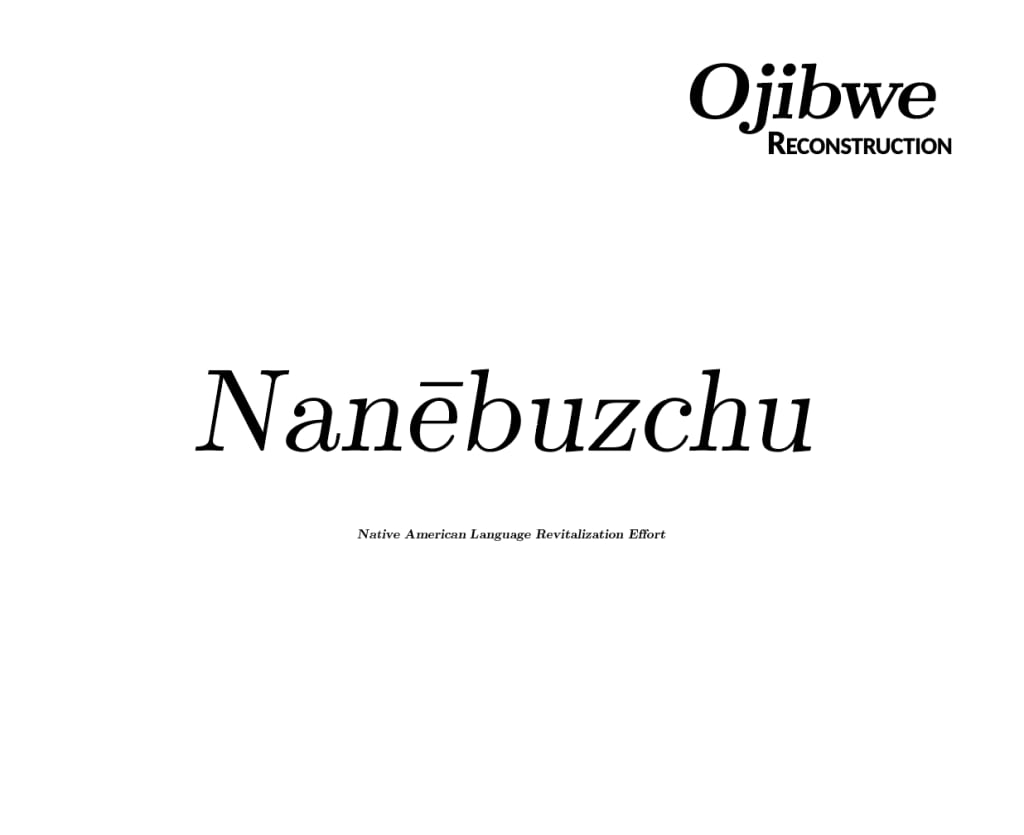
Efforts to overly preserve or "freeze" a language in time often lead to its decline. A language that cannot adapt risks becoming a museum artifact, studied but not spoken.
With a deep grasp of human cognition and an awareness of the ways people have communicated over millennia, I once aspired to reconstruct and unify the diverse languages of Native American cultures. Yet, with countless other pursuits demanding my interests and attention due to the relevancy, the project has remained dormant for years.
This is an example of how modernization can breathe life into these languages by facilitating common ground, ensuring their relevance in contemporary contexts:
What I dislike about Native American languages is the poor structure they were given, as no one seemed to care enough to refine them. These languages are beautiful but appear awkward when written—and not in a "good ugly" way like German.
For example, Niin gikendaan Anishinaabemowin is a phrase I wouldn’t dare to attempt pronouncing. If you want a language to survive, it must adapt to the area in which it’s spoken, or else it risks being lost in translation. In some cases, preservation efforts can do more harm than many realize.
Take "Anish," which I often hear people mispronounce as aneesh instead of onish, which really either or because language is dictated by which is easier to pronounce when talking. It should be streamlined to Anisch, as the "sch" naturally implies a balanced pronunciation. Similarly, anishinaabe is overwhelming for many speakers, particularly—inaabe, where enābē is sufficient enough and easier to understand.
Suffixes need to modernized in an elegant but simple way; you want to steer clear of overly complex terms, like rechtsschutzversicherungsgesellschaften, which is not unlike our own: antidisentablishmentarianism.
Most of that you skipped right over one or the other or both. You don't care because it was too much, and that is exactly what they will do to your respective languages which you wish to preserve.
Simplifications must be made to these languages to become more approachable. For example:
Niin is simply Nīn, and gikendaan which can have an overwhelming number of interpretations can be simplified to gicandān.
Which allows for something a bit complex for those unfamiliar, which causes: Niin gikendaan Anishinaabemowin
—to be more mentally pronounceable as: Nīn gicandān Anischenābē(mōen)
Say what you will, but I will not say Boozhoo simply because it reminds me of the word: booze, bozo, bonjour, and achoo, which makes it a very unappealing word, and I feel like that may have been intentional.
Therefore: Beūschū or Būzchū to modernize Boozhoo.
Unfortunately, Nanaboozhoo appears to have been transcribed by missionaries, and the evidence of dissatisfaction is the intentional distancing from it into Nanabozho. Which, I recommend: Nanubeūschū , Nanēbūzchū, or Nanābūzchū.
What you also need to understand is that accents, diacritics, or any marks attached to Latin characters will almost always disappear unless their absence affects the overall appearance. This would turn Nannēbeūschū into Nannebeuschu, and Nanēbūzchū into Nanēbuzchu.
Personally, if it were up to me, I would choose Nanēbuzchu. If you're concerned about the exact pronunciation, my last name is correctly pronounced LADY, then Lah-tee, and finally Leh-tee. Communication and understanding are all that matter in language; but let's discuss some changes we humans have made.
Why does it have to be done this way? Standards, understandings, and just how we think and perceive jumbles of information. Here is a quick lesson from the last two thousand years, and why it is important to keep these records:
Ueni, uidi, uici became Veni, vidi, vici, shifting from "weni, widi, wiki" to "ve-ni, vi-di, vi-ki," and, much later, vi-chi which reflects Italianate pronunciation. If you were Deutsch, you'd would pronounce it "feni, fidi, fichi"
Jove was originally pronounced as Yohweh and spelled IOVE, derived from DJOVIS to DJOVS to JOVS to JOVE (similiar to how Dyeus became Dious then Diovs then Dios/Deva/Diva) PATER, which itself came from DYOUS PITAR.
You do not have to believe investigative evidence and logic, I do not wish to convert anyone to anything.
This evolved into Jove, Jehovah, and Iohveh in various regions, eventually becoming YHWH as a shared deity during Polytheistic Judaism, at a time when the Roman Pantheon welcomed all gods: Dios Padre, Deus Pater, Zeus Pater (Dzeus), Dyaus Pitar (Vedic), Jupiter, Dyeus Phtr, Jehovah, and Tiw Thor.
It's undeniable that Jove can be transliterated to Hebrew, and from other ancient languages which would have matched identically to YHWH due to the issue of their vowels. Though, Yohweh and Yahweh are not far off. People get lost in classifications and walls which they made themselves.
The ancient world shared many things such as Dyaus Pitar being a primordial Hindu God along with Agni Deva, and Dyeus Pater being the primordial Greek, Judean, and Italic gods along with Agnus Dei, or its vocative form: Agni Dei. Dei comes from Dyeus/Deus, just like how Deva came from Deus.
Imagine if you will, a v for a u and suddenly you have Devs.
Ju in Jupiter quite literally means "Sky" or "Heavenly," to as simple as simply "God," due to the corruption from Deus/Dyeus. Piter means father, which when combined both mean simply God the Father, and Heavenly Father. Iupiter transformed into Jupiter.
Had we preserved the ancient pronunciations, the Vatican would now be situated on Watican Hill.
PRŒLIUM became Proelium, and later refined into Prolium, while remaining relatively consistent as proh-lee-um.
CONSERVATORIBVS evolved into Conservatorbus. However, bus would have fallen off and would have been simplified into a Conservator of Everything, or perhaps it would have been renamed to Purist.
Caeser, pronounced Kaiser, eventually became Ceaser (Seizer).
Caelum, pronounced kai-loom, transformed into Cœlum, pronounced che-lum.
There are countless layers to Latin's evolution over the last two thousand years. You could pronounce words almost any way that aligns with established guidelines, and it would still be correct in the context of a particular time and place.
However, this is how you keep a language alive for two thousand years. I cannot take this on, but this should give someone the necessary understanding to do it themselves.
About the Creator
Andrew Lehti
Andrew Lehti, a researcher, delves into human cognition through cognitive psychology, science (maths,) and linguistics, interwoven with their histories and philosophies—his 30,000+ hours of dedicated study stand in place of entertainment.
Keep reading
More stories from Andrew Lehti and writers in History and other communities.
My Inspiration for Life
When I set out to understand human cognition and why humans were the way they were, I first applied this understanding to a very small slice shaped by my own biased perception. Over more than a decade of investigation, introspection, meta-cognition, and behavioral analyses, I found myself not on the opposite aisle, but on an empty overpass overlooking two massive chasms mislabeled as such. Between these two aisles, an infinitely smaller fenced-in area which bore the sign that read “Individuality.”
By Andrew Lehtiabout a year ago in Motivation
Sultan Mehmed II: The Conquest of Constantinople That Europe Never Forgot
In the spring of 1453, one of the most dramatic moments in world history unfolded when Sultan Mehmed II captured the great city of Constantinople. This event did not simply mark the fall of a city; it ended the thousand-year-old Byzantine Empire and transformed the balance of power between Europe and the Muslim world. Even centuries later, the conquest remains one of the most significant turning points in global history.
By Irshad Abbasi 2 days ago in History
Guard Your Battery
Why are some people so attractive just by standing there? It’s not because they are "likable," but because they don’t need everyone to like them. I realized later that truly charismatic people allow themselves to be criticized, but they never criticize themselves. They never try to please the world; instead, the world stops to watch them.
By Emily Chan - Life and love sharing3 days ago in Poets



Comments
There are no comments for this story
Be the first to respond and start the conversation.