
EPISODE IX – THE SKULLS AND THE SCHOLARS: The Birth of America’s Secret Power Networks
THE REPUBLIC CHRONICLES

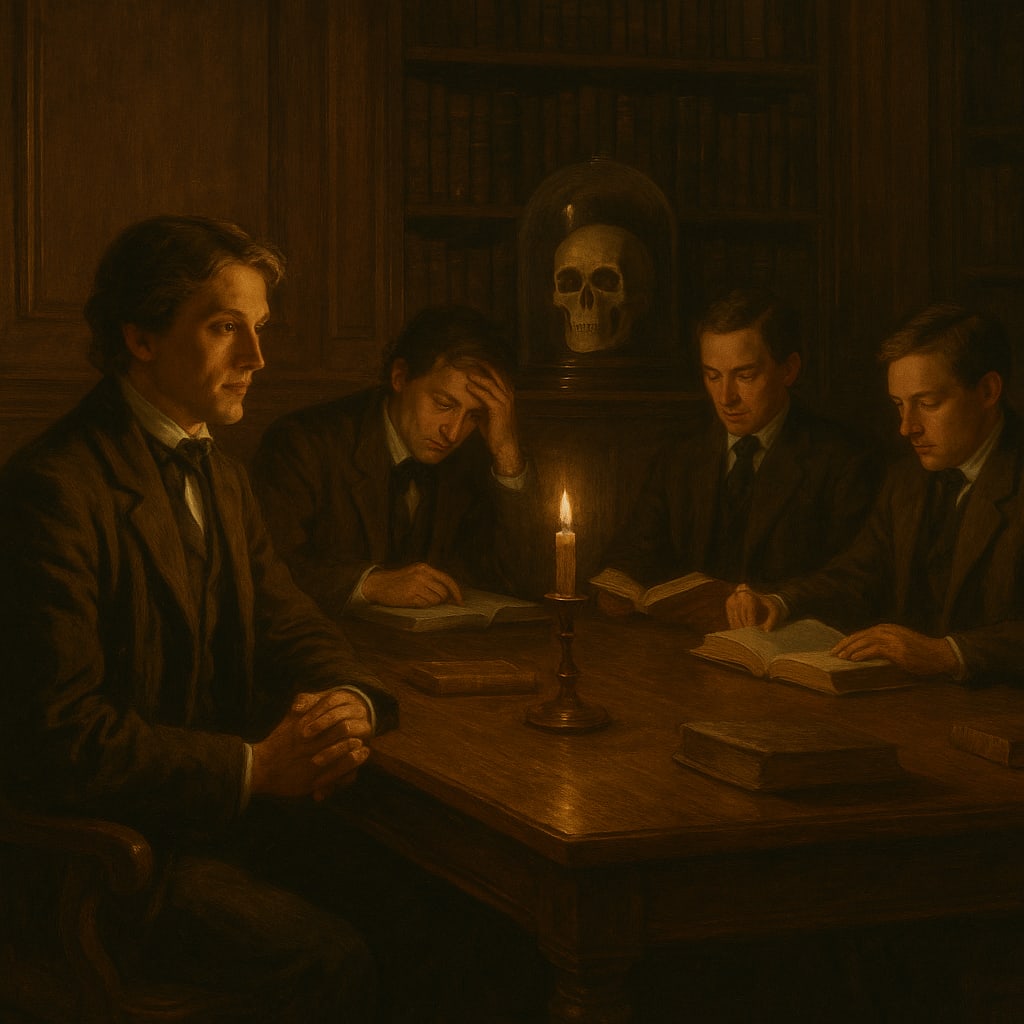
By day, they were students. Young men in stiff collars and ink-stained fingers, reciting Latin in classrooms framed by ivy and stone. They walked beneath bell towers, debated philosophy, and rehearsed the rituals of success. On the surface, they were simply the sons of the Republic’s rising class. Lawyers in waiting, future ministers, merchants, politicians.
But by night, in certain rooms where the curtains were drawn and the lamps burned low, some of them stepped into another world entirely. A world of passwords and oaths. A world where the Republic’s future wasn’t just studied, it was quietly rehearsed.
In these hidden chambers, America’s upper mind learned another lesson: that power, like knowledge, often prefers to move in the shadows.
I. The Ivy as a Gate
By the mid-19th century, the United States had grown beyond revolution and frontier. Railroads webbed the continent. Industry roared. Cities sprawled into smog and steel. And with that growth came a new class: families whose wealth no longer came from land alone, but from factories, banks, and rail lines.
Their sons; and almost always sons, needed training. Not just in letters and law, but in belonging.
Harvard, Yale, Princeton, and the rest of the Eastern colleges became more than schools. They became gates. To pass through them was to step into a network of influence that stretched from Boston boardrooms to Washington offices. Yet even inside those gates, there were inner circles.
Fraternities, debating societies, and clubs offered social life. But above them... higher, fewer, more controlled... rose a different kind of institution: the secret society. Not simply for friendship, but for selection.
They were asking a question the Republic had never quite stopped asking:
Who gets to steer the ship?
II. The Tomb on the Hill
At Yale, on a quiet corner of campus, rose a windowless building the students simply called “The Tomb.” Heavy stone, no clocks, no outward sign of what lay within. Only rumors, and the occasional flicker of candlelight slipping through the cracks.
This was the home of Skull and Bones. Perhaps the most infamous of America’s collegiate secret societies.
Each year, a small number of juniors were “tapped”. Chosen, often publicly and dramatically, to join. The selection wasn’t about grades alone. It was about promise. Charisma. Ambition. Family names and future stakes.
Inside, they practiced rituals that blended mock-funeral theatrics with fraternal bonding. They swore oaths of loyalty and secrecy. They told their deepest stories, their worst failures, their unspoken fears. The idea was simple:
If you strip a man of his pretenses and bind him to others in the dark,
he will remember them in the light.
And in the decades to come, when some of those men rose to positions of power. Senators, judges, cabinet members, even presidents. They carried with them the invisible threads spun in those rooms.
Skull and Bones was not the only such society, but it became the symbol, the lightning rod, for all of them.
III. The Web Expands
Harvard had its own circles. Princeton, too. Clubs with names like Porcellian, Fly, Ivy, Cap and Gown. Some were rowdy, some literary, some oddly monastic. Yet they shared a common purpose: to gather future leaders and tie them to one another long before the world knew their names.
These societies operated on a simple principle:
Power is not just what you know,
it’s who will take your call at midnight.
In their meeting rooms; paneled wood, cigar smoke, and the soft scratch of fountain pens, friendships became alliances. Rivalries became cautionary tales. A favor granted at twenty could become a debt repaid at fifty, in a boardroom or an embassy or the Oval Office.
To the outside world, this was coincidence. To those inside, it was the quiet architecture of opportunity.
IV. The Ethics of the Inner Circle
Were these societies sinister? Holy? Harmless? The answer, like most things American, is complicated.
On one hand, they shaped careers, concentrated influence, and often mirrored the inequalities of their era. For much of their history, they were closed to women, minorities, and anyone outside a narrow band of class and connection. In that way, they were mirrors of the Republic’s own blind spots.
On the other hand, they were also crucibles of conscience. Inside, stripped of titles, members were forced to confront one another as equals in a way the outside world rarely demanded. Wealth and rank mattered less when the door closed. Stories mattered more.
Some emerged from these societies more aware of their responsibility. Others used their networks to hoard power like a private currency.
The societies themselves did not dictate character. They merely amplified it.
The Republic’s secret networks were neither all villains nor all visionaries. They were something far more human: flawed arenas where ambition, loyalty, ego, and idealism tangled in the half-light.
V. Myth, Conspiracy, and the American Imagination
As the decades rolled on and some of these “Bonesmen,” club men, and initiated scholars rose to high office, the public began to sense a pattern. A judge here, a senator there, a president whose yearbook photo quietly showed membership in some unknown group.
Rumor did what rumor always does: it grew teeth. Whispers of hidden handshakes and coded signals, of secret agendas and puppet strings, swirled through newspapers and, later, the airwaves. Skull and Bones, in particular, became a canvas for every fear about unseen power.
Did they meet to rule the world? Did they script wars, markets, elections? The boring truth is this: no small college group can single-handedly control a continent. But the more interesting truth is this:
When you gather driven people in closed rooms,
you do not get omnipotence. You get influence. And in a Republic built on the myth of equal opportunity, the idea of any inner circle, any head start granted in secret; has always felt like a betrayal of the ideal, even when it functions simply as an old-fashioned boys’ club.
That tension between mythic equality and real-world networks is part of the American story. The secret societies merely give it a face.
VI. The Republic’s Shadow Curriculum
What did the Skulls and the scholars actually learn in those rooms that they didn’t learn in classrooms? Not calculus. Not Latin.
They learned something far more practical:
- How to read a room.
- How to keep a confidence.
- How to navigate shame, failure, and ambition in front of witnesses who would one day be powerful.
- How to belong to a story larger than themselves.
Rituals; however strange, theatrical, or archaic, served a purpose. They marked the border between the ordinary world and the inner one. They said: Here, we are something else.
The Republic has always had two curriculums:
the official one of textbooks and grades,
and the unofficial one of relationships and reputation.
The secret societies were simply the most honest expression of that second syllabus. They did in cloaked rooms what the broader culture does in quieter ways: sort, bond, exclude, elevate.
VII. Cracks in the Marble
The 20th century brought wars, depressions, and revolutions not just overseas but on campus. New voices arrived... women, students of color, immigrants’ children, and they were not content to remain outside the circle.
Protests rattled the windows of old clubs. Membership lists leaked. Traditions were questioned, criticized, reformed. Some societies opened their doors wider. Others clung harder to the past and faded into irrelevance, relics of a narrower age.
The myth of secret American power didn’t die, but it diversified. New networks emerged... think tanks, lobbying groups, corporate boards, digital communities. The old stone Tombs found themselves sharing the stage with glass conference rooms and encrypted group chats.
The story of unseen influence moved online, but the pattern remained:
We gather. We decide. We shape. Often out of sight.
The question the Republic must keep asking is not, “Do secret groups exist?” Of course they do.
The real question is:
Do they serve the Republic, or only themselves?
VIII. The Iron Lighthouse Reflection
The Skulls and the scholars remind us of a simple, uncomfortable truth:
Even in a nation built on open ballots and public debate, power loves a closed door.
Yet the existence of networks; secret, elite, or otherwise, does not automatically doom the Republic. Every human society forms circles. What matters is whether those circles ultimately widen, or shrink. Whether they use their advantage to open paths for others, or to pull the ladder up behind them.
The Republic’s greatest strength has never been that everyone starts in the same place. It’s that, over time, more people get to step onto the stage. More voices find the microphone. More hands, once pressed against the glass, are invited inside.
The old Tombs still stand. The old societies still meet. But they are no longer the only architects of the future.
In a strange way, the legacy of those secret clubs is this:
They forced America to ask, again and again, how serious it is about its own promise. Are we a nation of back rooms, or a nation of open doors?
The Iron Lighthouse shines not to expose every shadow, but to remind us that shadows are only possible because light exists at all.
About the Creator
The Iron Lighthouse
Where folklore meets freeway. A guide to the strange heart of the American backroads...
Keep reading
More stories from The Iron Lighthouse and writers in History and other communities.
EPISODE VIII – THE GILDED WEB: Power, Industry, and the Rise of the New American Titans
Before the skyscrapers carved their teeth into the sky… Before Wall Street became a myth and a menace… Before America woke up and realized it was no longer a frontier nation but an empire of industry. There was steel. There was oil. There was ambition hot enough to melt both.
By The Iron Lighthouse2 months ago in History
The Seven Wonders of the World: Amazing Human Creations
People have always been fascinated by things that are grand and unusual. From the very beginning of civilization, humans wanted to build structures that were not just useful, but also showed their skill, creativity, and ambition. The Seven Wonders of the World are the most famous examples of this desire. They are impressive not only because of their size or beauty, but also because of the stories they tell about our past, different cultures, and human innovation. The idea of the Seven Wonders comes from ancient travelers and historians who listed the most remarkable human creations. Even though some of these wonders no longer exist, their legacy continues to inspire people around the world. Let’s explore each one, looking at their history, significance, and why they remain unforgettable. 1. The Great Pyramid of Giza (Egypt) The Great Pyramid of Giza is the only surviving wonder of the original Seven Wonders. Built around 2560 BCE as the tomb of Pharaoh Khufu, it is an extraordinary engineering achievement. Made from more than two million limestone blocks, some weighing over 15 tons, the precision of its construction is still astonishing today. The pyramid shows the power and beliefs of ancient Egypt and continues to attract visitors from all over the world. It is a true symbol of human skill and vision. 2. The Hanging Gardens of Babylon (Iraq) The Hanging Gardens of Babylon are famous for their beauty and clever design, though historians still debate whether they really existed. Ancient stories say King Nebuchadnezzar II built these stepped gardens for his wife, Amytis, who missed the green hills of her homeland. The gardens, described as terraces full of trees, flowers, and shrubs, appeared to float above the city. Whether real or partly mythical, they show how ancient people combined nature and architecture in extraordinary ways. 3. The Statue of Zeus at Olympia (Greece) Around 435 BCE, the sculptor Phidias created the Statue of Zeus at Olympia. This huge statue of the Greek god Zeus, seated on a throne, was over 12 meters tall and made of ivory and gold-plated bronze. It represented both artistic skill and religious devotion. Even though it was destroyed long ago, records and artistic depictions keep its memory alive, showing the Greeks’ dedication to beauty, religion, and craftsmanship. 4. The Temple of Artemis at Ephesus (Turkey) The Temple of Artemis, built around 550 BCE, was dedicated to the Greek goddess of the hunt and wilderness. Known for its enormous size, detailed sculptures, and beautiful design, it was rebuilt several times after destruction, reflecting its cultural importance. People traveled from across the Mediterranean to see it, making the temple a center of religion, art, and commerce. Today, its ruins still tell the story of a civilization that valued beauty and spiritual devotion. 5. The Mausoleum at Halicarnassus (Turkey) Built between 353 and 350 BCE, the Mausoleum at Halicarnassus was the tomb of Mausolus and his wife Artemisia. Combining Greek, Egyptian, and Lycian styles, it stood around 45 meters tall and was decorated with intricate sculptures. Its design influenced monumental tombs for centuries. Even after earthquakes destroyed it, the Mausoleum remains a symbol of human creativity and architectural achievement. 6. The Colossus of Rhodes (Greece) The Colossus of Rhodes, built between 292 and 280 BCE, was a massive bronze statue of the sun god Helios, celebrating Rhodes’ victory over an invading army. Over 30 meters tall, it was one of the tallest statues of the ancient world. Although it only stood for 54 years before an earthquake toppled it, the Colossus became a symbol of triumph, resilience, and artistic achievement, inspiring large statues throughout history. 7. The Lighthouse of Alexandria (Egypt) The Lighthouse of Alexandria, or Pharos, was built around 280 BCE on the small island of Pharos. Standing over 100 meters tall, it served as both a landmark and a guide for sailors entering Alexandria’s busy harbor. Its elegant design combined functionality and beauty. Though earthquakes destroyed it long ago, it remains a symbol of human ingenuity and innovation in maritime engineering. The Legacy of the Seven Wonders The Seven Wonders are more than just buildings; they are symbols of human creativity, ambition, and achievement. Each wonder tells a story about the people who built it, the culture it came from, and the new ideas of its time. Even though some no longer exist, their stories continue to live through historical records, art, and the fascination of people worldwide. These wonders still inspire architects, artists, engineers, and travelers today. From the pyramids of Egypt to the Hanging Gardens of Babylon, they remind us that imagination and effort can create something that lasts for thousands of years. They are examples of determination, vision, and the pursuit of excellence. Conclusion The Seven Wonders of the World are timeless creations that celebrate human creativity and determination. They are more than stones, metals, or ruins—they represent entire civilizations and the marks they left on history. Even after centuries, their stories continue to inspire people to dream, create, and achieve greatness. These wonders remind us that with vision, passion, and effort, humans can build creations that
By Binan Mooona day ago in History
3 Everyday Rules That Exist Because Someone Once Did Something Very Stupid
Everywhere you go, you are surrounded by rules that feel oddly specific. Do not touch. No running. Contents hot. Do not insert body parts. These warnings aren’t theoretical. They weren’t written by pessimists or lawyers with too much free time. They exist because at some point in history, a real human being looked at a situation and thought, “This will probably be fine.”
By Enoch Sagini5 days ago in History


Comments
There are no comments for this story
Be the first to respond and start the conversation.