
EPISODE III – THE ARCHITECTS OF THE REPUBLIC: Building a Nation from Ink and Iron
The Republic Chronicles

Before there was a nation, there was a question... How does one build a country from chaos?
In the smoky aftermath of revolution, the United States was little more than a collection of bruised states bound by hope and habit. The war had ended, the king had retreated, but the idea of America; that fragile, luminous thing, had not yet found its body. The ink on the Declaration was barely dry, when the Founders realized the hardest part of revolution was not breaking free, but staying free.
They had toppled an empire. Now they had to construct a republic.
The Ruins and the Dream
1776 had been a declaration. 1783 was a reckoning. The soldiers who’d fought for liberty came home to farms in ruin, debts unpaid, and families changed. The government, such as it was, existed only on paper, under the Articles of Confederation. A well-meaning but wobbly framework, that gave the states freedom but the nation weakness.
Each state printed its own money, raised its own militias, and looked inward instead of outward. The new republic felt like a ship built of mismatched planks, taking on water faster than its crew could bail.
The war had been won by unity; peace was being lost to independence.
George Washington, retired at Mount Vernon, watched the discord with silent dread. “We have, probably, had too good an opinion of human nature,” he wrote. The general who once led an army now feared the country would eat itself before it ever learned to stand.
Something had to be done, and fast.
The Philadelphia Experiment
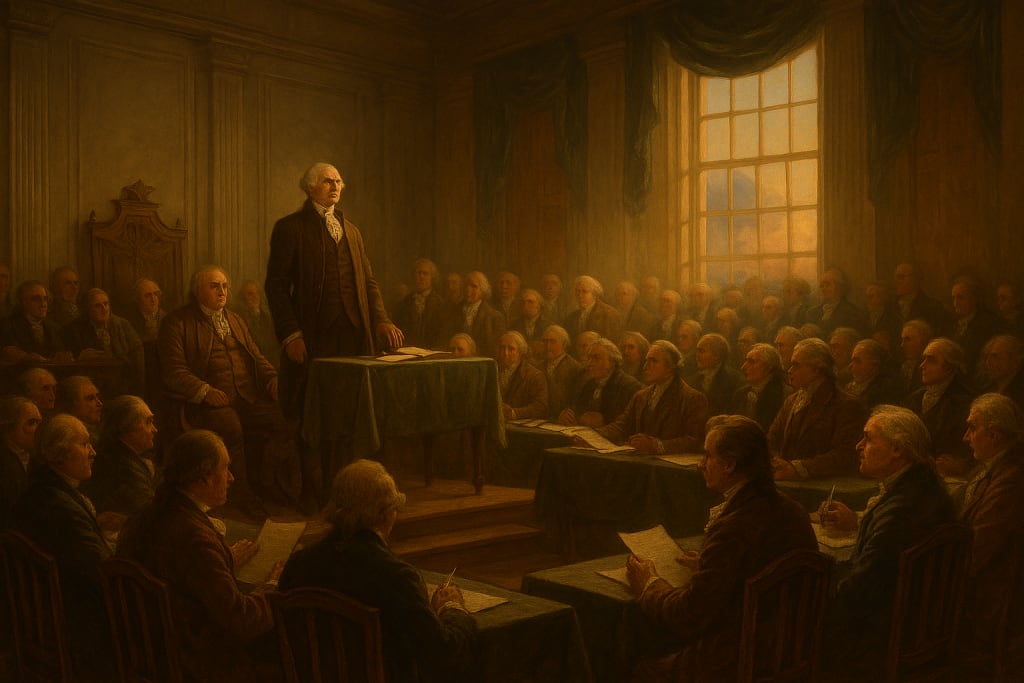
In the summer of 1787, delegates from twelve states gathered in Philadelphia. The heat was unbearable; the air hung thick with humidity and expectation. Behind closed doors, guarded by secrecy and sweat, they embarked on what Washington called “an experiment in government.”
The Constitutional Convention was less a meeting than a war of words. A gathering clash of tempers, intellects, and ideals.
There was James Madison, the quiet architect, whose mind was a scaffolding of logic and law.
Alexander Hamilton, the brash visionary, saw an America of industry, finance, and central strength.
Benjamin Franklin, old enough to remember the birth of lightning itself, served as philosopher and referee.
And at the head of it all, the stoic figure of Washington, presiding not as conqueror but as conscience.
They argued about everything: representation, taxation, trade, and tyranny. They debated how much power the people could truly handle before they tore themselves apart. They wrestled with ghosts of monarchy even as they tried to build a republic.
The windows were kept shut to guard their secrecy. Inside, the air turned thick with ink and sweat and history.
The Great Compromise
Out of the chaos came the crucible moment: large states wanted representation by population; small states demanded equality. The debate nearly broke the convention, until Roger Sherman of Connecticut proposed a daring middle road:
Two houses. One for the people, one for the states.
The House of Representatives and the Senate... the balance between democracy and order. It was a masterstroke of political alchemy, the kind of solution that could only be forged under unbearable pressure. The system was not perfect, no human design ever is, but it worked. And that was miracle enough.
The Shadows Beneath
Yet even in their triumph, the Founders were haunted. They spoke of liberty while slavery still thrived. They wrote of equality but denied half the population; women, a voice.
In taverns and fields, those left out of the new design wondered whether this “We the People” included them.
The Constitution’s silence on those injustices was not ignorance; it was avoidance. The men in that hall knew the contradiction too well. They called it a “necessary compromise,” a wound to be treated later. But the wound would fester for nearly a century before being reopened in blood.
Even in its brilliance, the republic carried its flaws like birthmarks. Reminders that idealism always coexists with imperfection.
The Ink That Binds
On September 17, 1787, the delegates gathered to sign the final document. Franklin, frail and weary, looked at the chair where Washington sat. The carving on the chair’s back was a half-sun. And Franklin, with a faint smile, said,
“I have often looked at that behind the president without being able to tell whether it was rising or setting. But now, at length, I have the happiness to know that it is a rising, and not a setting, sun.”
The Constitution... seven articles, written in plain English and uncommon courage, became the nation’s backbone. It was not scripture, but something perhaps rarer: a living document meant to evolve.
Each word was chosen with the care of a craftsman hammering iron. We the People. Three simple words, yet they reshaped the world’s understanding of power. For the first time, government did not flow down from kings, it rose up from citizens.
The Ratification Battles
But even as the ink dried, the war of words continued. Across the states, the debate raged: Federalists vs. Anti-Federalists. Hamilton, Madison, and John Jay took to their pens and launched The Federalist Papers, a series of essays defending the new Constitution.
They wrote by candlelight under pseudonyms, their arguments like musket volleys... clear, persuasive, relentless. Madison called the Constitution “a republic, if you can keep it,” echoing Franklin’s warning.
Opponents feared tyranny cloaked in new robes. They demanded protections for the individual, what would become the Bill of Rights. Out of that struggle, compromise again saved the day. Ten amendments were added, ensuring freedoms of speech, press, and conscience.
It was the final hammer strike that sealed the shape of the new republic.
The Birth of the Machine
By 1789, the gears of the new government began to turn. Washington, reluctantly but dutifully, became the first President of the United States. He accepted the role not as a throne but as a burden.
At his inauguration, his hand trembled as he placed it on the Bible. He spoke softly, humbly, as though afraid to disturb the silence of history. “The preservation of the sacred fire of liberty,” he said, “is finally staked on the experiment entrusted to the hands of the American people.”
Around him, the scaffolding of a new world took shape. Congress, the courts, the presidency... each part independent, yet bound together like cogs in an intricate clock.
It was not perfect, but it worked, and that was its genius.
The Philosophy of the Forge
The Founders were not demigods; they were craftsmen. They built the republic as blacksmiths build iron. Heating, hammering, and tempering it, until it could bear the weight of centuries.
They argued not because they disagreed about freedom, but because they cared too deeply about how to protect it. Madison feared anarchy. Jefferson feared tyranny. Hamilton feared weakness. Their fears, when blended, formed balance. A government of checks and counterweights that could flex without breaking.
The Constitution was more than a contract; it was a covenant. It demanded participation, vigilance, and faith... the holy trinity of democracy.
The Iron Lighthouse Reflection
Every great structure begins as a blueprint, and every blueprint begins as a question. The Founders’ brilliance lay not in answering every question, but in designing a nation that could ask them forever.
They left the machinery open to amendment, debate, and renewal. A living organism instead of a fossilized doctrine. That was their quiet genius. They knew that perfection is the death of progress.
The republic they forged from ink and iron still stands. Battered, mended, and tested, yet unbroken. Its architects are long gone, but their echoes remain in every vote cast, every protest shouted, every voice raised in the name of liberty.
We are the stewards of their design. The apprentices at their forge. And the fire still burns...
About the Creator
The Iron Lighthouse
Where folklore meets freeway. A guide to the strange heart of the American backroads...
Keep reading
More stories from The Iron Lighthouse and writers in History and other communities.
EPISODE II – THE FIRE AND THE FORGE: The Revolution That Built a Nation
Before the nation was born, it was burned... Smoke curled through the valleys of rebellion, a gray veil over red earth and restless hearts. The colonies had spoken their defiance in ink, but now came the language of fire and powder. It was 1776, and the world watched in disbelief as a ragged collection of farmers, tradesmen, and philosophers challenged the greatest empire on Earth.
By The Iron Lighthouse2 months ago in History
Imran Khan: The Journey of a Believer
Imran Ahmed Khan Niazi was born on October 5, 1952, in Lahore, into a well-educated Pashtun family. From an early age, he showed independence of thought and a quiet confidence that often set him apart. Educated first in Lahore and later at Aitchison College, he was sent to England for further studies, eventually attending the Royal Grammar School Worcester and later Keble College, Oxford, where he studied Philosophy, Politics, and Economics. At Oxford, Imran was exposed to global ideas, cultures, and debates. He was not only a student but also a sportsman, playing cricket with intensity and pride. Those years shaped his worldview—combining Eastern roots with Western education—and gave him a belief that discipline, preparation, and courage could change destiny. Rise of a Cricketing Icon Imran Khan’s greatest early fame came from cricket. Tall, athletic, and fiercely competitive, he entered Pakistan’s national team in the early 1970s. The beginning was not easy. He faced criticism for inconsistency and injuries, and some questioned whether he had the temperament for leadership. But Imran was relentless. He trained hard, studied the game deeply, and refined his skills as a fast bowler and all-rounder. Over time, he became the backbone of Pakistan’s cricket team. What truly set him apart was not just his performance, but his ability to inspire teammates. He believed in building confidence, unity, and self-respect within the team—qualities Pakistan cricket had often lacked on the world stage. His defining moment came in 1992, when he led Pakistan to victory in the Cricket World Cup. Against all odds, with an injured body and an underdog team, Imran captained Pakistan to its first—and so far only—World Cup win. That triumph transformed him into a national hero. For millions of Pakistanis, he became a symbol of hope: proof that belief and determination could overcome adversity. A New Mission: Giving Back After retiring from cricket, Imran Khan surprised many by not choosing a comfortable life of fame. Instead, he turned toward philanthropy. Inspired by the death of his mother from cancer, he envisioned building a world-class cancer hospital in Pakistan—something many considered impossible. In a country where public trust in institutions was low, raising funds for such a project seemed unrealistic. Yet Imran traveled across Pakistan and abroad, appealing directly to people. He spoke not as a celebrity, but as a son fulfilling a promise. Against expectations, Shaukat Khanum Memorial Cancer Hospital became a reality in 1994, offering free or subsidized treatment to thousands of patients. Later, he founded Namal University to provide quality education to underprivileged students. These projects strengthened his image as a man who could turn dreams into institutions—someone willing to sacrifice comfort for a cause. Entering Politics: A Difficult Road Imran Khan entered politics in 1996 by founding Pakistan Tehreek-e-Insaf (PTI). His message was simple but bold: justice, accountability, and independence from corruption and foreign influence. At a time when Pakistani politics was dominated by powerful families and entrenched interests, Imran was seen as an outsider—idealistic, but unrealistic. For years, PTI struggled. In elections, Imran sometimes won only a single seat, or none at all. Critics mocked him, calling him irrelevant and disconnected from political realities. Many former supporters lost patience. But Imran refused to quit. He believed that real change takes time and that nations are not transformed overnight. Slowly, his message began to resonate, especially with the youth. His speeches emphasized dignity, rule of law, and a Pakistan that could stand on its own feet. Massive rallies followed, particularly after 2011, when PTI emerged as a major political force. For the first time, Pakistan’s young generation felt represented by a leader who spoke their language. Prime Ministership: Power and Pressure In 2018, after more than two decades in politics, Imran Khan became the Prime Minister of Pakistan. Supporters celebrated it as the victory of perseverance. For Imran, it was the hardest phase of his life. Governing a country of over 200 million people came with immense challenges: economic crises, debt, political opposition, and complex foreign relations. Imran promised reforms, accountability, and welfare programs. His government introduced initiatives like the Ehsaas Program to support the poor and attempted to reform health and governance systems. However, criticism followed closely. Opponents accused him of inexperience and poor economic management. Political tensions remained high, and compromises—inevitable in politics—disappointed some of his most loyal supporters. Imran often spoke of the gap between ideals and reality, learning firsthand how difficult it is to bring change within an old system. Removal from Power and Continued Struggle In 2022, Imran Khan was removed from office through a vote of no confidence. He claimed it was the result of internal conspiracies and foreign pressure, while opponents argued it was due to governance failures. Whatever the interpretation, his removal marked another dramatic turn in his story. Instead of retreating, Imran returned to public rallies with renewed intensity. He framed his struggle as one not just for power, but for sovereignty and justice. Legal battles, arrests, and political restrictions followed, making his path even more difficult. To his supporters, Imran Khan became a symbol of resistance—someone standing against a powerful status quo. To critics, he remained a divisive figure. Yet no one could deny his impact on Pakistan’s political consciousness. Legacy Still Being Written Imran Khan’s story is not finished. Unlike his cricket career, which ended with a clear victory, his political journey remains open-ended. He has inspired millions to believe in change, to question authority, and to demand accountability. At the same time, he has faced criticism for mistakes, rigidity, and unmet promises. What makes Imran Khan unique is not perfection, but persistence. From cricket fields to cancer wards, from opposition benches to the prime minister’s office, his life reflects a constant refusal to accept limits imposed by others. In the end, Imran Khan stands as one of Pakistan’s most influential figures—a man who dared to dream big, stumbled often, but never stopped walking forward. Whether history judges him as a great leader, a flawed reformer, or both, his story will remain deeply woven into the narrative of modern Pakistan.
By The best writer about 9 hours ago in History
Military Strength of Alexander the Great and the Chola Empire: A Historical Comparison
Though separated by more than a thousand years and operating in vastly different geographical and cultural contexts, both forces achieved extraordinary success through discipline, innovation, and strategic brilliance. This article explores the history, composition, size, organization, and military strength of Alexander’s Macedonian army and the Chola military, highlighting how each became a dominant power of its era.
By Say the truth 6 days ago in History


Comments
There are no comments for this story
Be the first to respond and start the conversation.