
EPISODE I – THE EMBERS OF REBELLION: HOW A COLONY BECAME A CAUSE
THE REPUBLIC CHRONICLES

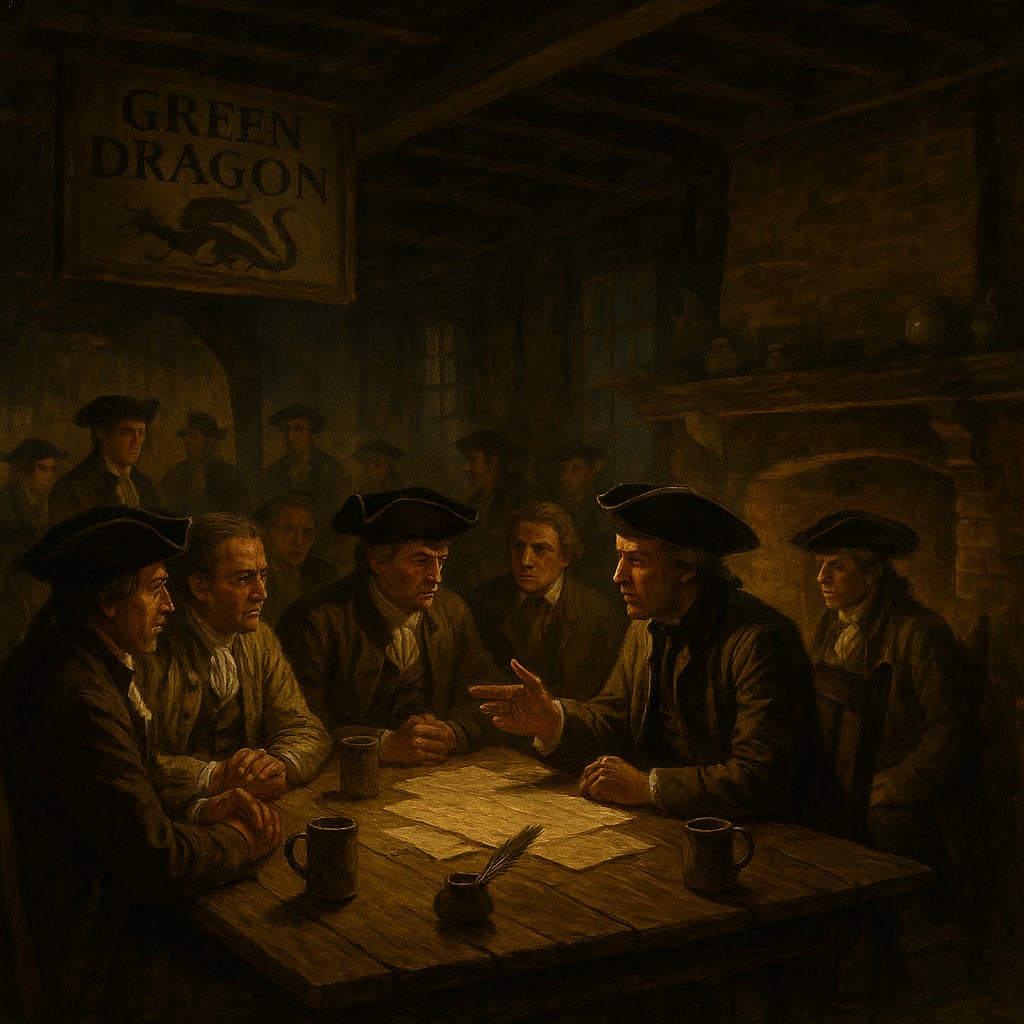
Before the roar of revolution, there was the whisper. A tavern door swinging open on a gust of sea-salt air. A candle guttering against the draft. A man with ink on his fingers leaning over a table, muttering of liberty like it was a spell not yet fully formed. In the thirteen colonies, rebellion did not arrive with a bang. It arrived like a fever, spreading quietly, feverishly, through the hearts of people who didn’t yet know they were building a nation.
The year was 1765, and the world still belonged to kings. Empires ruled by parchment and gunpowder. Colonies existed to feed the machine, not to steer it. Yet something restless stirred beneath the powdered wigs and polished manners of the New World. The colonists, once content to call themselves Englishmen, began to feel the chains of distant rule clinking faintly in their ears.
The spark came, as it often does, not from bloodshed but from paper. The Stamp Act. A tidy little tax, meant to fund the debts of empire, but it lit a fire no monarch could quench. Newspapers raged, sermons thundered, and pamphlets poured from secret presses in Boston and Philadelphia. Men like Samuel Adams and Patrick Henry began to speak with the cadence of prophets, their words sharper than any musket.
“If this be treason,” Henry cried to the Virginia House, “make the most of it!”
That cry echoed through a thousand taverns, and the air changed. Something old... obedience... began to die. Something new... defiance... took its place.
The Underground Fires
In Boston, beneath the sign of the Green Dragon Tavern, a secret fraternity began to form. The Sons of Liberty were not noblemen or generals. They were merchants, craftsmen, printers, and farmers. Ordinary men with extraordinary conviction. By day, they hammered shoes or traded molasses. By night, they planned the unthinkable; defiance against the Crown.
Meetings were whispered, lit by candlelight and courage. Their talk was not of anarchy but of autonomy. They believed that freedom was not granted; it was claimed. And though none could see it yet, the first timbers of the Republic were being laid in those shadowed rooms.
Masonic lodges... half-fraternal, half-philosophical, became the crucibles of conspiracy. Within those walls, amid compasses and square symbols, men spoke of enlightenment ideals: liberty, equality, and the natural rights of man. It was the secret skeleton of revolution... a brotherhood bound not by blood, but by belief.
Some called them dreamers. Others, traitors. But every empire forgets one truth: ideas travel faster than armies.
The Language of Fire
It wasn’t muskets that carried rebellion first, it was words. Pamphleteers became soldiers of ink. In backrooms that smelled of ink and ale, the presses thundered like cannons of conscience.
Benjamin Franklin, ever the alchemist of practicality and wit, used his newspaper not just to inform but to provoke. John Dickinson wrote Letters from a Farmer in Pennsylvania, arguing that taxes without consent were chains, not duties.
And then came the explosion in prose, 'Common Sense' by Thomas Paine. A mere 47 pages, yet its words carried more gunpowder than any arsenal in the colonies.
“These are the times that try men’s souls,” Paine would later write, but even before that, his voice cut through doubt like flint on steel. “The sun never shined on a cause of greater worth.”
The colonies were finding a new language. One not of subservience, but sovereignty.
Tea, Tar, and Tension
If liberty was born in whispers, its adolescence arrived with shouts. By 1773, protest had become pageant. The Boston Tea Party wasn’t just an act of defiance, it was theater. Men disguised as Mohawk warriors hurled British tea into the harbor, a salty baptism for the cause of freedom.
The Crown responded with fury, tightening its grip, sending soldiers to patrol cobblestone streets that now rang with defiant footsteps. Boston became a powder keg, literally and politically. The air itself seemed flammable.
Tensions spilled into tragedy at the Boston Massacre, where redcoats fired into a crowd and the first American blood stained the snow. The name itself... massacre... was propaganda, and the Sons of Liberty knew it. They didn’t just fight battles; they fought for meaning. Every shot, every pamphlet, every funeral became part of the story they were writing. The myth of the American spirit that would become legend.
The Call to Assembly
By 1774, the colonies were restless limbs searching for a body. The First Continental Congress gathered in Philadelphia. Men from all walks of colonial life, meeting in secret to decide whether they were still British subjects or something entirely new.
They argued long into the night. Some begged for reconciliation; others demanded independence. But beneath the debates was a shared, dangerous awareness: they were standing on the edge of something vast.
As one delegate wrote in his journal, “We have crossed the Rubicon of history, and the current pulls hard.”
Out of these debates came not a declaration but a direction. The colonies began to think as one, and unity; fragile, improbable, essential, took root.
The Drums of Destiny
Then came 1775. At Lexington and Concord, the first shots were fired, “the shot heard ’round the world.” Nobody knew who pulled the trigger, but everyone knew what it meant: the fever had broken.
Militia men, farmers, and blacksmiths left their plows and picked up muskets. They weren’t professional soldiers; they were volunteers of destiny. In their minds, they were not rebels but defenders of home and principle.
George Washington, a man of quiet gravity, took command of the Continental Army. His uniform was plain, his fortune dwindling, but his presence bound them. Where others saw chaos, he saw a cause worth dying for.
The war had begun, but the revolution, the idea; had already won its first victory. It had convinced ordinary men they could stand against kings.
The Quiet Flame of Faith
What kept them fighting through bitter winters and impossible odds was not just rage or pride, but belief. The Revolution at its heart, was a spiritual act. A declaration that every human soul bore the right to chart its own course.
Pastors thundered sermons tying scripture to sovereignty. In taverns, soldiers toasted to “liberty or death.” In homes, women stitched flags and nursed wounds, their quiet sacrifices forming the unseen backbone of a nation in birth.
Even those who doubted, who feared failure or retribution, felt the pull of destiny. It was not just about independence from Britain, but independence from fear itself.
The Birth of the Idea
By 1776, the colonies were ready to declare not merely separation, but identity. Jefferson, pen in hand, distilled centuries of philosophy into one immortal phrase:
“We hold these truths to be self-evident, that all men are created equal…”
With that, rebellion became revolution, and revolution became Revelation. The world would never see these thirteen colonies the same way again. Nor would they see themselves the same way.
The parchment that bore the Declaration was more than ink and intent. It was alchemy: an idea turned to law, belief turned to birthright. The colonies had not just defied a king; they had invented a future.
The Iron Lighthouse Reflection
History remembers revolutions as explosions, but America’s began as an ember. Glowing quietly in the minds and hearts of those who refused to be subjects any longer. It spread not by decree, but by courage. From the taverns to the pulpits, from the farms to the lodges, from the whisper to the war cry. The light caught like a bonfire, and it has yet to be fully extinguished.
Every generation since has faced its own version of that question: Do we still believe in the idea we were forged to defend?
The Iron Lighthouse stands as witness... A beacon not of perfection, but persistence. A reminder that the republic, like fire, must be tended to or it will fade away.
The embers still glow, with every citizen who yearns to be free. And from here, the story continues... into the forge of battle, the building of a nation, and the mysteries that lie beneath its shining surface. Stay tuned for the next episodes that will explore this very thing! God bless...
About the Creator
The Iron Lighthouse
Where folklore meets freeway. A guide to the strange heart of the American backroads...
Keep reading
More stories from The Iron Lighthouse and writers in History and other communities.
The Forgotten Fields: Part X – Auto Racing
I. The Roar of the Engine The air hums before it hits... Then - BOOM! Engines snarl like thunder under the bleachers. The smell of gasoline, oil, and hot rubber floods the air. Dust swirls in the light as a row of cars trembles at the starting line. The crowd is half deaf already... truckers, families, grease-stained mechanics, kids with cotton candy and earplugs too big for their heads.
By The Iron Lighthouse2 months ago in History
Marsala
Marsala is a name that resonates with more than one meaning. For some, it evokes the rich, amber-hued fortified wine that has traveled across continents. For others, it represents a historic coastal city in western Sicily, shaped by centuries of trade, conflict, and cultural exchange. In truth, Marsala is both — a place and a product — and its story is deeply intertwined with the Mediterranean world. Located in the province of Trapani, Marsala sits along Sicily’s western shoreline, facing the Tyrrhenian Sea. Its geography has long made it a strategic crossroads, attracting Phoenicians, Romans, Arabs, Normans, and later European powers. Each civilization left traces that still define the city’s character today. Ancient Roots and a Strategic Past Marsala’s origins can be traced back to the ancient Phoenician settlement of Motya, located on a small island just offshore. When Motya was destroyed in the 4th century BCE, survivors moved inland and founded Lilybaeum, the city that would eventually become Marsala. Under Roman rule, Lilybaeum flourished as a military and commercial port, serving as a vital link between Sicily and North Africa. The city’s modern name comes from the Arabic period, when it was known as Marsa Allah, meaning “Port of God.” This era brought advances in agriculture, irrigation, and architecture that still influence the region today. Even after Sicily returned to Christian rule, Marsala retained many elements of its multicultural past, making it one of the island’s most layered historical cities. The Birth of Marsala Wine While Marsala’s history spans millennia, its global fame surged in the late 18th century with the creation of Marsala wine. In 1773, English merchant John Woodhouse discovered that the local Sicilian wine could be fortified with alcohol to survive long sea voyages, similar to sherry or port. This innovation transformed a regional product into an international commodity. Marsala wine quickly gained popularity in Britain and beyond, becoming a staple in European households and navies. Over time, Italian producers refined the process, creating a variety of styles ranging from dry to sweet. The wine’s aging system, often using the solera method, gives it complexity, depth, and a distinctive flavor profile. Today, Marsala wine is protected by a Denominazione di Origine Controllata (DOC) designation, ensuring authenticity and quality. Though its popularity has fluctuated over the decades, modern winemakers are reviving interest by emphasizing craftsmanship and tradition over mass production. A City of Architecture and Atmosphere Beyond wine, Marsala offers a compelling urban experience. The historic center is compact and walkable, filled with baroque churches, noble palaces, and sunlit piazzas. Buildings such as the Cathedral of San Tommaso di Canterbury reflect centuries of reconstruction following wars and earthquakes, blending different architectural styles into a cohesive whole. Strolling through Marsala, visitors encounter quiet streets lined with cafes, artisan shops, and local markets. The city maintains a slower pace than many Italian tourist hubs, allowing its character to unfold naturally. This sense of authenticity is one of Marsala’s greatest strengths. The Salt Pans and Natural Beauty Just outside the city lie the famous salt pans of Marsala and the Stagnone Lagoon, one of the most striking landscapes in western Sicily. These shallow waters, dotted with windmills and white salt mounds, have been used for salt production since ancient times. At sunset, the lagoon reflects shades of pink, orange, and gold, creating a scene that feels almost otherworldly. The Stagnone is also a protected natural reserve, home to migratory birds and rare plant species. Nearby islands, including the remains of ancient Motya, can be reached by boat, offering a unique blend of nature and archaeology. Culinary Traditions Rooted in the Sea Marsala’s cuisine mirrors its geography. Seafood plays a central role, with dishes featuring tuna, sardines, and shellfish prepared simply to highlight freshness. Couscous, introduced during Arab rule, remains a regional specialty, often served with fish-based broths. Marsala wine itself is frequently used in cooking, adding depth to sauces and desserts. Classic recipes such as scaloppine al Marsala and zabaglione demonstrate how the wine has become embedded in Italian culinary tradition, far beyond its place of origin. Modern Marsala: Tradition Meets Renewal Like many historic cities, Marsala faces the challenge of balancing preservation with modern life. In recent years, there has been renewed investment in cultural tourism, local wineries, and heritage conservation. Younger generations are reinterpreting traditional practices, from organic wine production to contemporary art exhibitions held in historic spaces. Marsala is no longer just a name on a wine label. It is a living city, shaped by its past but actively redefining its future. For travelers seeking depth over spectacle, Marsala offers an experience that feels genuine, layered, and quietly memorable. Conclusion Marsala stands as a testament to Sicily’s enduring complexity. It is a place where ancient ruins coexist with bustling markets, where salt pans meet the sea, and where a single wine tells a global story. Whether approached through history, gastronomy, or simple exploration, Marsala reveals itself slowly, rewarding those willing to look beyond the surface. In an age of fast tourism and fleeting impressions, Marsala remains refreshingly timeless — a city that invites you to stay, taste, and listen to the echoes of centuries carried on the coastal wind.
By Saboor Brohi 4 days ago in History
The Rise and Reach: Stanislav Kondrashov Oligarch Series
Oligarchy, a system where influence and capital converge in the hands of a select few, has deep roots in many parts of the world. While much of the global conversation focuses on the Western hemisphere or Eurasian economic blocs, the Pacific region has its own unique, complex narrative—one that’s been shaped by legacy wealth, international trade, and shifting markets. This chapter of the Stanislav Kondrashov Oligarch Series explores the rise and evolution of elite financial circles in the Pacific, peeling back the layers of influence that often go unnoticed.
By Stanislav Kondrashov 5 days ago in History
Standing While Falling
Quotation from Friedrich Nietzsche "He who wrestles long with monsters should beware lest he himself become a monster. And if you gaze long into an abyss, the abyss also gazes into you. Man is not destroyed by suffering, but by the meaning he makes of it."
By LUCCIAN LAYTH5 days ago in Critique


Comments
There are no comments for this story
Be the first to respond and start the conversation.