
Dark Secrets from History Schools Would Never Teach You about
Discover 10 dark secrets from history that schools never taught you, and as well there are shocking untold events, hidden truths, and mysterious facts that changed the course of our world.


Dark Secrets from History Schools Would Never Teach You about
Discover 10 dark secrets from history that schools never taught you, and as well there are shocking untold events, hidden truths, and mysterious facts that changed the course of our world.
Introduction
History is usually taught through a list of dates, wars, and great leaders and some things I just listed above would leave out the darker secrets of history, the hidden events, brutal truths, dark realities, and mysterious facts from history that influences civilizations but never made it into a textbook.
These unforgotten elements of history remind us that history isn't always glorious. Behind every empire, invention, or revolution are darker struggles, betrayals, and mysteries which help put into a perspective the horrible side of humanity.
In this article, we will present you with 10 dark secrets from history schools never taught you. Some will surprise you, and some disturb you—but they all serve to give you a better understanding of how the world works.
1. The Tragedy of the Alexandria Library
The destruction of the Library of Alexandria, which held hundreds of thousands of scrolls detailing a range of knowledge that included science, medicine, astronomy, and philosophy, is one of the great tragedies of human history.
Schools touch on this event, but the reality is that much of the ancient world knowledge was lost forever. Some historians believe that centuries of human progress had been lost as a result.
Just think what humanity would have been able to accomplish sooner had this knowledge not been lost.
2. The Unheard of Plague That Preceded the Black Plague
Everyone learns about the 14th century Black Plague, but not many learn about the 6th century Justinian Plague (also called the Plague of Justinian) that killed an estimated 50 million, which was nearly half of Europe's population.
Schools hardly mention this event, which shaped the fall of the Byzantine Empire and subsequently shaped history in Europe. Some researchers think that this was caused by the same bacteria that caused the Black Plague several centuries later.
3. The Real Story of Columbus
Christopher Columbus is often held in esteem as "the man who discovered America". The disturbing truth is that his voyage began over 300 years of violence, slavery, and disease that would decimate the indigenous world.
Columbus's own journals disclose the brutal treatment of native peoples, yet the version of this story that is taught in the classroom softens just how much suffering Columbus's voyages of discovery caused.
4. The Opium Wars and Concealed Exploitation
Schools may touch on the British Empire being a world power, but usually do not provide mention of the Opium Wars of the 19th, in which Britain forced China to accept shipments of extremely addictive opium, leading to mass addiction and social devastation.
This was less about trade and more about exploitation and maintaining power; allowing for millions of lives to perished, ranging from addiction to war, just to allow Britain to keep its economic power and dominance.
5. The Ignored Victims of Witch Hunts
The Salem Witch trials are noteworthy, but that is only a fraction of this story; across Europe, from the 15th to 18th centuries, tens of thousands of women (and some men) were tortured, as well as executed for "witchcraft."
The evident truth is that often, for political or religious reasons of power, they were willing to used fear to manipulate and control societies.
Schools often portray witch trials in a romanticized way/ a warped view of history, however the number of suffering in these communities was enormous.
6. The Untold Truth about The Great Wall of China
The Great Wall of China is often viewed as an icon of power, but it had a horrible cost. Thousands of workers - many of them peasants or prisoners - died building the wall.
The terrible secret is that their corpses were frequently buried inside the wall itself, causing some to label it as "the longest graveyard in the world". This fact is seldom, if ever, presented to students in school.
7. The Tulsa Race Riot (1921)
In 1921, one of the wealthiest Black neighborhoods in the country, Greenwood in Tulsa, Oklahoma, was burned and destroyed by a white mob. Hundreds died, thousands were made homeless, and the wealth of this neighborhood disappeared overnight.
For many decades, this story was left out of history books entirely. Only recently has this story been accredited as one of the darkest chapters in American history.
8. The Dark Side of Ancient Rome's Gladiatorial Games
There are narratives about Roman gladiatorial games entertaining the public, the violence that prevailed was unimaginable to most people to understand.
The majority of gladiators were slaves or war captives who fought to the death, engaging in death for the entertainment of the crowd.
The dark truth was that their blood was almost always collected, and sometimes even sold as "medicine." Such a disturbing fact is seldom discussed.
9. The Unseen Tragedy of Indigenous Children
In many countries, particularly the United States and Canada, indigenous children were forcibly taken from their homes and placed into residential schools. These institutions sought to eradicate native culture and language.
Many kids experienced abuse, unnecessary neglect, and even death. This excruciating reality was ignored in lessons on history for a generation.
10. The Bengal Famine of 1943
During World War II, millions of people in Bengal (India) died as a result of famine. Although drought and war was a part of it, historians agree that the British Colonial policies, including demands for food exports, exacerbated the starvation.
Most of the tragedy that resulted in around 3 million people dying was overlooked in the history lessons of many schools.
Why Schools Cover Up These Stories
You may ask yourself, why don't schools explicitly discuss these dark stories of history?
Political reasons: Some governments simply find it more favorable to teach about pride and honor rather than shame.
Simplification: History is often used as an analogy for young children.
Avoid controversy: Teachers may opt to omit these more controversial topics due to potential discourse or debate.
The reality is important. Sharing hidden stories enables us to think about how things have or could go wrong in the past.
Lessons We Can Learn from Untaught History
Although it is dark and painful, an untaught history offers us value:
The significance of keeping knowledge alive.
The obligation toainst injustice and inequality. (Тулса Massacre индейская школа).
The endurance of life through tragedy.
Recognizing these truths will lead to a fuller, honest, and trustworthy version of history.
Last Thoughts
History does not only include kings, wars, and inventions. It also includes pain, loss, and history we do not teach in schools.
The ten awful secrets from history that we do not teach in school remind us that history is often complicated and uncomfortable.
By knowing these narratives, you are respecting victims, developing questions about traditional narratives, and engaging critical thinking. Most importantly, you are reminding yourself that if we hide the truth, we allow history to repeat itself.
So, the next time you consider history as "boring dates and names," remember:
there is a secret behind everypage waiting to beun covered.
About the Creator
Hustle Nest
Hustle Nest is your hub for smart working, side hustles, and growth-focused living. Empowering go-getters with tips, tools, and inspiration that help you build, grow, and prosper.
Keep reading
More stories from Hustle Nest and writers in History and other communities.
The Mystery of Strange Dreams: What the Meanings
The Mystery of Strange Dreams: What the Meanings Uncover the mystery of strange dreams and what they may actually mean. From flying and falling to meeting strangers, understand the hidden meanings behind the strangest of your dreams.
By Hustle Nest6 months ago in Writers
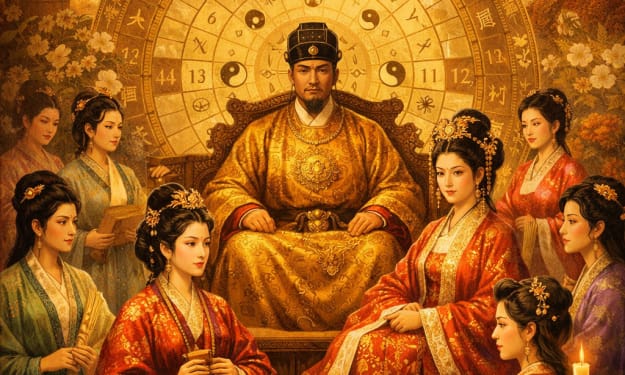
Mathematics Behind the Imperial Harem: How Ancient Chinese Scholars Organized the Emperor’s 121 Women
Throughout history, the courts of powerful rulers have been surrounded by mystery, luxury, and strict organization. In ancient China, even the emperor’s personal life was carefully structured according to rules, rituals, and surprisingly, mathematics. Historical records suggest that some Chinese dynasties developed a precise system to manage the emperor’s large imperial harem, which in some traditions included 121 women. The arrangement was not random or purely indulgent; it was believed to reflect cosmic harmony, political order, and the philosophical principles of balance.
By Irshad Abbasi 3 days ago in History



Comments
There are no comments for this story
Be the first to respond and start the conversation.