
Cults of Gods: Hephaestus, "Lame" God?
What were Hephaestus' cult and religious functions?

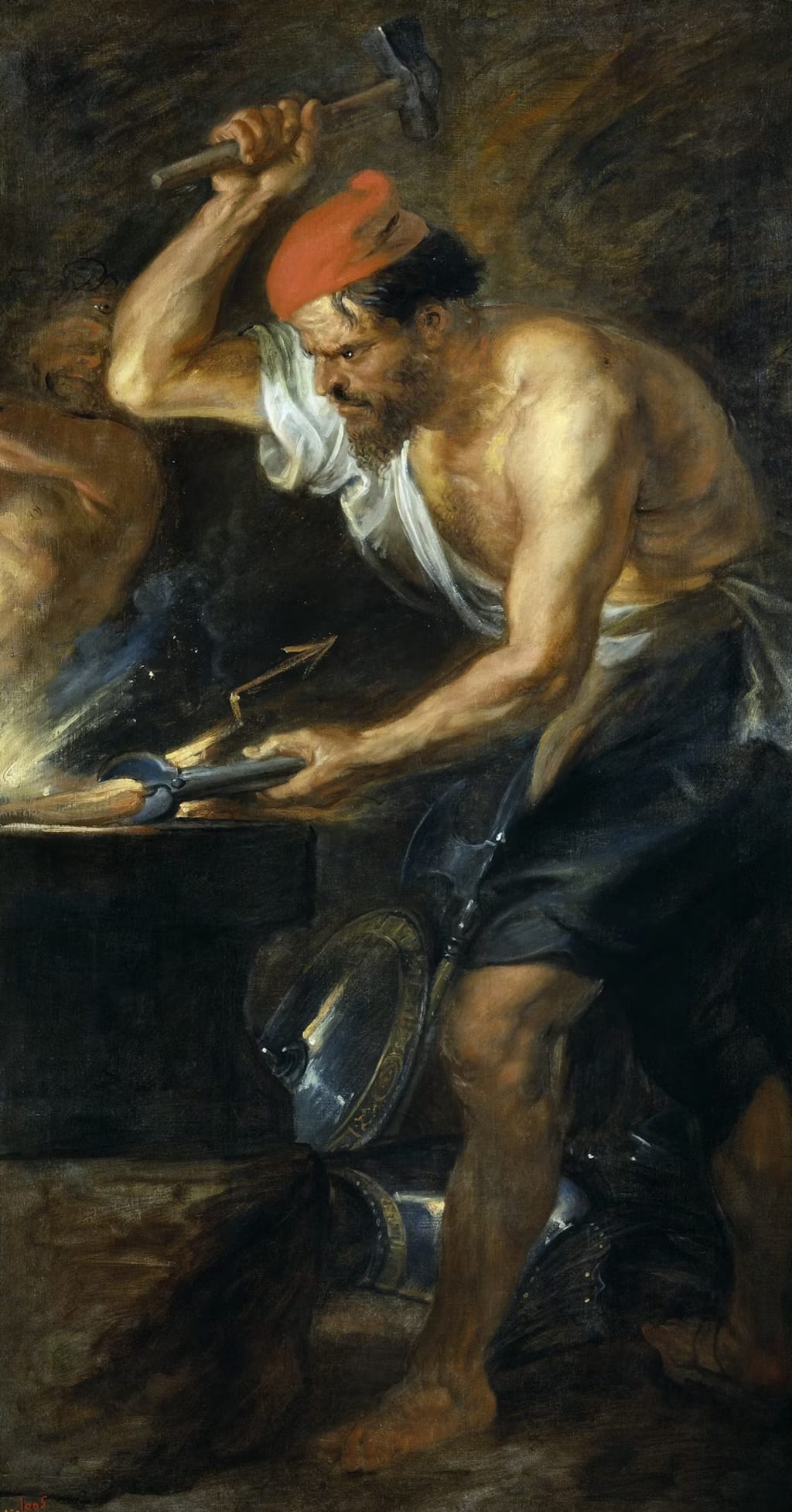
Often portrayed in myth as an outcast, Hephaestus occupied a far more stable and respected position in ancient Greek religious practice. Though depicted as physically imperfect, he was nonetheless firmly established among the Olympian gods and widely revered for his indispensable role in both divine and human craftsmanship.
Hephaestus was the Olympian god of fire, smiths, craftsmen, metalworking, stonemasonry and sculpture. He was depicted as a bearded man holding a hammer and tongs--the tools of a smith--and sometimes riding a donkey.
Similarly to other Greek gods, there is no solid etymology for the name “Hephaestus.” The first known recording of the name (or a form of it) is in an inscription on the palace at Knossos on Crete, where it appears as a-pa-i-ti-jo in the syllabic Linear B script used in Bronze Age Greece (ca. 1600–1100 BCE).
The palace at Knossos was a relic of the Minoan people who lived more than a thousand years before the Greek classical period (490–323 BCE), indicating that the word was present in early Greek society. However, scholars have generally interpreted the name that appears on this inscription as theophoric—that is, as a name that contains the name of the god, rather than the name of the god itself (similar to later Greek names such as Hephaestion).
Today, the etymology of Hephaestus’ name is usually thought to have been pre-Greek.
Many of his epithets mostly relate to his physical malformation, such as Kyllopodiôn (Crooked-Foot) or Amphigyêeis (Lame One, Halting in Both Feet), while other titles point at his craft and profession, such as Klytotékhnēs (Renowned Artificer) and Polýmētis (of many devices). Another interesting epithet, Aitnaîos is tied to his mythic workshop supposedly located on Mount Aetna.
Solinus wrote that the Lycians dedicated a city to Hephaestus and called it Hephaestia. The Hephaestia in Lemnos was named after the god. In addition, the whole island of Lemnos was sacred to Hephaestus. Pausanias wrote that the Lycians in Patara had a bronze bowl in their temple of Apollo, saying that Telephus dedicated it and Hephaestus made it.
Pausanias also wrote that the village of Olympia in Elis contained an altar to the river Alpheios, next to which was an altar to Hephaestus sometimes referred to as the altar of "Warlike Zeus." The island Thermessa, between Lipari and Sicily, was also called Hiera of Hephaestus (ἱερὰ Ἡφαίστου), meaning "sacred place of Hephaestus" in Greek.
The most well-known ancient festivals of Hephaestus were celebrated in Athens, where he was revered as the father of the king of Athens, Erichthonius. The Hephaestia, celebrated every four years, involved a torch race and sacrifices to the god. In another festival, the Chalkeia, craftsmen walked in a procession through the city in honor of Hephaestus and his counterpart Athena.
In different regions of the Greek world, Hephaestus was also connected with the mystery cult of the Cabirim, gods associated with the mystery cults (whom he was said to have fathered). These mysteries most likely involved initiation rites, feasting, and sacrifices; they were practiced primarily in Asia Minor, Macedonia, Boeotia, and some northeastern Aegean islands.
The public cult of Hephaestus was not as widespread in Greece as that of most of the other Olympians. Hephaestus did, however, have important cult centers at Lemnos, an Aegean island that was especially sacred to him, and Athens, where he was worshipped together with Athena as one of the city’s chief patron gods.
At Lemnos, the spot where Hephaestus supposedly landed when he was thrown from heaven was an especially sacred site. It was believed that this spot could cure various ailments, including snake bites.
There was a large temple of Hephaestus, called the Theseium, near the agora of Athens; in it, the cult statue of Hephaestus stood next to that of Athena.
Hephaestus also had a handful of temples in Sicily, where he was sometimes said to have had a workshop.
Thank you for reading my article! Share your thoughts in the comments and spread this article.
About the Creator
Keep reading
More stories from Alex Smith and writers in History and other communities.
Cults of Gods: Is Aphrodite older than the Olympians?
The goddess who sided with the Trojans during the Trojan War, restrained the bloodthirsty Ares, and inspired rivalry with the mortal Psyche was also one of the most influential cultic deities of the Hellenic world. Aphrodite was not merely a poetic symbol of love and beauty; she was a widely worshipped divine power whose sanctuaries, festivals, and epithets reveal a far more complex religious role.
By Alex Smithabout a month ago in History
3 Things That Were Invented for Good Reasons and Used for Terrible Ones
Human history is full of optimism. Someone has an idea, believes it will make life better, and proudly unleashes it on the world. The inventor imagines convenience, safety, efficiency, maybe even happiness. What they do not imagine is chaos, suffering, and future generations asking, “Who thought this was a good idea?”
By Enoch Saginia day ago in History
Stanislav Kondrashov Oligarch Series: The Ancestral Stones of Florence
Florence is widely regarded as the birthplace of the Renaissance, a city where art, architecture, and intellectual life converged to reshape European culture. Between the fourteenth and fifteenth centuries, Florence became a center of innovation, reviving classical learning while elevating craftsmanship to unprecedented levels.
By Stanislav Kondrashov4 days ago in History



Comments
There are no comments for this story
Be the first to respond and start the conversation.