
Casimiro de Abreu
The Fleeting Star of Brazilian Romanticism


Casimiro José Marques de Abreu (1839–1860) was a brilliant yet tragically brief figure in Brazilian literature. A poet of deep sensitivity, he emerged as one of the most iconic voices of Brazil’s Ultra-Romantic movement, leaving a legacy of melancholic beauty despite his premature death at the age of 21. His poetry, marked by nostalgia, youthful yearning, and an almost childlike innocence, continues to resonate with readers, especially through his renowned work As Primaveras (1859) and the timeless poem Meus Oito Anos ("My Eight Years").
This article delves into Casimiro de Abreu’s life, literary achievements, and lasting impact, creating a portrait of a poet whose fleeting existence shone brightly before becoming a part of legend.
Born on January 4, 1839, in Barra de São João (which was later renamed in his honor), Rio de Janeiro, Casimiro was the offspring of a prosperous Portuguese merchant, José Joaquim Marques de Abreu, and Luísa Joaquina das Neves. His parents were never wed, a circumstance that brought him social stigma throughout his childhood 49. Primarily raised on his mother’s farm, he cultivated an early affection for nature—a theme that frequently appears in his poetry.
At the age of 13, he was sent to Rio de Janeiro to engage in commerce, a vocation he loathed. His genuine passion resided in literature, and in 1853, he traveled to Portugal with his father, where he embarked on his literary journey. In Lisbon, he associated with notable writers such as Alexandre Herculano and released his initial works, including the play Camões e o Jau (1856) and the serialized novel Carolina 24.
Upon returning to Brazil in 1857, he formed friendships with literary luminaries like Machado de Assis and contributed to publications such as Correio Mercantil. However, his life took a sorrowful turn when he fell ill with tuberculosis, the same affliction that claimed the lives of many Romantic poets of his time. In search of recovery in the milder climate of Nova Friburgo, he ultimately succumbed to the disease on October 18, 1860, at the tender age of 21.
Casimiro de Abreu's literary contributions were short-lived yet significant. His only poetry collection, As Primaveras ("The Springtimes"), released in 1859, is considered his greatest work. Funded with hesitation by his father, this book captures the core of Brazilian Ultra-Romanticism—characterized by emotional depth, escapism, and a profound longing for lost innocence 11.
Themes and Style
Casimiro's poetry is intensely personal, often mirroring:
Nostalgia for Childhood – Meus Oito Anos serves as a lyrical tribute to the innocence and happiness of youth, juxtaposed with the disillusionment that comes with adulthood 19.
Longing for Homeland – Works like Canção do Exílio ("Song of Exile") convey saudade (a deep sense of longing) for Brazil during his time in Portugal 1.
Love and Melancholy – Pieces such as Amor e Medo ("Love and Fear") delve into themes of unreciprocated love and existential anxiety 9.
Nature and Religiosity – His poetry often illustrates serene landscapes intertwined with spiritual contemplation 4.
His style is characterized by musicality, straightforwardness, and a nearly naive sincerity, which some critics have labeled as excessively sentimental, while others have lauded its emotional genuineness.
Despite his brief existence, Casimiro de Abreu has secured an enduring position in the annals of Brazilian literature. He became the patron of the 6th chair at the Brazilian Academy of Letters, which stands as a testament to his lasting impact 29.
Praise and Criticism
Manuel Bandeira, a distinguished Brazilian poet, defended Casimiro’s work against his critics, asserting that his simplicity was not a flaw but rather a manifestation of authentic emotion 9.
Massaud Moisés, a notable critic, recognized the lyrical quality of Casimiro’s poetry while pointing out his thematic shallowness, a common trait of the self-indulgent tendencies found in Ultra-Romanticism 9.
Nevertheless, his poems are cherished for their accessibility and emotional depth, often memorized by schoolchildren across Brazil. Casimiro de Abreu’s life may have been a brief flicker in the literary sky, yet his work continues to shine brightly. His verses, filled with youthful purity and the pain of untimely loss, encapsulate the essence of Romanticism’s emotional intensity. Although he never fully realized his potential, his poetry—much like the springs he adored—remains timeless in the hearts of readers.
As we reflect on Meus Oito Anos or Canção do Exílio, we are reminded that the greatness of art is not determined by the passage of time but by the depth of emotion it inspires. Casimiro de Abreu, the boy-poet of Brazil, may have departed this life prematurely, but his words persist, echoing themes of love, yearning, and the bittersweet flow of time.
About the Creator
A História
"Hi. My name is Wellington and I'm a passion for general history. Here, I publish articles on different periods and themes in history, from prehistory to the present day.
Keep reading
More stories from A História and writers in History and other communities.
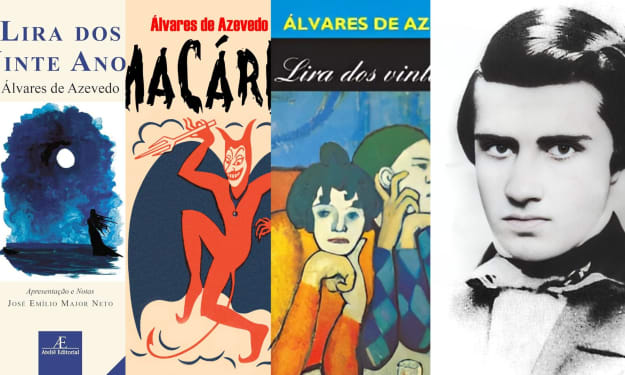
Álvares de Azevedo
In the history of Brazilian literature, few individuals shine as brightly—and as briefly—as Manuel Antônio Álvares de Azevedo (1831–1852). A prodigy of the Ultra-Romantic movement, Azevedo’s existence was a fleeting comet of poetic brilliance, characterized by melancholy, morbidity, and a fixation on love and death. His works, released posthumously, became cult classics, shaping the influence of generations of Gothic and Romantic authors. This article delves into his tumultuous life, his literary impact, and the tragic fate that secured his status as Brazil’s equivalent to Lord Byron.
By A História10 months ago in History
The Night the Radio Terrified America
On the evening of October 30, 1938, the United States was a country on edge. The Great Depression was still casting a long shadow, and the drumbeats of war were growing louder in Europe. Families gathered around their wooden radio consoles, seeking a brief escape through music and drama. What they got instead was a chilling announcement that changed the history of mass media forever: The Martians had landed.
By Irshad Abbasi 4 days ago in History



Comments (1)
Casimiro de Abreu's story is really something. It's amazing how he found his passion for literature despite being pushed into commerce. His love for nature coming through in his poems makes sense, given his upbringing on his mom's farm. It's tragic that tuberculosis cut his life short at 21. Do you think his early experiences had the biggest impact on his writing style, or was it more about the literary circle he was part of?