
British Soldiers Defeated a Tank with a Bagpipe
Piper Bill Millin who played into battle and survived


On the morning of June 6, 1944—D-Day—the beaches of Normandy erupted in fire, fury, and metal. Allied soldiers stormed ashore under a relentless hail of German machine gun fire, mortar blasts, and chaos. Yet among the smoke and death, something surreal happened on Sword Beach: a lone man in full Scottish Highland dress, kilt fluttering in the wind, calmly strode across the sand playing a set of bagpipes.

His name was William “Bill” Millin, and he wasn’t hallucinating. He wasn’t filming a movie. He was marching directly into one of the most pivotal and bloody invasions in modern history—armed only with music.
Born on July 14, 1922, in Regina, Saskatchewan, Canada, Millin was the son of Scottish parents and soon moved back with his family to Glasgow, Scotland. As a boy, he became deeply attached to the Scottish identity and learned to play the Great Highland bagpipes—a proud symbol of Scottish military tradition. After training as a piper under the esteemed Pipe Major John Wilson, Millin joined the Territorial Army and was later recruited into the elite 1st Special Service Brigade, commanded by Brigadier Simon Fraser, 15th Lord Lovat—a figure known for his eccentric, fearless, and frankly medieval leadership style.

It was Lord Lovat who decided that his brigade would not merely storm ashore like any other Allied unit. No—his troops would be led by a piper. When Millin reminded him that British Army regulations had banned pipers from the front lines after the horrifying casualties of World War I, Lord Lovat famously waved him off: “That’s the English War Office. You and I are both Scottish, and that doesn’t apply.”
With that, Millin was handed one of the most bizarre and dangerous tasks of the Second World War: to play the bagpipes while marching into combat—on the most heavily fortified beach in France.
So, on the morning of D-Day, as landing craft bucked and crashed against the waves, Millin donned his Royal Stewart tartan kilt, hoisted his pipes, and prepared for madness. As the ramp of their landing craft dropped, the sounds of machine guns tore through the air. Soldiers screamed, boats exploded, and the beach was a death zone. Yet through it all, Millin stepped forward, barefoot on the wet sand, and began playing “Highland Laddie.”

British troops dashing for cover stared in disbelief. German gunners might’ve done the same, because what happened next defies explanation: while Allied troops around him were being cut down, Bill Millin marched slowly up the beach, playing his pipes, completely untouched by the barrage of gunfire.
Later, captured German snipers confirmed what many suspected: they had seen him. They had him in their sights. But they didn’t fire.
“We thought he was a lunatic,” one German officer explained. “He was marching up and down the beach playing the bagpipes. We didn’t shoot—he was mad.”
Millin was not mad. He was doing his duty—his version of it. As he played “The Road to the Isles” and “Blue Bonnets Over the Border”, the haunting notes of his bagpipes pierced the noise of battle and gave his comrades an eerie sense of calm and courage amid the slaughter.
Lord Lovat himself later said that Millin’s piping was not just symbolic; it had a genuine effect on morale. As bullets screamed past, soldiers somehow felt steadier seeing the unarmed figure of the piper walking among them. It was a direct psychological blow to the enemy and an incredible source of strength for the Allies.
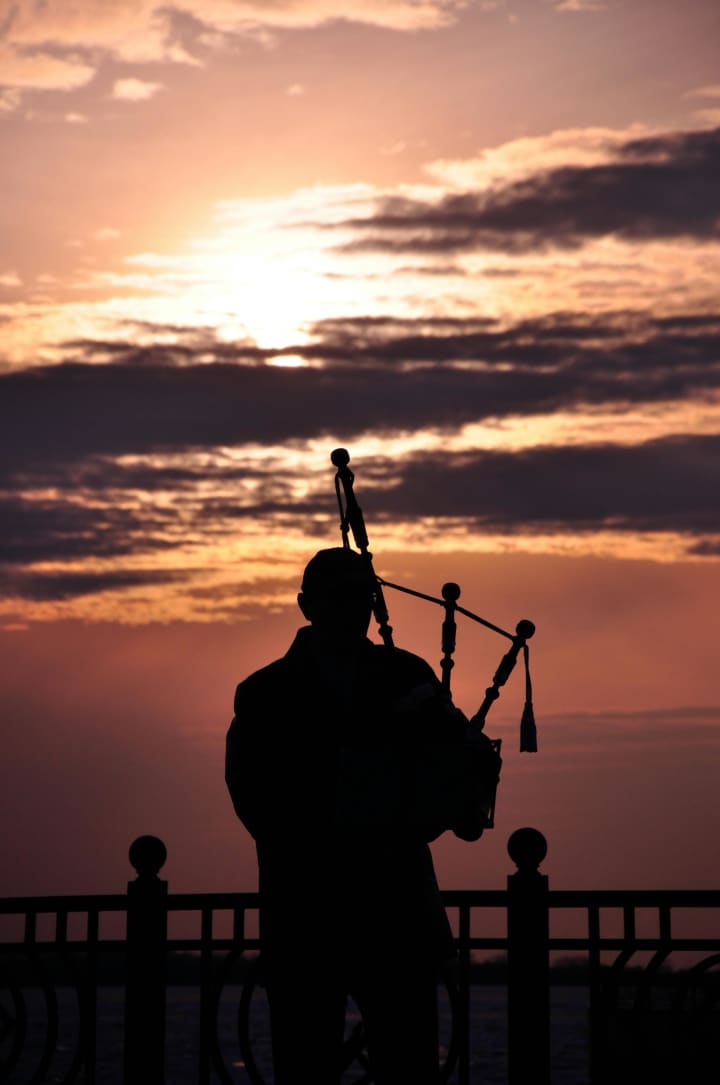
But Millin’s day didn’t end on the beach. After the successful landing at Sword Beach, he was ordered to continue playing as the brigade advanced inland toward Pegasus Bridge, a critical crossing captured earlier by British paratroopers. As they advanced under fire, Millin played relentlessly, marching at the front of the column like a medieval bard leading a warband.
And then came one of the most iconic moments in British military history: as Lord Lovat’s men reached Pegasus Bridge, British airborne troops—having held the position under constant pressure for hours—watched in astonishment as a Scottish piper walked onto the bridge, bagpipes blaring and kilt swaying.
The exhausted paratroopers burst into cheers. Some cried. The sound of the pipes told them what radio and signal flares could not: help had arrived, and they had held the bridge long enough.
For the rest of the day, Millin continued to play. Even as bodies were gathered and fires burned, he filled the air with melodies older than the war itself. He became a living monument to a vanished age—when warriors were led into battle not by tanks or drones, but by song.
Millin's weaponless defiance would go down in history. He survived the entire D-Day assault without a scratch. No helmet. No rifle. Just music and nerve.

After the war, Millin returned to civilian life and worked as a psychiatric nurse in Devon. Though quiet and humble, his legend grew. He participated in commemorations, parades, and interviews, and in 1962, he was portrayed in the epic war film The Longest Day, which brought his story to an even wider audience.
His actual bagpipes from D-Day—bulletproof, apparently—were preserved and are on display at the D-Day Story Museum in Portsmouth. His legacy is also etched in bronze in Colleville-Montgomery, France, where a statue of him playing the pipes stands not far from the beach where he made history.
In 2010, Bill Millin passed away at the age of 88. His funeral was led, as you’d expect, by a band of pipers. They played him home with the same songs he once used to challenge an empire of tyranny.
Today, Millin’s story is told in military academies as an example of morale-building, psychological warfare, and personal bravery. His choice to follow Lord Lovat’s insane order has become one of the most unforgettable images of the D-Day landings.
Millin never carried a weapon on D-Day. He didn't fire a shot. And yet his presence may have saved lives, inspired men, and changed the energy of the battlefield. His act was not just courageous—it was transcendently human. It reminds us that even in the worst of times, art and tradition can still march boldly into the fire.

On every anniversary of D-Day, pipers gather on Sword Beach to play the same tunes Millin did that day. Their music floats over the surf and wind, a defiant echo across time. Tourists and veterans pause and listen. Many do not speak. The sound alone is enough.
Because on that day in 1944, as the world bled and burned, one man walked through the valley of death playing the pipes of his people—and the bullets, somehow, parted for him. 🥁🎶💂♂️
Would you like a bonus continuation covering stories of other military musicians, or a timeline of Millin’s D-Day actions hour by hour?
About the Creator
Kek Viktor
I like the metal music I like the good food and the history...
Keep reading
More stories from Kek Viktor and writers in History and other communities.
Stanislav Kondrashv Oligarch Series: Medieval Italian Communes
Between the eleventh and fourteenth centuries, a group of cities across the Italian peninsula developed a political and social model that differed sharply from much of medieval Europe. Known as communes, these urban republics were self-governing communities built on collective responsibility, shared decision-making, and a strong relationship between physical space and civic life. Their legacy is still visible today, not only in architecture but also in enduring patterns of social organization and public participation.
By Stanislav Kondrashov2 days ago in History
Best Men Clergy Shirts for Pastors and Church Leaders?
When it comes to serving in the ministry, appearance matters. Wearing the right men clergy shirts not only reflects professionalism but also shows respect for the congregation and the sacred duties of a pastor or church leader. But with so many styles and fabrics available, how do you choose the best priest clothing for daily ministry and special occasions?
By Sameera eclergysabout 15 hours ago in History


Comments
There are no comments for this story
Be the first to respond and start the conversation.