
Ashoka and the Three Kings of South India: Power, Diplomacy, and Moral Conquest
Emperor Ashoka the Great of the Mauryan Empire is remembered not only as a mighty conqueror but also as one of history’s most extraordinary moral rulers. While much attention is given to his brutal conquest of Kalinga and his later transformation into a promoter of peace and Buddhism, less discussed—but equally important—is Ashoka’s relationship with the three great kings of South India: the Cholas, Cheras, and Pandyas.

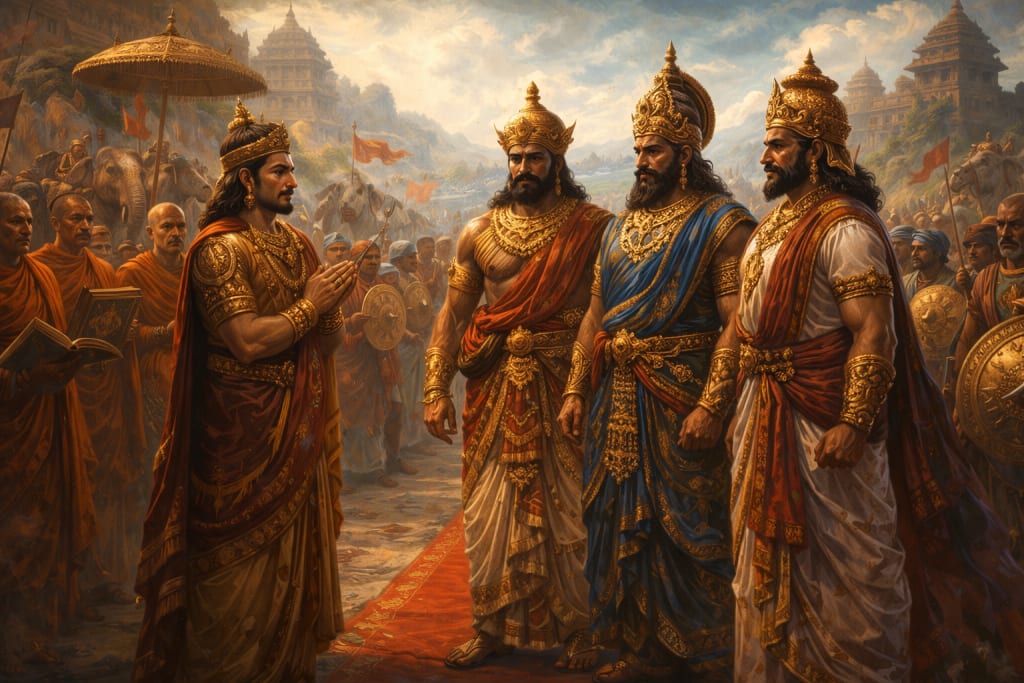
Unlike his northern campaigns, Ashoka did not wage a full-scale war against these southern powers. Instead, his interaction with them reveals a unique blend of political realism, military restraint, and ideological influence.
The Mauryan Empire at Its Peak
By the mid-3rd century BCE, the Mauryan Empire under Ashoka stretched from Afghanistan in the northwest to Bengal in the east, and from the Himalayas in the north to the Vindhya ranges in central India. After the devastating Kalinga War (c. 261 BCE), Ashoka experienced profound remorse over the human cost of warfare. This event marked a turning point in his reign.
Though Ashoka remained a powerful emperor with a massive standing army, he consciously chose a different path—Dhamma (Dharma)—a policy emphasizing moral governance, tolerance, non-violence, and welfare.
The Three Kings of South India
During Ashoka’s reign, South India was ruled by three ancient and powerful dynasties:
The Cholas – Dominant in the fertile Kaveri delta
The Cheras – Ruling parts of present-day Kerala and western Tamil Nadu
The Pandyas – Based in the Madurai region
These kingdoms were culturally rich, economically strong, and politically independent. They controlled important trade routes, especially maritime commerce with Rome, Southeast Asia, and Sri Lanka.
Was There a War Between Ashoka and the Southern Kings?
Historical evidence strongly suggests that Ashoka did not conduct a direct military invasion of the Cholas, Cheras, or Pandyas. This is significant, considering Ashoka’s immense military capability.
In Ashoka’s 13th Rock Edict, he explicitly mentions the southern kingdoms:
“The Cholas, the Pandyas, the Satiyaputras, the Keralaputras…”
This inscription confirms that these kingdoms lay outside Mauryan political control, yet were fully acknowledged by Ashoka. Instead of war, Ashoka pursued diplomacy, cultural influence, and moral authority.
Why Ashoka Did Not Invade South India
Several reasons explain Ashoka’s restraint:
Geographical Challenges
Dense forests, rivers, and mountain ranges made southern campaigns logistically difficult.
Economic Pragmatism
The southern kingdoms were key trade partners. War would disrupt commerce and revenue.
Post-Kalinga Transformation
Ashoka’s conversion to Buddhism led him to renounce aggressive warfare.
Stable Southern Powers
The Cholas, Cheras, and Pandyas were well-organized and not weak targets.
Moral Conquest Instead of Military Conquest
Ashoka introduced the concept of “Dhamma-Vijaya” (Victory through Dharma), replacing “Dig-Vijaya” (Victory through War). This ideological conquest aimed to win hearts rather than territories.
Ashoka sent:
Buddhist missionaries
Medical aid
Herbal and animal welfare knowledge
Moral teachings on tolerance and compassion
These efforts extended to South India, where Buddhism gradually gained influence without coercion.
Cultural Exchange and Religious Influence
Although South India did not become politically Mauryan, Ashoka’s reign contributed to:
The spread of Buddhism in Tamil regions
Construction of stupas and monasteries
Growth of ethical governance ideals
Archaeological findings in Tamil Nadu and Kerala suggest early Buddhist presence, likely supported by Ashoka’s missionary policy.
The Strength of the Southern Kings
It is important to recognize that the southern kings were not passive recipients of Ashoka’s influence. Sangam literature portrays them as:
Brave warriors
Skilled administrators.
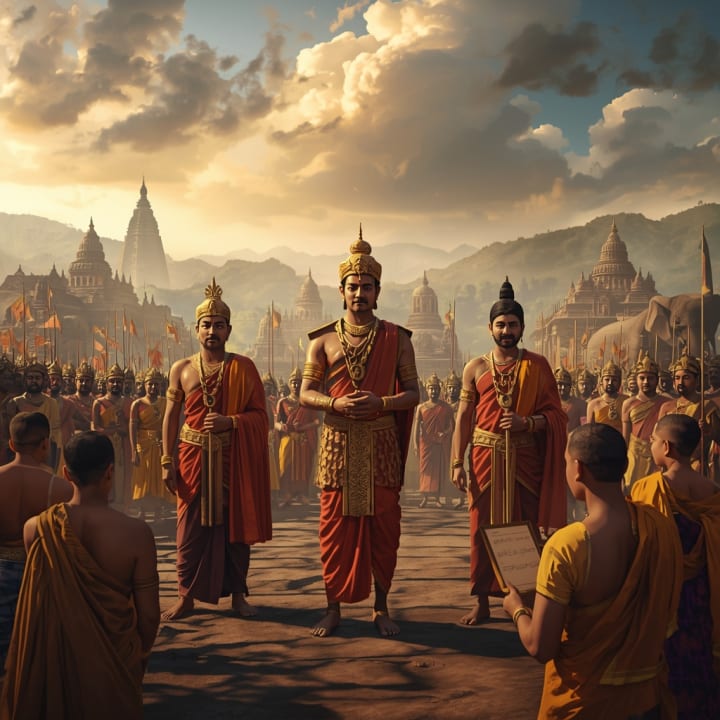
Generous patrons of art and poetry
Their ability to remain independent from the Mauryan Empire highlights their political strength and diplomatic skill.
Ashoka’s Statesmanship: Respect Over Domination
Ashoka’s recognition of southern kings in his edicts shows mutual respect rather than imperial arrogance. He did not attempt forced assimilation but instead acknowledged their sovereignty.
This approach prevented unnecessary bloodshed and maintained long-term stability across the subcontinent.
Historical Significance
The interaction between Ashoka and the southern kingdoms represents:
One of the earliest examples of soft power diplomacy
A shift from military imperialism to ethical governance
Respect for regional diversity within the Indian civilization
Unlike many ancient emperors, Ashoka understood that lasting influence does not always come from conquest.
Conclusion
The story of Ashoka and the three kings of South India is not a tale of battlefield clashes but a profound lesson in leadership. Ashoka, once a ruthless conqueror, chose restraint and moral authority over military domination. The Cholas, Cheras, and Pandyas, in turn, retained their independence while engaging in cultural and diplomatic exchange.
This unique relationship stands as a timeless reminder that true greatness lies not in conquering lands, but in earning respect, spreading wisdom, and governing with compassion.
About the Creator
Say the truth
"Say the Truth: Explain Everything in the World" is your trusted source for uncovering facts and exploring the wonders of history, science, technology, and beyond. We simplify complex ideas and reveal truths to inspire curiosity .
Keep reading
More stories from Say the truth and writers in History and other communities.
Chandragupta Maurya vs the Greek Empire: The Clash That Reshaped Ancient India
Background: Alexander’s Invasion and Its Aftermath The roots of the conflict trace back to Alexander the Great’s invasion of India in 326 BCE. Although Alexander defeated King Porus at the Battle of Hydaspes, his army refused to advance further east. Upon his return westward and his death in 323 BCE, Alexander’s vast empire fractured among his generals, known as the Diadochi.
By Say the truth about 2 hours ago in History
3 Ordinary Places That Hid Something Truly Disturbing for Years
Most of us take comfort in ordinary places. Schools feel safe. Homes feel familiar. Workplaces feel predictable. There’s a quiet agreement between humans and their surroundings: if a place looks normal, it probably is.
By Enoch Sagini7 days ago in History
The Quiet Rise of Global Militarization
The Quiet Rise of Global Militarization Across the world, governments are increasing military spending, expanding defense industries, and modernizing weapons systems—often without openly acknowledging why. There are no formal declarations of war, no mass troop mobilizations, and no clear enemy named in many cases. Yet behind the scenes, a quiet shift is taking place. Global militarization is rising, not loudly, but steadily, reshaping international relations in ways that may define the coming decades.
By Wings of Time 7 days ago in History



Comments
There are no comments for this story
Be the first to respond and start the conversation.