
Araújo Porto-Alegre
The Visionary Who Shaped Brazilian Art and Literature


Manuel de Araújo Porto-Alegre stands out as a remarkable figure in Brazilian cultural history. Born in 1806 in Rio Pardo, located in the southern province of Rio Grande do Sul, Porto-Alegre was truly a visionary. As a painter, poet, playwright, architect, critic, diplomat, and professor, his impact was felt across various fields, securing his essential role in shaping Brazil's cultural identity in the 19th century.
From a young age, Araújo Porto-Alegre exhibited a strong passion for the arts and intellectual endeavors. He was sent to Rio de Janeiro, the former capital of Brazil, to attend the Royal School of Sciences, Arts and Crafts, which later evolved into the Imperial Academy of Fine Arts. During his time there, he received guidance from European artists and scholars, absorbing influences that would inform his classical and romantic preferences.
Yet, his education was not solely characterized by technical proficiency; Porto-Alegre's intellect was also enriched by Enlightenment principles and the emerging romanticism that was taking root in Europe. He quickly became an active participant in Brazil's cultural modernization, merging European artistic styles with the unique elements of Brazilian culture.
Araújo Porto-Alegre is recognized as one of the pioneering figures of Brazilian Romanticism. He was a key founding member of the 'Sociedade Epicureia,' a collective of young Brazilian intellectuals dedicated to literary reform. In 1836, he collaborated with Gonçalves de Magalhães to publish Niterói, a manifesto-journal that is regarded as the official inception of Brazilian Romanticism.
His poetry and essays were characterized by a strong sense of nationalism, often exploring themes related to Brazilian identity, nature, and historical introspection. Although he may not be as widely recognized today as other Romantic poets such as Castro Alves or Gonçalves Dias, Porto-Alegre established much of the ideological foundation for their work. He aimed to free Brazilian literature from the constraints of colonial Portuguese influence, advocating for a style that embraced native landscapes, indigenous themes, and national history.
Additionally, he founded and edited numerous journals and magazines that served as vital platforms for the spread of Romantic and nationalist ideas in Brazil. Through these publications, he not only articulated his own perspectives but also fostered a new generation of writers and intellectuals.
Porto-Alegre made substantial contributions to the visual arts. After his studies in Europe, especially in France and Italy, he returned to Brazil with a fresh perspective on the importance of art in the country's cultural landscape. He took on the roles of professor and later director at the Imperial Academy of Fine Arts in Rio de Janeiro, where he played a pivotal role in shaping academic art in Brazil. He championed the inclusion of local themes in visual arts, urging artists to portray Brazil's landscapes, people, and traditions instead of merely imitating European styles. His own artwork often embodied this philosophy, although he gained much of his recognition through his roles as an educator, critic, and administrator. Under his guidance, the Academy flourished as a nurturing ground for Brazil's emerging artists and architects, promoting a multidisciplinary approach that fused aesthetics with national education and civic pride.
Porto Alegre made a significant yet often overlooked impact in architecture and urban planning. He envisioned Rio de Janeiro as a capital that embodied both beauty and grandeur akin to European cities, while also showcasing a distinct Brazilian identity. His efforts included the design of various public monuments and buildings, as well as active participation in urban enhancement and modernization debates. His architectural style frequently embraced neoclassicism, reflecting his overarching artistic belief in harmonizing tradition with modernity.
Alongside his artistic and literary pursuits, Porto-Alegre held a diplomatic role, serving as Brazil's ambassador to various nations, such as Prussia and Portugal. Throughout these diplomatic missions, he fostered strong ties with European artistic movements, promoting Brazilian culture internationally while also integrating foreign influences into his work. In his later years, he continued to engage as a writer and intellectual, participating in public discussions regarding art, culture, and national identity. He died in Lisbon in 1879, leaving a multifaceted and profound legacy.
Araújo Porto-Alegre's impact is rooted in his comprehensive view of culture. He aimed to integrate literature, art, architecture, and politics into a unified national identity rather than merely excelling in one area. His contributions mirror a pivotal time in Brazilian history when the fledgling nation was striving to establish its identity post-independence from Portugal, and his work was instrumental in forming the intellectual groundwork for a unique Brazilian cultural identity. Although he may not always receive the recognition he deserves today, his legacy is deeply ingrained in the institutions he influenced, the movements he sparked, and the students he mentored. As a trailblazer of Brazilian Romanticism, an innovator in fine arts education, and a cultural representative, Araújo Porto-Alegre demonstrated the significant role of creativity in the process of nation-building.
About the Creator
A História
"Hi. My name is Wellington and I'm a passion for general history. Here, I publish articles on different periods and themes in history, from prehistory to the present day.
Keep reading
More stories from A História and writers in History and other communities.
Gonçalves de Magalhães
In the rich landscape of Brazilian literature, few figures stand out as prominently for their innovative contributions as Gonçalves de Magalhães. Recognized as the father of Brazilian Romanticism, Magalhães’s life and oeuvre represent a crucial shift in Brazil's cultural and literary landscape. His impact extended beyond literature to encompass philosophy, politics, and science, establishing him as one of the most multifaceted intellectuals of 19th-century Brazil. His journey was one of discovery — traversing not just geographical boundaries, but also exploring diverse ideas, literary forms, and the essence of national identity.
By A História10 months ago in History
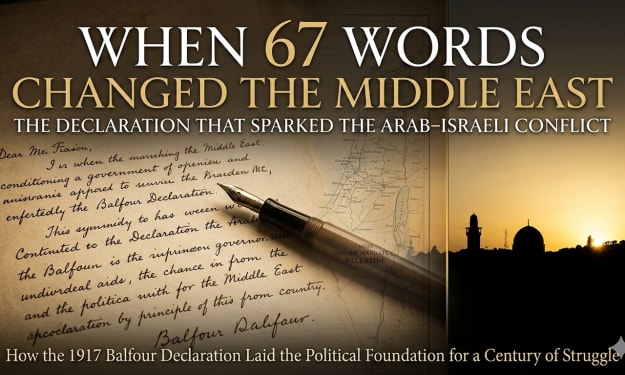
When 67 Words Changed the Middle East: The Declaration That Sparked the Arab–Israeli Conflict
In the long and turbulent history of the Middle East, few political documents have had as profound and lasting an impact as the Balfour Declaration. Written in just 67 words in 1917, this brief letter from British Foreign Secretary Arthur Balfour to Lord Rothschild would go on to shape the destiny of Palestine and lay the foundation for what became the Arab–Israeli conflict. A century later, the consequences of those carefully crafted words continue to influence geopolitics, identity, and regional stability.
By Irshad Abbasi 4 days ago in History
Who is your "Person"?
It's important to recognize that you cannot go through life as easily on your own. My name is Elizabeth and I'm a survivor of child abuse and horrific trauma. Healing from trauma is not a quick fix and recognizing that it will take time, is part of the struggle.
By Elizabeth Woods5 days ago in Psyche



Comments
There are no comments for this story
Be the first to respond and start the conversation.