
Adolf Hitler: Rise and Fall of a Dictator
"Understanding the Man Behind One of History’s Darkest Chapters"

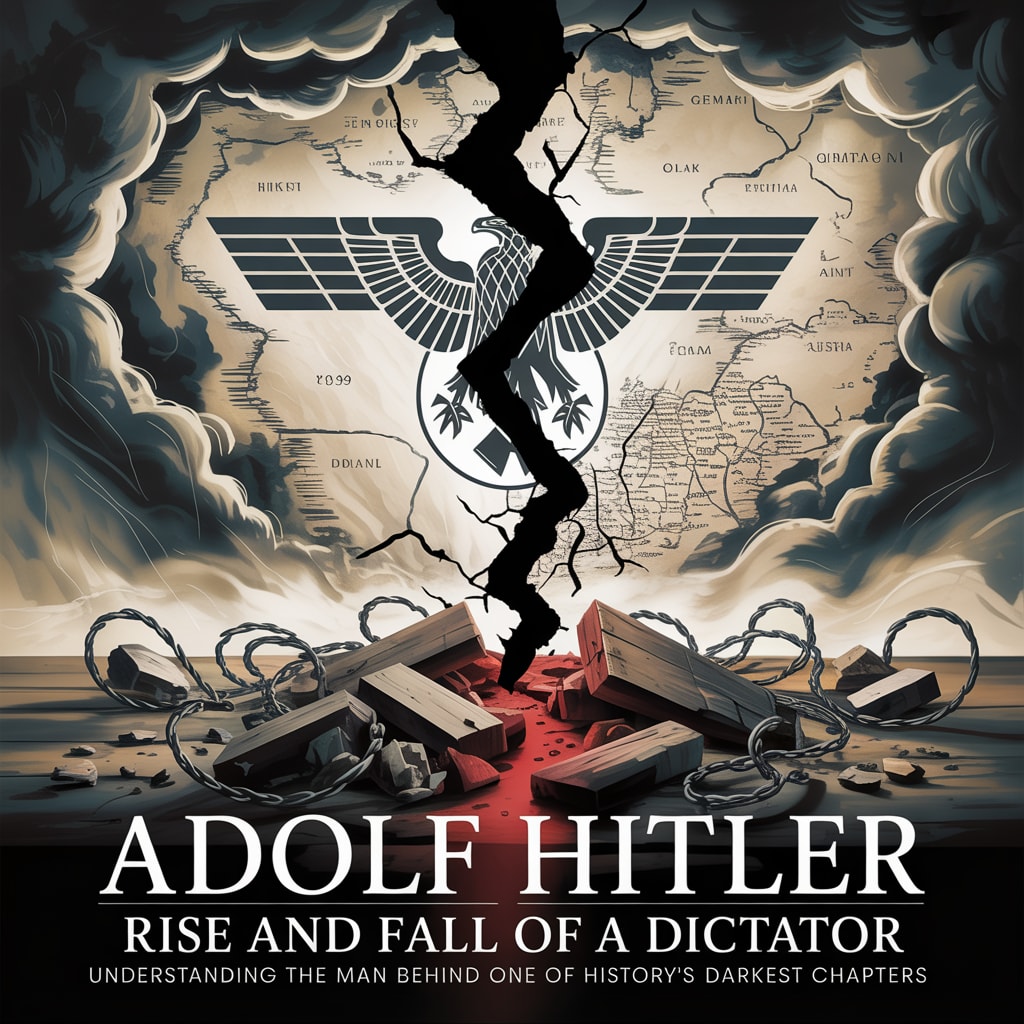
Adolf Hitler: Rise and Fall of a Dictator – Understanding the Man Behind One of History’s Darkest Chapters
Few names in history evoke as much horror, fascination, and debate as Adolf Hitler. Born in Austria in 1889, he would become the architect of one of the most devastating periods the world has ever known. His rise from a disillusioned World War I soldier to the absolute ruler of Nazi Germany illustrates how toxic ideology, charismatic manipulation, and political instability can combine to produce catastrophic consequences. To understand Hitler is not to excuse him, but rather to confront the mechanisms that allowed such a figure to gain power, maintain control, and unleash a wave of destruction that resulted in millions of deaths and the near-collapse of civilization. This is a story not just about a man, but about the dangers of unchecked ambition, racial hatred, and the seduction of authoritarian rule.
Early Life and Influences
Adolf Hitler was born on April 20, 1889, in Braunau am Inn, Austria-Hungary. His early life was marked by instability, conflict with his father, and dreams of becoming an artist. After being rejected twice by the Academy of Fine Arts in Vienna, he fell into poverty and developed deep resentment toward the multicultural makeup of the city, particularly targeting Jews and Slavs. These early years were crucial in forming the ideological seedbed of hatred and nationalism that would later define his political rhetoric.
World War I provided Hitler with a sense of purpose. He served as a soldier in the German army, earning the Iron Cross for bravery. But the war's end brought humiliation to Germany, enshrined in the Treaty of Versailles. Like many Germans, Hitler viewed the treaty as a betrayal, and he blamed Jews and communists for Germany’s defeat—a view widely propagated in the postwar political climate. This "stab-in-the-back" myth became a cornerstone of his future propaganda.
The Rise to Power
Hitler joined the German Workers' Party in 1919, quickly rising to leadership and transforming it into the National Socialist German Workers' Party (NSDAP), or Nazi Party. His oratory skills and mastery of mass propaganda drew support from disillusioned veterans, nationalists, and ordinary citizens burdened by economic hardship.
In 1923, he attempted a coup—the Beer Hall Putsch—which failed, landing him in prison. During his brief imprisonment, he wrote Mein Kampf, outlining his vision of racial hierarchy, German expansionism, and the need for absolute leadership. Although initially dismissed as fringe, Hitler's ideas resonated with a population reeling from hyperinflation, unemployment, and political chaos.
By 1933, the Nazi Party had become the largest in the Reichstag. President Paul von Hindenburg appointed Hitler Chancellor, mistakenly believing he could be controlled. Within months, Hitler consolidated power through the Reichstag Fire Decree and the Enabling Act, which gave him dictatorial authority. The Weimar Republic was dismantled, and Hitler declared himself Führer in 1934 after Hindenburg’s death.
Totalitarian Rule and Ideological Terror
Hitler’s Germany was built on totalitarian control, racial purity, and expansionism. The Nazi regime quickly suppressed opposition, established a police state, and promoted Aryan supremacy. Jews, Roma, disabled individuals, and political dissidents were dehumanized through state-sponsored propaganda and gradually excluded from public life through discriminatory laws.
The Holocaust—systematic genocide targeting Jews—would claim six million lives. Hitler’s obsession with racial purity and “cleansing” Europe of so-called undesirables culminated in industrialized murder in concentration and extermination camps.
Simultaneously, Hitler pursued aggressive foreign policy aimed at reversing the Treaty of Versailles and expanding German territory. The annexation of Austria (Anschluss), the invasion of Czechoslovakia, and the 1939 invasion of Poland triggered World War II.
World War II and Hitler’s Downfall
Initially, Hitler’s military strategies, such as Blitzkrieg (lightning war), brought rapid victories across Europe. However, his decision to invade the Soviet Union in 1941 marked a turning point. Underestimating Soviet resilience and facing the harsh Russian winter, the Wehrmacht stalled.
In 1944, facing growing resistance and Allied advances from both East and West, Hitler’s regime began to unravel. Despite desperate counterattacks like the Battle of the Bulge, Germany’s defeat became inevitable.
By April 1945, Soviet troops had encircled Berlin. On April 30, as Allied forces closed in, Hitler committed suicide in his bunker. One week later, Germany surrendered unconditionally.
Legacy and Cautionary Lessons
Adolf Hitler’s legacy is one of mass death, tyranny, and destruction. Yet it is also a case study in how democratic systems can collapse from within when fear, propaganda, and demagoguery go unchallenged. Hitler did not seize power overnight—he was voted into office, welcomed by elites who underestimated him, and supported by millions who believed his lies or turned a blind eye to his brutality.
Understanding Hitler is essential not to glorify or sensationalize his life, but to recognize the conditions that allowed him to thrive. His story is a chilling reminder of the consequences of hatred, authoritarianism, and silence in the face of injustice. The world must remember so it never repeats.
About the Creator
Abid khan
"Writer, dreamer, and lifelong learner. Sharing stories, insights, and ideas to spark connection."
The Holland Hotel - A Railroad-Era Landmark in East Tawas
When the Holland Hotel opened on July 31, 1893, East Tawas was staking its future on rail connections and lake traffic. Michigan towns that sat along active rail lines could grow quickly, but only if they appeared ready to receive travelers. The Holland Hotel was built to send that signal.
By Paul Austin7 days ago in History
"The Power of Belief: Ideology in the Roman Kingdom"
The Rise of Ideology in the Roman Kingdom In the earliest days of Rome, long before it became a republic or an empire, the Roman Kingdom was bound together by more than kings, armies, or stone walls. What truly unified Rome was a powerful and carefully shaped ideology—one that defined how Romans understood authority, duty, morality, and identity. This ideological foundation transformed a small settlement on the banks of the Tiber River into a disciplined and resilient civilization, prepared to rule others long after its kings were gone.
By The best writer 7 days ago in History



Comments
There are no comments for this story
Be the first to respond and start the conversation.