literature
Geek literature from the New York Times or the recesses of online. Our favorite stories showcase geeks.
Take Another Look.
I recently stumbled across the title of an old book that I read when I was a young teen. One early morning I was searching Spotify for an upbeat playlist of Broadway musical tunes --great for running!-- and found a song from Daddy-Long-Legs. I thought, That is the exact name of a book I read in school! I remembered nothing about it, except that my twelve- or fourteen-year-old self thought that this book ended in a surprisingly happy way. In mid-stride I clicked over to the full album on Spotify and listened to the rest of the songs, confirming that this soundtrack was taken from the book I had read as a child.
By Hannah Marie. 4 years ago in Geeks
10 Great Scenes from Shakespeare Plays
I am a person who adores Shakespeare. I have posters of him in my bedroom, I have his plays in beautiful editions and, oh yeah, I teach Shakespeare Plays too. The way I became interested in Shakespeare was fairly strange. I remember watching Ian McKellan's Macbeth and then Ben Whishaw's Hamlet then basically thinking to myself 'what?' and 'how?' I was shocked at the sheer amount of energy given into these performances, and as the curious nine-year-old I was, I wanted to find out more. Over the years, I became more and more enamoured by Shakespearean Verse, going on to read all of the plays attributed to him (yes, and 'The Arden of Faversham' even though it is not technically canon). And as someone who is now in their mid-20s, I can honestly say that I have spent a good portion of my life researching, studying, re-reading and critiquing the work of the bard.
By Annie Kapur4 years ago in Geeks
Book Review: "The Cement Garden" by Ian McEwan
Domestic Thrillers are a point of interest in my reading life, I have read many from the strange tragedy “The Arden of Faversham” all the way down to the novels of Lisa Jewell and company. There are huge differences throughout history when it comes to the domestic thriller, but I have never quite been able to put my finger on what has been missing until now. Children. Children are not left out, if you ask me. But in the realm of domestic thriller, the ‘thrilling’ nature of the book normally takes place between the mother and father rather than the children and the parents. Be that as it may, I think I have finally found a domestic thriller that does not only the latter one, but seems to do both in quite a stomach churning manner. When I say I have read a lot of Ian McEwan, I even have a signed copy of that book he wrote about Shakespeare’s Hamlet. But, I had constantly overlooked this one for some reason and to be honest, it has thoroughly disgusted and surprised me. But mostly, it disgusted me.
By Annie Kapur4 years ago in Geeks
Book Review: "Water Shall Refuse Them" by Louise McKnight Hardy
I adore the realm of folk horror which tends to include some far-away atmosphere of a forest, wooded area or even something like a ‘Wicker Man’ like surrounding. Only a few books can do that successfully without making it look cliché, forced or even too ‘fairy-tale’ in design. One of the books that does this folklorish atmosphere very well is Daniel Kehlmann’s “Tyll” and another one I will say that is honestly one of the best atmospheres of a novel I have read this year is Louise McKnight Hardy’s “Water Shall Refuse Them”. Now, at first when you start reading the novel, you will never guess what the title means, the penny only really drops at the end and the reason is that you have to read the whole novel to find out why the title is actually very important to make everything fall into place and to help us understand the character of Jennifer. As we delve further into the book, we realise as well that something is seriously wrong with the way that Jennifer presents herself to the reader. The way in which she behaves with her family may seem like the average arrogance of a teenager but, in fact, it is something far more disturbing and to be honest - by the end of the book you will have to make up your own mind about her character.
By Annie Kapur4 years ago in Geeks
"The Picture of Dorian Gray" and Dark Orientalism
Orientalism is a colonial/postcolonial theory that intersperses aestheticism and exoticism within its midst. Written in his book of the same name, Edward Said made a case for why colonial Britain and its imperialist culture used exotic items as a fetishisation and flirtation of wealth. In a decadent culture which was admittedly richly disgusting, the pinnacle of wealth is represented by items from India, Persia and other countries of the Eastern World that were under imperialist rule or were thought to have looser morals than the upper class of the British folk. Another more sinister and yet believable idea of Orientalism is that to own parts of cultures that were either under British rule or, by most, were not but should have been because of the ‘loose morals’ argument was an act of ownership which the British upper class of the late Victorian Era often felt entitled to. Since the empire was theirs, so was the authority and therefore, so were the goods - including the famed diamond which is still in England today. Edward Said states a message about the ideas surrounding this kind of authority and what they mean:
By Annie Kapur4 years ago in Geeks
Book Review: The Assassin's Blade (Throne of Glass series) by Sarah J. Maas
Celaena Sargothien is the most feared assassin in all of Adarlan, and she is only a young girl. Adarlan is a cruel place where magic has been abolished and everyone who practices it tragically wiped out by the King of Adarlan. The Assassin's Blade is a series of five novellas that take place in a range of settings, but predominantly, Rifthold, where Celaena lives in the Assassin's Keep, alongside her archenemy Sam Cortland, and is trained by her master Arobynn Hamel.
By Chloe Anne4 years ago in Geeks
From Page to Handcrafted
Believe it or not, I have lived 1,000 different lives. I have been Persephone, trapped in the underworld with Hades. I have been Poppy, trying to escape a life of imprisonment as the Maiden. I have even been a high fae ruling a kingdom of dreams. Every time I open the new pages of a book I become a new person. I feel their joy, their sorrows, and understand their dreams. These are the feelings I love to bring to life for the others who share my sense of adventure.
By Katie Bruckman5 years ago in Geeks
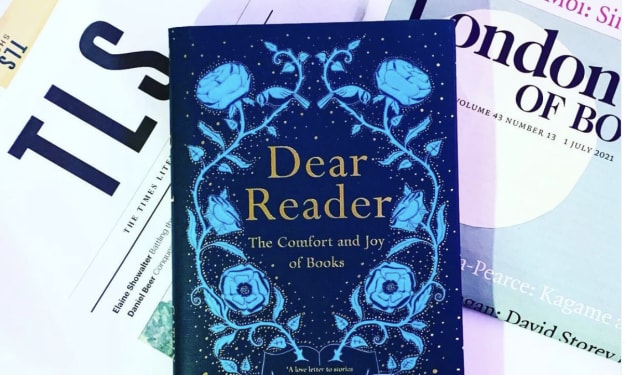
Book Review: "Dear Reader" by Cathy Rentzenbrink
When it comes to writing, I would personally love to write an autobiography like this one when I’m a little older. Writing a book about how much you appreciate books and the authors behind them is a special kind of personal autobiography in which you can really get close to the narrator and where their lives are leading them. It is also a great chance to share some really great book recommendations with the reader. For me, I have read quite a few (but not all!) of the books within this autobiography. I was more or less stunned by the fact that the novel “The Reader” by Bernard Schlink was included. I was told to read that in sixth form and I really did not get over the emotional scarring it left on me. The books are not all good though, some of them are ones that I did not wholeheartedly agree with but then again, it is not my autobiography. You should all take one lesson from this book if any: read what you feel like and do not let anyone else tell you that what you are reading is not ‘worthy’ or that it doesn’t make you ‘academic’ in reading.
By Annie Kapur5 years ago in Geeks
The Manciple's Tale, by Geoffrey Chaucer
A medieval manciple was in effect the quartermaster of an Inn of Court, responsible for buying and looking after the food supplies for the lawyers who lived and worked there. Chaucer’s Manciple looks after the needs of more than thirty men “that weren of lawe expert and curious”, but when it comes to doing deals over the price of food, he “sette hir aller cappe”; in other words, he was the real brains of the place.
By John Welford5 years ago in Geeks
The Man of Law's Tale, by Geoffrey Chaucer
The Man of Law’s Tale (from Chaucer’s Canterbury Tales), with its introduction and epilogue, has been preserved on a fragment of manuscript separate from any other tale. It cannot therefore be certain that Chaucer intended this to be the fifth tale, which is where many modern editions place it. Indeed, it would appear from its epilogue that the Shipman is about to tell the next tale, whereas what we usually get next is the amazing prologue of the Wife of Bath, followed by her tale. This is simply evidence that Chaucer was never able to edit the work as a whole, but it is unfortunate that we cannot relate this tale to its neighbours with any certainty.
By John Welford5 years ago in Geeks
The Importance of Reading “Swann’s Way” by Marcel Proust
Born in the July of 1871 in France, Marcel Proust would go on to write what is considered to be one of the longest novels ever accomplished in human history. Sometimes called either “A Remembrance of Things Past” or more commonly, “In Search of Lost Time” - this book starts off with the first and possibly most famous volume - “Swann’s Way”. “Swann’s Way” is about the narrator’s memory of a man of elegance and style, a Jewish man named Charles Swann who would bring the family apricots in a basket and eventually began speaking to the narrator of a writer that he knew and the young narrator was obsessed with the idea of. But before this, we get various memories of a family who owns a home in Combray and how Charles Swann initially became a hinderance in the narrator’s life. An exercise in the futility of familial relations and a display of how one person can hinder another’s life and upbringing. This metaphorical flower of a narrator can never actually flower since Charles Swann is being entertained downstairs whilst the child narrator is therefore being deprived of his mother’s goodnight kiss and such. There is a massive importance to reading this novel today, especially if you wanted to start to understand how French Literature slowly made its way from Victor Hugo’s older and more revolutionary one into this newer one in which decadence was a slowly dying trade and people were afraid of whenever the next war may break out. The emotional maturity of this novel never ceases to amaze and enlighten me as to exactly how many emotions are actually possible for one human being.
By Annie Kapur5 years ago in Geeks
C S Lewis: an academic best known for his books for children
Clive Staples Lewis was born on 29th November 1898, in Belfast, Northern Ireland. His father was a local solicitor. His mother died when he was nine and he was sent away to school immediately afterwards. After attending several preparatory schools he went to Malvern College where he became interested in Norse and Celtic literature. He also had private tuition that helped him to develop his critical skills to a high degree.
By John Welford5 years ago in Geeks