
Haven Demo Lays the Groundwork for First Private Space Station
“How a single test mission is paving the way for the first fully private orbital station and a new era of commercial space.”


How a single test mission could usher in a new era of commercial space exploration
Space has long been the domain of governments, astronauts, and billion-dollar programs. But with the successful Haven Demo mission, a new frontier is emerging: the first privately operated space station. This milestone signals a shift from state-controlled orbits to a commercialized low-Earth orbit, opening opportunities for research, tourism, and even manufacturing beyond Earth.
---
What is the Haven Demo?
The Haven Demo was a test flight conducted by Haven Aerospace, a private aerospace company aiming to establish a fully operational space station by the mid-2030s. Unlike prior test missions that focused on launching satellites or resupplying the International Space Station (ISS), Haven Demo tested the core modules, docking procedures, and life-support systems for a standalone orbital habitat.
According to company spokespersons, the mission successfully validated:
1. Automated docking systems – allowing future spacecraft to attach safely without manual intervention.
2. Life support redundancy – critical for maintaining stable oxygen, temperature, and pressure in a closed environment.
3. Structural integrity in microgravity – ensuring that modular components can survive long-term exposure to orbital conditions.
This demonstration proves that private companies are no longer dependent on government stations for orbital operations.
---
Why it matters
The Haven Demo lays the groundwork for a completely commercial space station, a concept that was previously the stuff of science fiction. Experts argue that such stations could revolutionize multiple industries:
Scientific Research: Microgravity offers unique conditions for experiments in biology, physics, and material science. Private stations allow researchers to conduct studies without waiting for government approvals or ISS availability.
Space Tourism: Companies like Haven envision orbital hotels or tourism modules, providing a commercial alternative to suborbital flights offered by Blue Origin and Virgin Galactic.
Manufacturing in Space: Certain high-tech products, like fiber optics and pharmaceuticals, benefit from microgravity. A private station could become a hub for zero-gravity manufacturing.
Dr. Lena Rodriguez, an aerospace analyst, explains:
> “The Haven Demo is a clear signal that the private sector can create sustainable operations in orbit. If successful, it reduces dependence on government programs and opens a new chapter in human activity beyond Earth.”
---
How it works
Haven’s approach relies on modular design. Instead of building a single massive station, smaller modules can be launched and linked in orbit. This provides:
Flexibility – modules can be upgraded or replaced without taking the station offline.
Cost efficiency – smaller rockets can deliver parts incrementally, reducing initial expenses.
Safety – redundant modules allow for compartmentalization in case of emergencies.
Additionally, Haven Demo tested autonomous resupply protocols. Automated cargo vehicles docked, offloaded, and departed without human supervision, showcasing the potential for continuous operation without astronauts on site initially.
---
The broader space economy
The commercial space sector has grown rapidly over the past decade. Companies like SpaceX, Blue Origin, and Axiom Space have already paved the way for private orbital operations. Haven’s initiative builds on these foundations, signaling the next step: a fully private orbiting platform.
By 2030, analysts predict the global space economy could exceed $1 trillion, fueled by satellite internet, space tourism, asteroid mining, and private research facilities. Haven’s success positions them as a leader in low-Earth orbit commercialization.
---
Challenges ahead
Despite the promise, private space stations face hurdles:
High Costs: Launching, assembling, and maintaining orbital structures requires billions of dollars.
Regulatory Approval: Nations and international space treaties govern orbital operations, and private stations must comply with safety, debris, and environmental regulations.
Technical Risks: Long-term operation in space presents challenges like radiation, micrometeoroids, and equipment failures.
However, Haven’s demo shows that technological and logistical challenges can be overcome with careful planning and incremental testing.
---
Why it’s historic
Haven Demo represents more than a successful mission; it’s a paradigm shift. For decades, space has been dominated by government agencies like NASA, Roscosmos, and ESA. Now, private entities are demonstrating that they can plan, execute, and sustain operations in orbit independently.
This milestone not only accelerates innovation but also democratizes access to space. Researchers, entrepreneurs, and even tourists may soon experience a permanent private presence in low-Earth orbit, opening opportunities previously unimaginable.
---
Final Thoughts
The success of the Haven Demo is a pivotal moment in human space exploration. It shows that private companies can safely and efficiently operate in orbit, potentially transforming research, tourism, and industry. As we move toward the first privately operated space station, humanity may finally step into a new era: one where space is no longer just a government domain, but a frontier for business, innovation, and exploration.
About the Creator
Fiaz Ahmed
I am Fiaz Ahmed. I am a passionate writer. I love covering trending topics and breaking news. With a sharp eye for what’s happening around the world, and crafts timely and engaging stories that keep readers informed and updated.
Keep reading
More stories from Fiaz Ahmed and writers in Geeks and other communities.
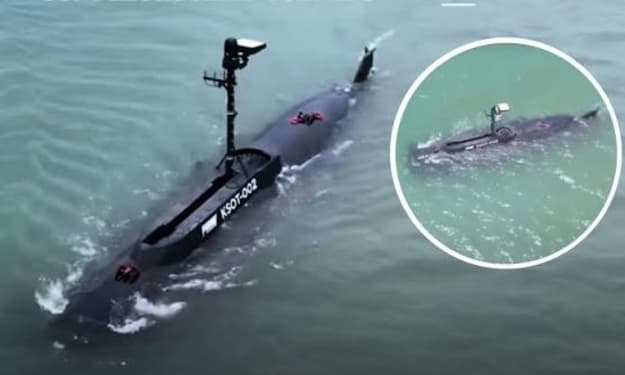
Torpedo Fired from Autonomous Submarine: Stealth Vessel Proves Underwater Warfare Supremacy
Inside the breakthrough that could redefine naval combat and underwater strategy In a remarkable demonstration of modern military technology, a torpedo was recently fired from an autonomous submarine, marking a milestone in naval warfare. Unlike traditional submarines, this unmanned vessel combines stealth, artificial intelligence, and advanced weaponry to operate independently — a development that some experts say may redefine underwater combat forever.
By Fiaz Ahmed 2 months ago in Geeks
Marvel Zombie
The last entry into our 2025 superhero projects catalogue is Marvel Zombies. This was a show that was anticipated by absolutely no one and it disappeared from the public consciousness as quickly as it was released. There was nothing special about the project that made it a must see, or a must remember. In fact if anything it's a must forget.
By Alexandrea Callaghan18 days ago in Geeks
Silver Screen Magic with Mae West
American actress and singer Mae West became a popular film actress during the Great Depression. She started entertaining in vaudeville, then performed on Broadway, and finally went to Hollywood. She signed up with Paramount Pictures and made her debut in the 1932 film “Night After Night.” She also starred in musicals, comedies, and crime dramas. The American Film Institute named her one of the best classic Hollywood actresses.
By Rasma Raistersabout 5 hours ago in Geeks


Comments
There are no comments for this story
Be the first to respond and start the conversation.