
Dangerous Minds (1995) Review: Michelle Pfeiffer Can’t Save This White Savior Drama
Dangerous Minds (1995), starring Michelle Pfeiffer, is remembered for its soundtrack and White Savior clichés rather than storytelling. Here’s why the film has aged poorly—and why it deserves a critical reappraisal 30 years later.

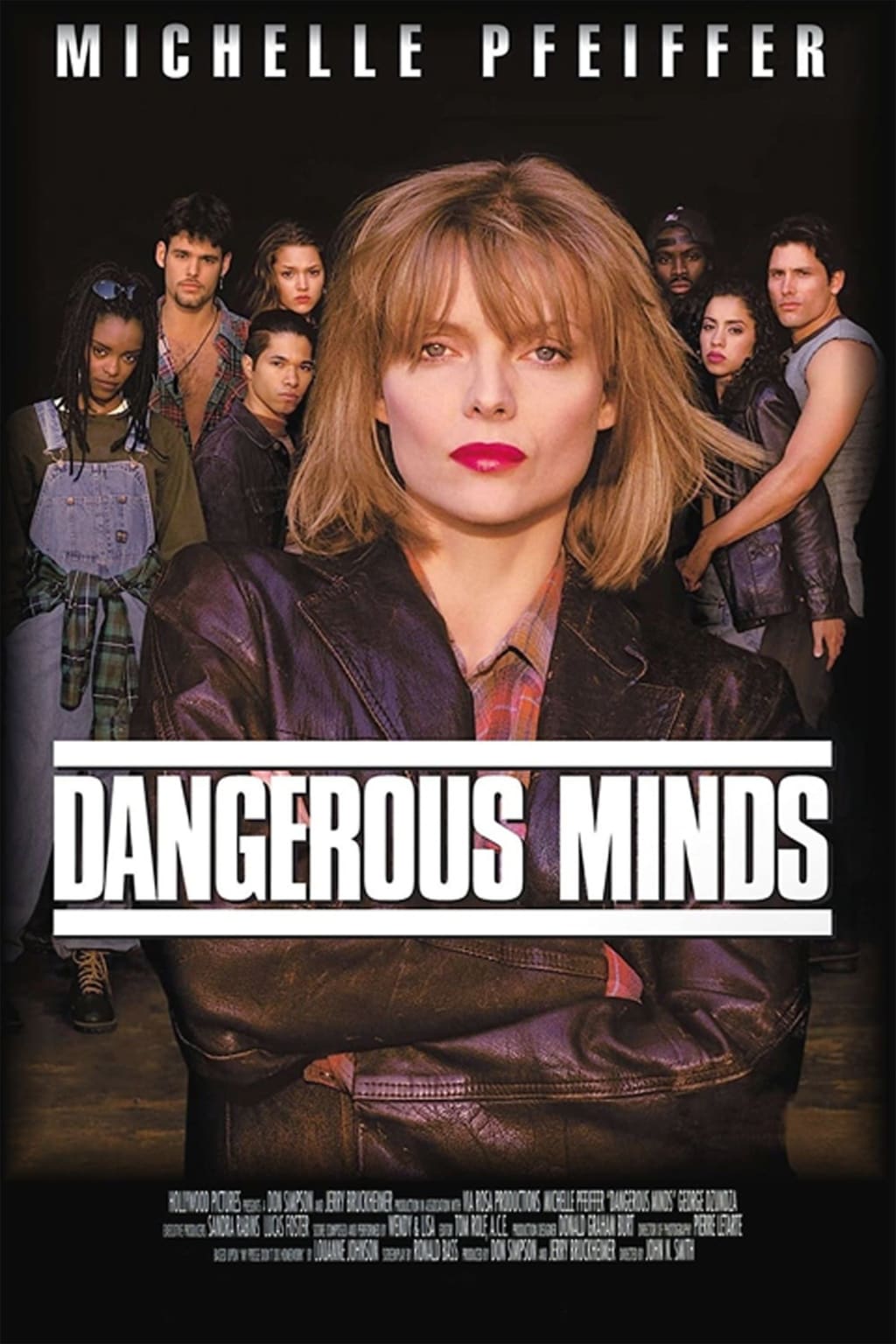
Dangerous Minds
Directed by: John N. Smith
Written by: Ronald Bass
Starring: Michelle Pfeiffer, George Dzundza, Wade Dominguez, Courtney B. Vance
Release Date: August 11, 1995
⭐ 1.5 out of 5 stars
The Problem with Dangerous Minds
The White Savior trope has haunted Hollywood for decades, but it reached a low point in the 1990s. By that time, audiences should have known better, yet studios continued to greenlight stories where a noble outsider swoops in to “rescue” underprivileged communities. Few films illustrate this misstep more than Dangerous Minds (1995), a beige and uninspired melodrama that somehow became a box office hit.
Based on LouAnne Johnson’s memoir—yes, actually titled My Posse Don’t Do Homework—the film tries to transform her real-life experiences as an ex-Marine teaching in California into a gritty inspirational drama. Instead, what we get is a predictable, condescending tale that leans hard on stereotypes while asking Michelle Pfeiffer’s charm to do all the heavy lifting.
⸻
Michelle Pfeiffer vs. the Inner-City Stereotypes
Pfeiffer plays LouAnne Johnson, a former Marine who becomes a teacher despite not holding a teaching certificate. The school, desperate to fill classrooms, places her in charge of a group of so-called “troubled” students. Of course, these kids are written less like people and more like a collection of clichés imagined by a middle-aged white screenwriter.
Every student is a gang member, dancer, or rapper stereotype. Their leader, Emilio (Wade Dominguez), is practically stamped with “dead meat” from his first scene. You can see his tragic fate coming from a mile away: he’s the troubled soul who begins to connect with LouAnne—right before his inevitable death serves as the film’s melodramatic turning point.
⸻
Cringe Lessons and Bob Dylan Metaphors
LouAnne’s teaching methods are equally cringe-inducing. At one point, she writes “Never shoot your homeboy” on the chalkboard and has her students break it down grammatically. Later, she turns to Bob Dylan’s lyrics to explain metaphor and poetry, as if folk music by a 1960s icon is the key to unlocking the minds of 1990s urban teens.
This isn’t empowerment—it’s condescension wrapped in a misguided attempt at “relatability.”
⸻
A Wasted Supporting Cast
The supporting adults in Dangerous Minds don’t fare much better. George Dzundza plays Hal, LouAnne’s fellow teacher and Marine buddy, who drinks, smokes, and coughs his way through scenes with no real purpose. Courtney B. Vance plays the principal in what might be one of the flattest performances of his career. Delivering every line in a monotone affectation, he sounds less like an authority figure and more like an unintentional ASMR experiment.
Meanwhile, Andy Garcia was supposed to play LouAnne’s love interest, but his character was cut from the film. What remains is a story with dangling threads and awkwardly patched holes, making the editing feel more like a TV movie than a feature film.
⸻
Michelle Pfeiffer Can’t Rescue the Script
To her credit, Michelle Pfeiffer is one of the most naturally likable actors of her era. But even she can’t salvage Dangerous Minds. Her character is underwritten, her teaching strategies veer between laughable and insulting, and for some reason she adopts a sporadic Southern accent that comes and goes without explanation. (The real LouAnne Johnson is from Pennsylvania, so this was likely Pfeiffer trying to entertain herself during filming.)
⸻
Why Dangerous Minds Hasn’t Aged Well
Nearly 30 years later, Dangerous Minds feels less like an inspirational teacher drama and more like a cultural artifact—a reminder of how badly Hollywood misunderstood representation in the 1990s. The seams are obvious, the plot threads fray, and the film’s condescending message only grows more grating with time.
Sure, the film was a commercial hit—boosted by Coolio’s “Gangsta’s Paradise,” which became one of the biggest soundtrack singles of the decade. But while the song endures, the film itself has slipped into obscurity, remembered more for its clichés than its craft.
⸻
Final Thoughts
Dangerous Minds is technically competent but fatally flawed. It’s a movie that mistakes stereotypes for depth, clichés for inspiration, and melodrama for meaning. Even Michelle Pfeiffer, one of the best actresses of the 1990s, couldn’t save it.
⭐ 1.5 out of 5 stars
If you want to revisit the cultural missteps of 1995 cinema, check out the upcoming episode of the I Hate Critics 1995 Podcast, where Dangerous Minds is featured. It’s a fascinating way to see how films once marketed as serious dramas can look completely different with 30 years of hindsight.
Tags
Dangerous Minds review, Michelle Pfeiffer Dangerous Minds, Dangerous Minds 1995, White Savior movies, 90s teacher dramas, Dangerous Minds soundtrack, Gangsta’s Paradise, Dangerous Minds Michelle Pfeiffer review, I Hate Critics Podcast
About the Creator
Sean Patrick
Hello, my name is Sean Patrick He/Him, and I am a film critic and podcast host for the I Hate Critics Movie Review Podcast I am a voting member of the Critics Choice Association, the group behind the annual Critics Choice Awards.
Keep reading
More stories from Sean Patrick and writers in Geeks and other communities.
Silver Screen Magic with Mae West
American actress and singer Mae West became a popular film actress during the Great Depression. She started entertaining in vaudeville, then performed on Broadway, and finally went to Hollywood. She signed up with Paramount Pictures and made her debut in the 1932 film “Night After Night.” She also starred in musicals, comedies, and crime dramas. The American Film Institute named her one of the best classic Hollywood actresses.
By Rasma Raisters5 days ago in Geeks
Twitter Outage
For millions of users around the world, Twitter—now known as X—is more than just a social media platform. It’s a real-time news source, a communication tool, and a digital town square. So when a Twitter outage occurs, confusion spreads quickly. Users rush to search questions like “is Twitter down?”, “is X down right now?”, or “why is X not working?” hoping for clarity. In recent years, X outages have become highly visible events, often trending across other platforms within minutes. Whether the issue lasts a few minutes or several hours, a Twitter down situation highlights how deeply embedded the platform is in daily online life. When Twitter Goes Down: What Users Experience During a typical Twitter down incident, users may encounter several problems at once. Timelines stop refreshing, posts fail to load, and notifications disappear. Some users can open the app but see blank feeds, while others are completely locked out. These moments spark a flood of searches like “is Twitter down right now?” and “Twitter not working.” As branding has shifted, the same frustration now appears under newer searches such as “is X down?”, “X down?”, or “X is down.” The name may have changed, but user expectations remain the same: instant access and real-time updates. The Role of X Down Detectors and Status Tools When users suspect an outage, many turn to tools like X down detector or Twitter down detector websites. These platforms collect real-time reports from users and visualize spikes in complaints. A sudden surge often confirms that the issue isn’t isolated. People also search for Twitter status updates, hoping for official confirmation. While X occasionally posts updates during major outages, users often rely on external sources first—especially when the platform itself isn’t accessible. Is X.com Down or Something Else? One of the most common questions during an outage is “is x.com down?” While it may appear that the entire platform is unavailable, the underlying cause can vary. Sometimes the issue affects only certain regions, mobile apps, or specific features like posting or direct messages. In other cases, users notice that third-party integrations fail. This leads to additional searches such as “X not working” or “is X down?” as people try to determine whether the problem lies with their device, internet connection, or the platform itself. Cloudflare and Large-Scale Outages Occasionally, outages are linked to infrastructure providers rather than X directly. Cloudflare, a major content delivery and security service used by many large websites, has been associated with widespread disruptions across the internet. During a Cloudflare outage, multiple platforms can experience downtime simultaneously. When this happens, searches for “Cloudflare outage” often rise alongside “Twitter is down.” These events show how interconnected modern platforms are and how a single failure point can affect millions of users at once. Grok Down: A New Kind of Concern With the introduction of AI-powered features, outages now extend beyond basic posting and browsing. Some users have reported instances of Grok down during broader X outages. When Grok, the platform’s AI assistant, stops responding, it adds another layer of frustration—especially for users who rely on it for research, summaries, or creative tasks. As X continues to expand its feature set, future outages may impact different services independently, making it harder to quickly understand what exactly is broken. Why Twitter Outages Feel So Disruptive Unlike many platforms, X thrives on immediacy. It’s often the first place people go during breaking news, global events, or emergencies. When Twitter is down, users lose access to real-time conversations and firsthand updates. This is why even short outages trigger widespread concern. Questions like “is Twitter down?” or “is X down right now?” aren’t just about inconvenience—they reflect a sudden loss of connection to the global conversation. How Users Cope When X Is Down When an X outage occurs, users often migrate temporarily to other platforms to confirm the issue or share updates. Ironically, people frequently use those platforms to say that Twitter is unavailable. In the meantime, down-detector sites, tech forums, and news outlets become the primary sources of information. For creators, journalists, and businesses, downtime can disrupt workflows and audience engagement. Scheduling posts, responding to trending topics, or managing customer communication becomes impossible until service is restored. What Outages Reveal About Digital Dependence Every major Twitter outage serves as a reminder of how dependent modern communication has become on a few centralized platforms. Whether the search term is “Twitter down?” or “X down?”, the concern is universal. While most outages are resolved relatively quickly, their impact lingers. They raise questions about platform stability, transparency, and the importance of having alternative channels for communication. Final Thoughts A Twitter outage—or X outage—is rarely just a technical hiccup. It’s a moment that exposes how essential the platform has become for news, discussion, and connection. From searches like “is Twitter down right now?” to monitoring X down detector reports, users instinctively seek reassurance and answers.
By Saboor Brohi a day ago in Geeks



Comments (1)
Not crazy about this flick. But still a loyal Michelle Pfeiffer fan. She's “white gold” like Bruno Mars says. LOL.