
Time Travel: Science, Possibility, and Paradoxes
"Exploring the physics, paradoxes, and future of time travel."

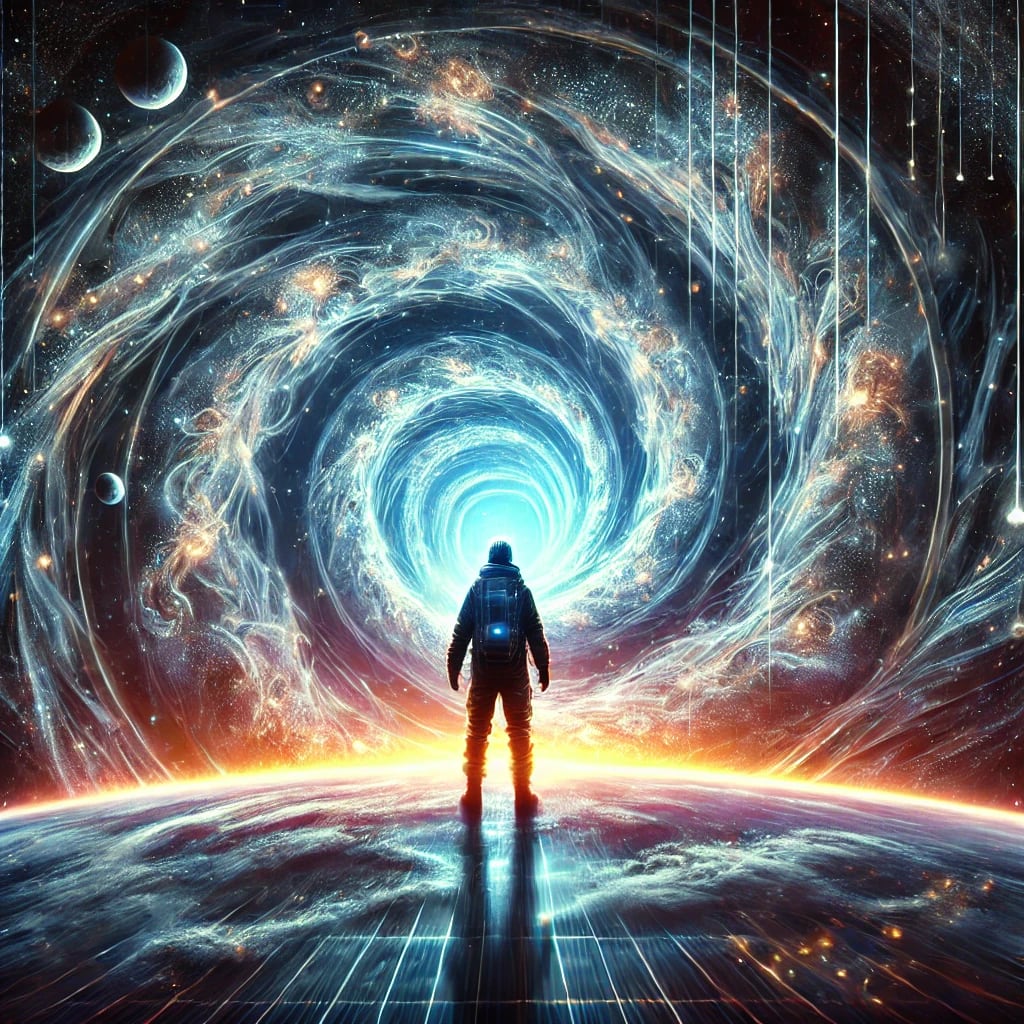
Since the dawn of civilization, humans have been fascinated by the idea of time travel. From ancient myths to modern-day science fiction, the dream of stepping into a machine and journeying into the past or future has captured our imagination. But could time travel ever become a reality? Or is it destined to remain within the pages of novels and the frames of blockbuster movies?
While time travel has long been a theoretical puzzle, modern physics offers intriguing possibilities. Concepts from Einstein’s theory of relativity, wormholes, quantum mechanics, and closed time-like curves suggest that under the right conditions, bending time might not be entirely impossible.
So, let’s take a deep dive into the science, paradoxes, and potential future of time travel to uncover whether we’ll ever be able to break free from the constraints of time.
Einstein’s Relativity: The Foundation of Time Travel
To understand time travel, we must first understand Albert Einstein’s theories of relativity, which revolutionized our understanding of space and time.
1. Special Relativity and Time Dilation
Einstein’s Special Theory of Relativity (1905) showed that time is not absolute—it is relative and can slow down or speed up depending on how fast an object moves.
🔹 Time Dilation Effect: If you travel at speeds close to the speed of light, time for you slows down relative to those on Earth. This means astronauts moving at near-light speeds could experience only a few hours, while decades pass for those left behind.
🔹 The Twin Paradox: If one twin travels at near-light speed while the other stays on Earth, the traveling twin ages slower and returns younger than their sibling—a real example of forward time travel proven by experiments with atomic clocks.
2. General Relativity and Warping Time
Einstein’s General Theory of Relativity (1915) introduced the concept that massive objects, like planets and black holes, bend space-time, creating gravitational effects that also influence time.
🔹 Gravitational Time Dilation: The closer you are to a strong gravitational field, the slower time moves. This was observed with astronauts on the International Space Station, where time moves slightly faster than on Earth.
🔹 Black Holes as Time Machines: If you orbit a supermassive black hole without falling in, time for you would move much slower than for those farther away—creating a real-life effect of traveling to the future.
But what about traveling to the past? That’s where things get more complicated.
Wormholes: Theoretical Time Portals?
A concept often explored in science fiction is wormholes—shortcuts through space-time that could, in theory, allow for time travel.
🔹 What Are Wormholes? Theoretical passages connecting two points in space-time, first predicted by Einstein and physicist Nathan Rosen in 1935 (Einstein-Rosen Bridges).
🔹 Can They Be Time Machines? If one end of a wormhole experiences time dilation (for example, by moving at near-light speed), stepping through it could allow someone to travel backward or forward in time.
🔹 The Problem? Wormholes are extremely unstable and would collapse instantly unless held open by an unknown exotic material with negative energy.
Scientists like Kip Thorne (who consulted on Interstellar) suggest that if we discover a way to stabilize wormholes, they could function as time machines.
Paradoxes: The Dangers of Changing the Past
Even if time travel were possible, it raises serious logical contradictions known as time travel paradoxes.
1. The Grandfather Paradox
One of the most famous paradoxes: If you travel back in time and prevent your grandfather from meeting your grandmother, you would never be born. But if you were never born, how did you go back in time?
2. The Bootstrap Paradox
A time loop where an object or piece of information has no clear origin. Imagine a scientist travels back in time and gives Einstein the equations for relativity before Einstein discovers them. Who originally invented the theory?
3. The Butterfly Effect
Small changes in the past could cause massive unintended consequences in the present. This is a key theme in movies like The Butterfly Effect and Back to the Future.
Some theories suggest that paradoxes could be avoided through alternate timelines or multiverse models, where each time travel event creates a new, separate reality.
Could Time Travel Ever Be Achieved?
Physicists are divided on whether time travel is truly possible. Some potential methods include:
🔹 Cosmic Strings: Hypothetical 1D defects in space-time that could allow closed time loops.
🔹 Rotating Universes: Discovered by Kurt Gödel, suggesting a spinning universe could allow paths that return to the past.
🔹 Quantum Mechanics & Time Loops: Some theories propose that quantum entanglement might hold the key to understanding time’s flow and reversibility.
However, huge challenges remain—including the vast amounts of energy required, potential causality violations, and whether the laws of physics would even permit time travel at all.
Final Thoughts: Science Fiction or Future Reality?
Time travel remains one of the greatest mysteries of the universe. While forward time travel (via time dilation) is already proven, traveling to the past remains a theoretical challenge filled with paradoxes and unanswered questions.
Yet, as physics continues to evolve, we may one day uncover the secrets of time itself. Perhaps the time travelers of the future are already among us—waiting for the moment when science catches up to imagination.
Until then, the dream of time travel continues to fascinate, inspire, and challenge the very nature of reality.
About the Creator
Ahmet Kıvanç Demirkıran
As a technology and innovation enthusiast, I aim to bring fresh perspectives to my readers, drawing from my experience.
Keep reading
More stories from Ahmet Kıvanç Demirkıran and writers in Futurism and other communities.
The Digital Afterlife: Can Technology Make Us Immortal?
For as long as humans have existed, we have been obsessed with the idea of immortality. Ancient rulers built pyramids to preserve their legacies, alchemists searched for the elixir of life, and philosophers debated the nature of the soul. But what if the key to eternal life isn’t in magic or mythology—but in technology?
By Ahmet Kıvanç Demirkıranabout a year ago in Futurism
Writing To Succeed
If you want to find something that will help readers find your writing, possibly expand your audience, and maybe even get you noticed for other things, then you’re not alone. But how can you get it done in a world full of want-to-be writers? Look less at what you’re writing now, and more at what other writers have used to boost their views and reads.
By Jason Ray Morton 6 days ago in Writers




Comments
There are no comments for this story
Be the first to respond and start the conversation.