future
Exploring the future of science today, while looking back on the achievements from yesterday. Science fiction is science future.
When Algorithms Decide: The Ethics of Artificial Intelligence
Artificial intelligence is no longer a concept confined to the pages of science fiction novels or the speculative musings of Silicon Valley futurists. It is here, embedded in the infrastructure of modern life, quietly shaping decisions that affect who gets hired, who receives medical treatment, who is granted a loan, and who is flagged as a security risk. We have handed extraordinary power to systems we barely understand, and the ethical reckoning is only just beginning.
By noor ul aminabout 12 hours ago in Futurism
Journal of Behavioral Homeostasis
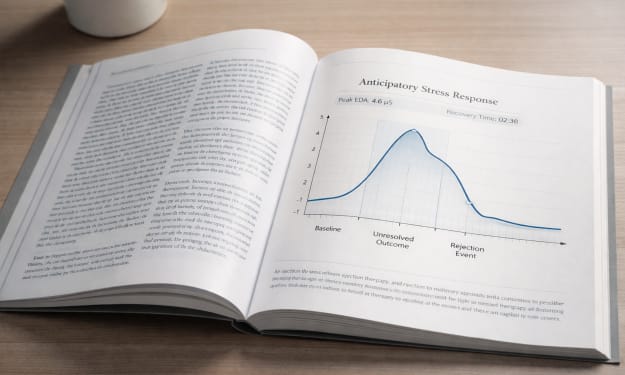
Journal of Behavioral Homeostasis Vol. 52, Issue 1 (2043) On the Therapeutic Function of Rejection Yielded Expectation Adaptation and the Regulation of Anticipatory Stress Abstract Chronic exposure to unresolved outcomes has emerged as a significant source of sustained psychological stress in contemporary environments characterized by continuous evaluation and delayed feedback. Yielded Expectation Adaptation (YEA) therapy was developed to reduce distress associated with rejection through structured exposure to definitive negative outcomes. Early clinical trials demonstrated measurable reductions in physiological arousal and cognitive rumination following controlled refusal events, despite participants reporting subjective disappointment. Subsequent adoption beyond clinical settings introduced voluntary and recreational applications collectively described as “outcome rehearsal.” This study examines therapeutic efficacy alongside broader cultural implications arising from the normalization of definitive outcomes as a mechanism of emotional regulation. Background Modern individuals navigate an unprecedented volume of unresolved outcomes. Applications remain pending without timelines. Messages linger unanswered. Creative work circulates through opaque review systems that offer neither clarity nor closure. Even social interaction increasingly unfolds within structures that defer resolution, producing prolonged periods of suspended expectation. While anticipation has traditionally been framed as motivational tension, emerging research suggests that sustained uncertainty carries significant cognitive and physiological costs. Patients presenting with chronic anticipatory stress frequently describe difficulty disengaging from unresolved possibilities, reporting persistent rumination, impaired attentional recovery, and elevated baseline anxiety. Clinical observation revealed an unexpected pattern: for many individuals, the distress associated with waiting exceeded the distress of rejection itself. Participants described negative outcomes as “sharp but clean,” contrasting them with the diffuse strain of indefinite possibility. Once an outcome was known — even an unfavorable one — subjects reported immediate reductions in cognitive load and renewed capacity for directed attention. These observations prompted investigation into whether rejection, when encountered deliberately and under controlled conditions, might function not solely as a negative experience but as a regulatory one. Yielded Expectation Adaptation therapy emerged from this line of inquiry. The approach centers on structured exposure to definitive refusal, designed to reduce anticipatory distress by recalibrating emotional responses to negative outcomes. Early implementations included simulated evaluative scenarios, scripted interpersonal declines, and guided exercises in which participants intentionally sought low-stakes rejection experiences. Initial reception within clinical communities was cautious. The idea that rejection might serve therapeutic ends appeared counterintuitive; however, preliminary findings consistently demonstrated improved physiological recovery following outcome resolution. Participants did not report enjoying rejection. They reported relief at the end of waiting. Subsequent literature began referring to the model simply as YEA therapy. Early Clinical Findings Pilot studies focused on individuals experiencing persistent anticipatory distress, including professionals navigating competitive hiring processes, creatives engaged in repeated submission cycles, and individuals reporting prolonged uncertainty within interpersonal relationships. Across multiple trials, participants undergoing YEA therapy demonstrated faster emotional recovery following negative feedback compared to control groups receiving traditional cognitive reframing interventions. Notably, the therapeutic effect appeared tied not to reinterpretation of rejection but to outcome definitiveness. When uncertainty was removed, even unfavorable results allowed subjects to reorganize attention and resume forward-directed behavior. Emotional stabilization occurred independently of outcome desirability. Whether such stabilization enhances persistence toward uncertain objectives was not assessed in initial trials. Initial findings were drawn from three pilot cohorts totaling 124 participants across clinical and non-clinical populations. Measures included heart-rate variability, post-session cortisol sampling, and standardized rumination inventories administered at 24-hour intervals. While sample sizes were limited, consistency across cohorts prompted further investigation into non-traditional applications of the model. Researchers initially framed these findings as evidence that emotional regulation may depend less on outcome valence than on outcome clarity — a distinction that would later prove central to understanding YEA’s broader cultural trajectory. Expansion Beyond Clinical Contexts As familiarity with YEA therapy increased, individuals began applying its principles independently outside clinical settings. Participants experimented with deliberate exposure to minor refusals, describing the practice as preparation rather than treatment. Examples included requesting unlikely accommodations, submitting creative work to rapid-response review forums, and engaging in structured interpersonal exchanges designed to produce immediate closure. In some peer-led sessions, participants delivered timed refusals limited to brief standardized phrases, preventing narrative elaboration and accelerating outcome resolution. These practices were soon described collectively as outcome rehearsal. The stated aim was efficiency: eliminate prolonged anticipation, reduce emotional backlog, restore equilibrium. Online communities formed around shared rehearsal strategies. Forums tracked experiments in shortening decision cycles. Informal gatherings organized structured refusal exchanges modeled on early YEA exercises. Participants described feeling clearer following sessions, attributing relief not to rejection itself but to the restoration of certainty. By 2041, digital platforms offered guided outcome simulations. Users submitted proposals or personal statements for predetermined rejection responses, receiving definitive outcomes in place of extended uncertainty. What began as resilience training increasingly functioned as routine maintenance. Longitudinal Observations Extended tracking of frequent YEA participants revealed sustained reductions in anticipatory distress across professional and interpersonal domains. Subjects reported decreased reactivity to uncertainty and increased willingness to disengage from prolonged evaluative processes. Participants described these changes as increased realism or maturity. However, longitudinal analysis identified convergence toward modest, low-volatility objectives and a gradual reduction in variance among reported long-term goals. Engagement with speculative creative work, competitive applications, and relational pursuits involving delayed feedback declined across cohorts. These shifts were rarely framed as losses. Participants instead described calibration, emphasizing efficiency and emotional sustainability. Goal selection trended toward incremental trajectories. Despite these patterns, expressions of desire for authentic acceptance outcomes remained consistent. Participants reported increasing comfort with rejection while continuing to articulate longing for genuine affirmation. Rejection, when rehearsed, appeared to lose much of its destabilizing force. Whether it also lost its capacity to clarify what was genuinely wanted remained unclear. Discussion The widespread adoption of YEA suggests that relief from uncertainty fulfills a significant psychological need. Across populations, participants demonstrate reduced anticipatory distress following structured exposure to definitive outcomes. Emotional recovery accelerates. Rumination declines. Individuals report increased stability and improved capacity to disengage from unresolved possibilities. These outcomes align with predictive regulation models, which propose that the brain prioritizes clarity over desirability when restoring equilibrium. Rejection functions less as injury than as resolution — a definitive update that permits cognitive reorganization. The normalization of outcome rehearsal may therefore represent an adaptive response to environments saturated with deferred evaluation. Participants frame YEA engagement as a method of preserving energy, shortening the waiting cycle, and maintaining emotional efficiency. Longitudinal findings suggest equilibrium and expansion may not scale proportionally. Frequent YEA engagement correlates with decreased participation in high-variance pursuits and reduced tolerance for prolonged uncertainty. Emotional volatility declines alongside willingness to pursue outcomes perceived as unlikely. Participants continue to describe themselves as hopeful. Structured rejection reduces destabilization but does not eliminate longing. The wish to be chosen persists even as individuals become increasingly skilled at rehearsing refusal. It remains unclear whether the growing cultural preference for definitive outcomes represents an evolution in resilience or a recalibration of perceived attainability. Emotional equilibrium may be achieved through strengthened tolerance of disappointment. It may also be achieved through subtle contraction of the scale at which individuals are willing to hope. Further research is required to determine whether widespread engagement with YEA strengthens individuals against disappointment — or gradually reduces the range of futures they consider reachable. Author’s Notes: Current findings suggest that individuals do not appear to want less; rather, they appear increasingly practiced at relinquishing desire before it encounters resistance. The reduction of distress may indicate progress; whether it reflects expansion or contraction remains unresolved.
By Mina Carey2 days ago in Futurism
Alzheimer’s Disease, the Renin-Angiotensin System, and COVID-19
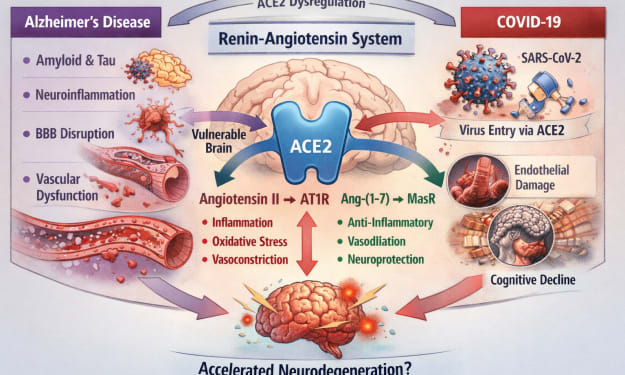
I. Alzheimer’s Disease: More Than Amyloid Alzheimer's disease has long been framed as a proteinopathy defined by extracellular β-amyloid plaques and intracellular tau tangles. While these remain central pathological hallmarks, the explanatory model of the disease has expanded considerably over the past two decades.
By Alain SUPPINI5 days ago in Futurism
Apple iPhone Manufacturing in Pakistan – A New Era for Local Technology Industry . AI-Generated.
Apple iPhone Manufacturing in Pakistan – A New Era for Local Technology Industry Introduction Pakistan’s technology and manufacturing sector is on the verge of a historic transformation. With global smartphone giant Apple planning to begin iPhone refurbishment and manufacturing operations in the country, the development signals a powerful shift in Pakistan’s role within the international electronics supply chain.
By Muhammad Abbas khan5 days ago in Futurism
Let’s Be Real: Can AI Ever Truly Feel the Spark of Creativity?. AI-Generated.
Honestly, I’ve spent the last few days playing around with AI. It’s everywhere—from our Spotify lists to our smart homes. It’s almost impossible to go a single day without interacting with some form of an algorithm. And while everyone is panicking about ChatGPT taking over the world and replacing every job on the planet, I started thinking about something deeper. I started wondering: Can a bunch of cold, calculated code and mathematical algorithms ever really understand the messy, beautiful, and sometimes chaotic "soul" that humans put into their work?
By Umar Waleed6 days ago in Futurism
Digital Echo: How My "What’s up?" Builds Machine Intelligence 🤖
Moving from the rainy UK 🇬🇧 to sunny Italy 🇮🇹 was more than just a change of scenery; it was a total lifestyle overhaul. I traded the factory floor for a home office and physical labor for a freelance career in the fast-paced world of AI. Most people, when they hear about working in Artificial Intelligence, imagine writing complex algorithms or analyzing massive datasets—the kind of work I do in search relevance 📊. But there is another, much more monotonous side to this business: providing voice samples to train speech models. 🎤
By Piotr Nowak6 days ago in Futurism
Forget Coding: How "AI Power Users" Are Building the Next Generation of Million-Dollar Businesses. AI-Generated.
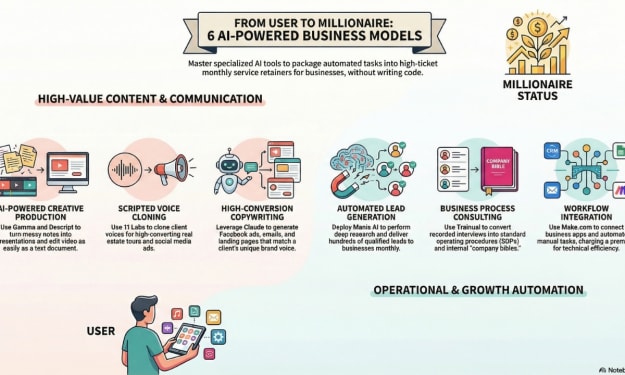
1. Introduction: The Death of the Developer Moat The technical moat is dead. For decades, a Computer Science degree was the ultimate gatekeeper to the digital economy—the ability to write code was the only way to build a scalable business. That barrier has been pulverized.
By Mohammad Hamid8 days ago in Futurism
Semiconductors Had Their Run. Here's Where I'm Putting My Money Next.
Let me tell you what I believe. Semiconductors - the chips that power everything from your phone to AI data centers - have been the greatest wealth-building sector of the last decade. If you held SMH (the semiconductor ETF) for the past 10 years, you're up roughly 15x.
By Destiny S. Harris9 days ago in Futurism
10 Mind-Blowing Space Stories School Never Told You
For many of us (especially if you grew up watching Star Trek), space truly feels like the final frontier. Sure, school taught us about planets, gravity, and maybe a little about rockets. But what we got was just a glimpse of the safe, simplified version.
By Areeba Umair9 days ago in Futurism