Microfiction
Simulationalism
There are a group of people for whom the simulation hypothesis is no longer a hypothesis. They believe with their entire beings, their whole hearts and minds, that we are indeed simulated beings living in a simulated world. In the mid to late 1980s, some of them, how many it is impossible to say, banded together to found a church, the Church of Simulationalism also known as the Simulationist Church. Through the process of simulational submersion (also known as transsubsimulationtiation or just transsubsimulation for short), in a sop to the Catholic doctrine of transubstantiation, they come to know of our “real” position in this universe as simulated beings living in a simulated world. The Simulationalists have borrowed heavily from Catholic tradition for their “faith” as you will learn if you read more on the topic. This “religion” was founded on a set of 18 core principles, their foundational maxims or Simulationist’s Creed, which are published in full here. Below I present only the first three maxims of the creed.
By Everyday Junglist2 years ago in Fiction
Computomorphism
The tendency to use analogy to computers and computing to explain and simplify complex biological systems and phenomenon is a recently acquired tendency of human psychology and is seen most often in pop culture writing about technology and neuroscience. The application of computomorphism in neuroscience gave rise to the compulogical fallacy. In their classic work, The Philosophical Foundations of Neuroscience, M.R. Bennet and P.M.S. Hacker gave the name mereological fallacy to the logical disorder plaguing much neuroscientific thought at the time. Then, and still to this day, neuroscientists commonly assigned various cognitive attributes to the brain that can only logically be attributed to a whole human being. Examples include things like having memories, desiring things, seeing, tasting, judging, evaluating, etc. Their intent was to show the logical contradictions that arise as a result of this erroneous view of cognition.
By Everyday Junglist2 years ago in Fiction
Lighten Up
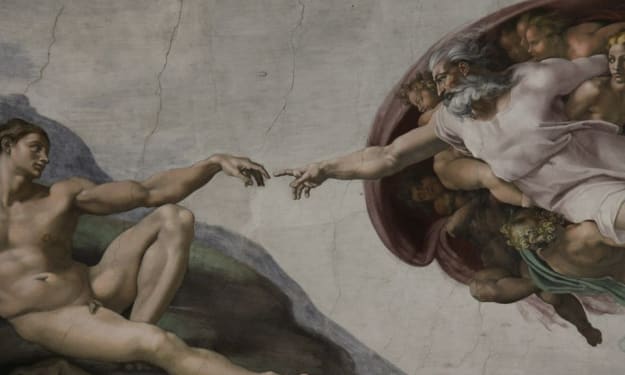
Michelangelo experienced an epiphany while lying on his back, staring at a blank section of the Sistine Chapel. This place is possitively humorless. All day long, I’m subjected to the droning of Gregorian chants. Nobody ever laughs or even smiles. The priests, monks, and nuns dress in lackluster clothes that purposely hide any suggestion of their human form. It must be the most depressing place on the planet.
By Mark Gagnon2 years ago in Fiction
Apocolypstick
Lady Peace struts her stuff when times are good. When the Gross Domestic Product is rising; industry, bustling; exports outpacing imports. Lady Peace knows how to dance when the music plays gaily. She dresses jaunty and wears enticing lipstick. Kisses for everyone!
By Gerard DiLeo2 years ago in Fiction
The Periodic Table
Prompt: writer a 500 word peice based on one of the following themes: Prison visit, the wall or let there be dragons. I went with the wall and I ended up going on a tangent and it became a part of one of my on-going fics I post on A03. On the next local writing meet up I am bringing this with me but someone else is going to read it. It will be interesting to hear this read out by somebody else. This was originally posted last night on the fan fiction website: Archive of Our Own aka A03.
By Chloe Gilholy2 years ago in Fiction