
India Organic Food Market Size and Forecast 2025–2033: A Healthy Shift Toward Sustainable Consumption
Rising Health Awareness, Government Support, and Export Potential Drive India’s Organic Food Revolution

India Organic Food Market Overview
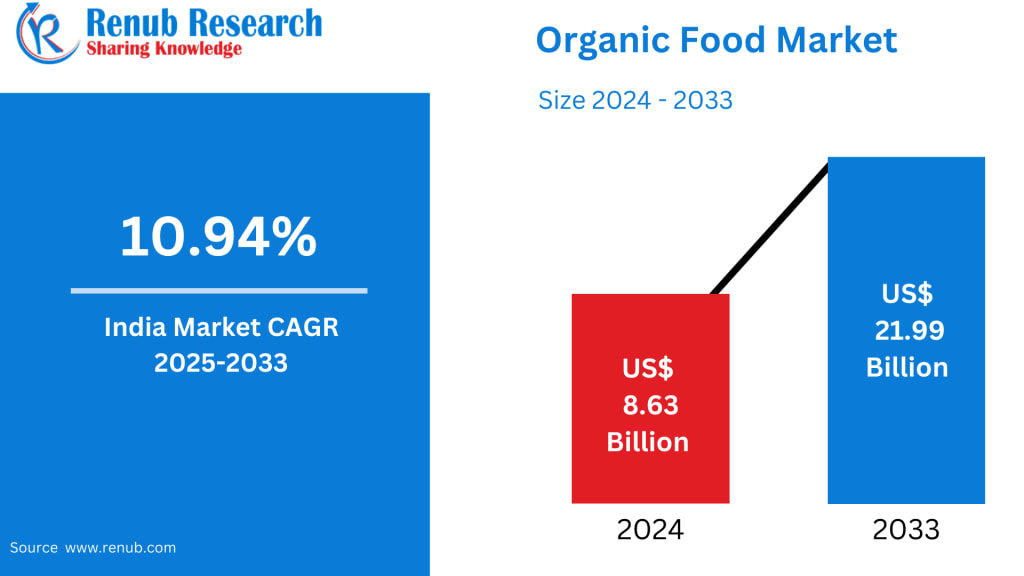
The India Organic Food Market is undergoing a major transformation, fueled by rising health consciousness, environmental awareness, and government-backed initiatives promoting sustainable agriculture. According to Renub Research, the market was valued at US$ 8.63 billion in 2024 and is projected to reach US$ 21.99 billion by 2033, growing at a robust CAGR of 10.94% from 2025 to 2033.
This rapid growth reflects a fundamental shift in consumer behavior. Indian consumers are increasingly prioritizing chemical-free, naturally grown, and sustainably sourced food products over conventional alternatives. Concerns over pesticide residues, soil degradation, lifestyle-related diseases, and environmental impact have accelerated the transition toward organic food.
Organic food consumption is no longer limited to niche urban populations. With better distribution networks, growing e-commerce penetration, and government support for organic farmers, organic food products are now reaching Tier 2 and Tier 3 cities as well. This widespread adoption is setting the stage for India to become one of the world’s most influential organic food markets over the next decade.
India Organic Food Industry Outlook
India’s organic food industry has evolved significantly from a small-scale, export-focused sector into a diversified domestic and international market. Organic fruits, vegetables, grains, spices, dairy products, and packaged foods are witnessing strong demand across households, hotels, restaurants, and institutional buyers.
Government initiatives such as the National Programme for Organic Production (NPOP) and Paramparagat Krishi Vikas Yojana (PKVY) have played a critical role in supporting farmers through certification, training, and financial incentives. Under the National Horticulture Mission (NHM), farmers receive Rs. 10,000 per hectare for organic cultivation (up to four hectares) and Rs. 5 lakh for group certification covering 50 hectares, significantly lowering entry barriers.
India is also a major exporter of organic products, supplying high-quality tea, spices, oilseeds, pulses, rice, and herbs to the U.S., Europe, and the Middle East. Strong international certifications and adherence to global standards have strengthened India’s reputation as a reliable organic supplier.
Despite challenges such as higher production costs and certification complexities, India’s organic food industry is positioned for sustained long-term growth, supported by rising domestic demand and expanding global opportunities.
Key Growth Drivers of the India Organic Food Market
1. Rural-to-Urban Migration and Lifestyle Changes
India’s rapid urbanization has played a pivotal role in increasing organic food consumption. As people migrate from rural areas to urban centers, lifestyle patterns shift toward wellness-oriented choices. Urban consumers are more exposed to health trends, nutritional awareness, and sustainable living concepts.
Cities such as Delhi, Mumbai, Bengaluru, Pune, and Hyderabad are witnessing strong demand for premium organic food products through supermarkets, specialty stores, and online platforms. Higher disposable incomes and education levels further support this trend, making organic food a lifestyle choice rather than a luxury.
2. Expanding Global Export Opportunities
India’s organic food exports are rising steadily due to increasing international demand for clean-label, chemical-free products. Indian organic tea, turmeric, cumin, ginger, rice, and oilseeds are particularly popular in global markets due to their purity, aroma, and nutritional value.
Government support for certification, participation in international trade fairs, and bilateral trade agreements have helped Indian exporters gain access to premium markets. As global consumers increasingly prioritize sustainability and traceability, India’s export-driven organic sector is expected to contribute significantly to market growth.
3. Strengthening Certification and Quality Standards
Certifications such as India Organic, USDA Organic, and EU Organic are playing a critical role in building consumer trust and expanding market access. These certifications ensure compliance with strict organic farming and processing standards, eliminating the use of synthetic fertilizers, pesticides, and genetically modified organisms (GMOs).
With growing consumer awareness, demand for certified organic products is rising across both domestic and export markets. Improved certification frameworks are helping eliminate fake organic claims, strengthening market credibility, and boosting long-term growth.
Challenges in the India Organic Food Market
Pest and Disease Management
Organic farming prohibits the use of synthetic pesticides, making pest and disease management a persistent challenge. Farmers rely on natural methods such as crop rotation, biological controls, and organic sprays, which are often less effective during severe infestations.
This results in lower yields, higher crop losses, and increased costs, which can discourage farmers from adopting organic practices. Addressing this issue through research, innovation, and farmer training is essential for sustained market expansion.
Inconsistent Quality and Regulatory Gaps
Despite existing frameworks, quality standards vary across regions due to inconsistent implementation and monitoring. In some areas, lack of awareness and weak enforcement results in uneven product quality, reducing consumer confidence.
Strengthening local certification systems, improving traceability, and ensuring strict compliance are crucial to maintaining the integrity of India’s organic food industry.
Regional Insights: India Organic Food Market
East India Organic Food Market
The organic food market in East India is expanding steadily, supported by government programs and rising health awareness. States like West Bengal, Odisha, and Bihar are seeing increased adoption of organic farming under PKVY schemes.
Organic tea, rice, vegetables, and spices dominate this region. However, challenges such as limited distribution networks and certification access remain barriers. With improved logistics and farmer participation, East India holds long-term growth potential.
West India Organic Food Market
West India is one of the fastest-growing organic food markets in the country. Maharashtra, Gujarat, and Goa are key contributors, driven by urban demand, rising incomes, and well-developed retail infrastructure.
Cities like Mumbai and Pune are major consumption hubs, supported by supermarkets, specialty organic stores, and online platforms. Despite price sensitivity and supply chain complexities, West India continues to lead organic food consumption in India.
India Organic Food Market Segmentation
By Product Type
Organic Fruits and Vegetables
Organic Meat
Poultry and Dairy Products
Organic Processed Food
Organic Bread and Bakery
Organic Beverages
Organic Cereals and Food Grains
Others
By Distribution Channel
Supermarkets / Hypermarkets
Specialty Stores
Convenience Stores
Online Retail Stores
Others
By Application
Bakery and Confectionery
Ready-to-Eat Food Products
Breakfast Cereals
Others
By Region
East India
West India
North India
South India
Competitive Landscape: Key Companies in the India Organic Food Market
The market is moderately fragmented, with a mix of established brands and emerging players expanding their portfolios and distribution networks. Key players are focusing on product innovation, certification, e-commerce expansion, and export growth.
Major Companies Covered (4 Viewpoints: Key Person, Overview, Recent Developments, Revenue Analysis)
Suminter India Organics Private Limited
Nature Bio-Foods Limited
Organic India Private Limited
Sresta Natural Bioproducts Pvt. Ltd. (24 Mantra Organic)
Phalada Agro Research Foundations Pvt. Ltd.
Mehrotra Consumer Products Pvt. Ltd.
Morarka Organic Foods Pvt. Ltd.
Nature Pearls Pvt. Ltd.
Conscious Food Private Limited
Nourish Organics Foods Pvt. Ltd.
These companies are investing heavily in farmer partnerships, supply chain efficiency, and brand awareness to capture growing demand from health-conscious consumers.
Future Outlook: India Organic Food Market 2025–2033
The future of India’s organic food market looks highly promising. With strong government support, expanding urban demand, rising export opportunities, and growing awareness of sustainable living, organic food is set to become mainstream rather than niche.
E-commerce, farm-to-table models, private labels, and improved certification systems will further accelerate adoption. As consumers become more educated about nutrition and environmental impact, organic food will play a central role in India’s evolving food ecosystem.
Final Thoughts
The India Organic Food Market is at the cusp of a long-term growth cycle. What was once a premium category for a few is now becoming an essential part of India’s food consumption pattern. With the market expected to grow from US$ 8.63 billion in 2024 to US$ 21.99 billion by 2033, organic food represents both a health revolution and an economic opportunity.
For farmers, brands, exporters, and investors alike, the coming decade offers immense potential. As sustainability becomes a necessity rather than a choice, India’s organic food industry is well-positioned to lead the future of responsible consumption—both at home and on the global stage.
About the Creator
Keep reading
More stories from Aaina Oberoi and writers in Feast and other communities.
Global Honey Market Size and Forecast 2025–2033: Sweet Growth Driven by Health, Sustainability, and Innovation
Global Honey Market Overview The global honey market is experiencing strong and sustained growth, reflecting changing consumer preferences toward healthier, natural, and clean-label food products. According to Renub Research, the honey market is expected to reach US$ 17.17 billion by 2033, up from US$ 10.55 billion in 2024, growing at a CAGR of 5.56% from 2025 to 2033.
By Aaina Oberoiabout 5 hours ago in Feast
My Tous les Jours Trip
As someone who lives in a rural area, I don't get the chance to visit fancy restaurants or bakeries that often. So, when a friend told me about a French-Asian bakery that's less than an hour away, I knew I had to check it out and grab some pictures for social media. Tous les Jours ended up providing an immersive experience that went above and beyond my expectations--although I did leave with a few reservations.
By Kaitlin Shanks28 days ago in Feast
Global Spices Market Size and Forecast 2025–2033
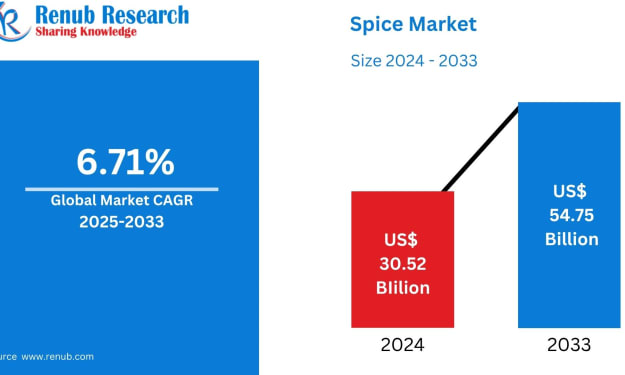
Global Spices Market Overview The Global Spices Market continues to witness robust growth as culinary traditions, health awareness, and food innovation intersect worldwide. Valued at US$ 30.52 billion in 2024, the market is projected to expand at a CAGR of 6.71% during 2025–2033, reaching an estimated US$ 54.75 billion by 2033. This steady rise is fueled by growing demand for ethnic cuisine, rising awareness of the health benefits of spices, and expanding applications in food processing, pharmaceuticals, and wellness products.
By Janine Root about 4 hours ago in Feast
How, Too
Many people wonder how, too. You are not alone, and I am an expert. I will teach you how, too! First, you need to remit a small application fee and fill out an application describing the nature of your financial situation and how often payments will be made, as this will have great bearing on how well I teach you how, too.
By Harper Lewis7 days ago in Fiction



Comments
There are no comments for this story
Be the first to respond and start the conversation.