
Germany Smokeless Tobacco Market Size & Forecast 2025–2033
Rising Demand for Smoke-Free Nicotine Alternatives Reshapes Germany’s Tobacco Landscape

Introduction
Germany’s tobacco industry is undergoing a notable transformation as consumer preferences gradually shift away from traditional cigarettes toward alternative nicotine delivery formats. Among these alternatives, smokeless tobacco is carving out a distinct and steadily expanding niche. Driven by heightened health awareness, tighter smoking regulations, and evolving social attitudes toward tobacco consumption, the German smokeless tobacco market is gaining renewed attention from manufacturers, retailers, and policymakers alike.
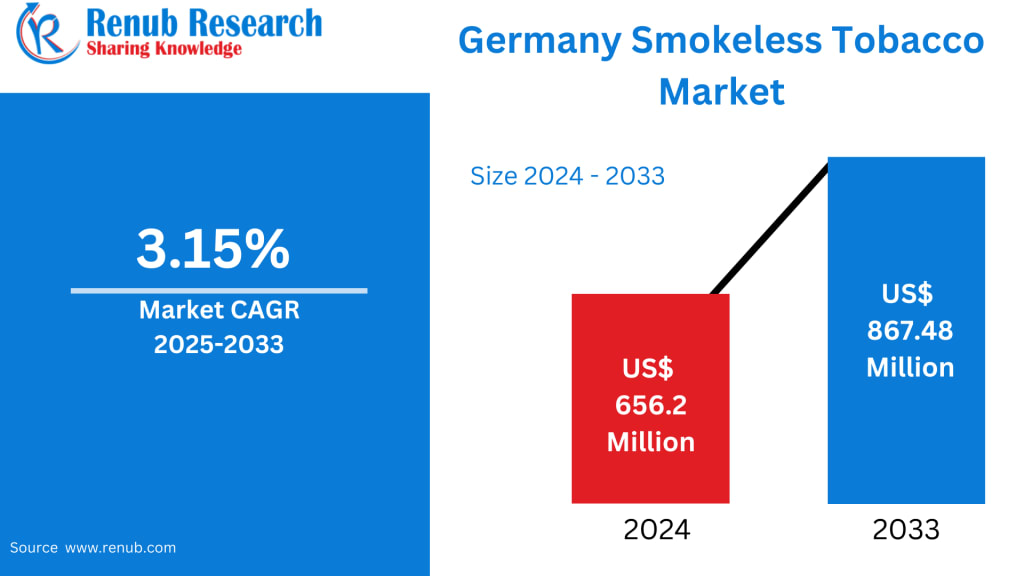
According to Renub Research, the Germany smokeless tobacco market is projected to grow from US$ 656.2 million in 2024 to US$ 867.48 million by 2033, expanding at a Compound Annual Growth Rate (CAGR) of 3.15% between 2025 and 2033. While modest compared to emerging nicotine categories, this growth reflects a resilient demand base and sustained consumer interest in smoke-free alternatives.
Germany Smokeless Tobacco Market Outlook
Smokeless tobacco refers to tobacco products that are consumed without combustion, eliminating smoke inhalation. These products are typically placed in the mouth or nasal cavity, allowing nicotine absorption through oral or nasal tissues. In Germany, smokeless tobacco primarily includes chewing tobacco, snuff, and related oral tobacco formats.
The appeal of smokeless tobacco in Germany stems from several factors. For many adult users, it offers discretion, convenience, and the ability to consume nicotine in smoke-free environments. For others, it is viewed as a transitional alternative away from cigarettes. Although health authorities emphasize that smokeless tobacco is not risk-free, public perception often considers it comparatively less harmful than smoking.
Germany’s strong public health messaging and anti-smoking policies have reshaped nicotine consumption habits over the past decade. As smoking bans expand across public spaces and workplaces, demand for non-combustible tobacco products continues to rise, supporting long-term market growth.
Key Growth Drivers in the Germany Smokeless Tobacco Market
Shift Toward Smoke-Free Alternatives
One of the most significant drivers of Germany’s smokeless tobacco market is the country’s accelerating transition toward smoke-free nicotine products. Stringent restrictions on smoking in restaurants, offices, and public transport have pushed consumers to seek alternatives that align with modern urban lifestyles.
Smokeless tobacco products allow users to avoid smoke, odor, and social inconvenience, making them particularly appealing in densely populated cities. This behavioral shift has opened new opportunities for manufacturers to expand their presence through diversified product portfolios and modern branding.
International companies such as British American Tobacco Plc. and Philip Morris International Inc. continue to explore smoke-free product strategies across European markets, including Germany, as part of broader harm-reduction initiatives.
Cultural Traditions and Regional Preferences
Germany’s smokeless tobacco consumption is also influenced by long-standing cultural traditions, particularly in southern regions such as Bavaria. Snuff and chewing tobacco have historical roots in rural communities, where social acceptance remains relatively strong among older demographics.
These traditions create a stable consumer base that buffers the market against declining cigarette usage. While younger generations may favor newer nicotine formats, regional loyalty to traditional smokeless tobacco sustains steady demand and preserves market continuity.
Product Innovation and Portfolio Expansion
Innovation plays a growing role in shaping the German smokeless tobacco market. Manufacturers are investing in improved packaging, portion-controlled formats, and flavor variations designed to appeal to adult consumers seeking convenience and discretion.
Modern snuff sachets, resealable containers, and premium branding have refreshed the category’s image, making it more relevant in contemporary retail environments. By modernizing traditional products, companies can extend product lifecycles and maintain relevance in a highly regulated market.
Challenges Facing the Germany Smokeless Tobacco Market
Strict Regulatory Environment
Germany enforces some of Europe’s strictest tobacco regulations, and smokeless tobacco products are no exception. Advertising restrictions, mandatory health warnings, and packaging regulations limit marketing flexibility and brand visibility.
Additionally, European Union-wide tobacco control policies impose further compliance requirements, increasing operational costs for manufacturers and distributors. These constraints make it challenging for new entrants to gain market share and for existing players to launch innovative offerings.
Rising Health Awareness and Competitive Alternatives
Growing public awareness of oral health risks associated with smokeless tobacco presents another challenge. Campaigns highlighting links to gum disease, oral cancer, and nicotine dependence have influenced consumer attitudes, particularly among health-conscious demographics.
At the same time, competition from nicotine pouches, vaping products, and other reduced-risk alternatives continues to intensify. These substitutes often benefit from stronger innovation narratives and broader consumer acceptance, placing pressure on traditional smokeless tobacco demand.
Segment Analysis
Germany Chewing Tobacco Market
Chewing tobacco maintains a niche yet stable presence in Germany, largely concentrated in regions with historical usage patterns. Although regulatory pressures and health concerns limit broader adoption, loyal consumer groups sustain consistent demand.
Manufacturers are responding by introducing flavored variants and contemporary packaging to attract younger adult users, ensuring the segment remains relevant despite overall market constraints.
Germany Snuff Smokeless Tobacco Market
Snuff remains the most culturally embedded smokeless tobacco product in Germany. Available in both dry and moist forms, snuff enjoys enduring popularity, especially in Bavaria and neighboring regions.
Modern portioned snuff sachets and flavored options have expanded its appeal beyond traditional users. Despite regulatory hurdles, snuff continues to represent a significant share of Germany’s smokeless tobacco market due to its deep-rooted cultural acceptance.
Distribution Channel Insights
Supermarkets and Hypermarkets
Supermarkets and hypermarkets serve as the primary distribution channels for smokeless tobacco in Germany. Their nationwide presence ensures consistent product availability, particularly in high-consumption regions.
Although advertising is restricted, in-store visibility and established consumer purchasing habits support stable sales volumes. Retail promotions and bulk packaging further strengthen this channel’s importance.
Online Stores
Online retail is emerging as a fast-growing distribution channel, offering convenience, privacy, and broader product selection. Digital platforms cater especially to younger, tech-savvy consumers who value discreet purchasing experiences.
Strict age verification requirements and regulatory oversight limit rapid expansion, yet Germany’s growing e-commerce culture positions online sales as a key growth avenue over the forecast period.
Regional Market Analysis
Berlin Smokeless Tobacco Market
Berlin’s smokeless tobacco market reflects urban consumption trends and strong regulatory enforcement. While vaping and nicotine pouches dominate the city’s nicotine landscape, niche demand persists for flavored snuff and select chewing tobacco products.
Diverse demographics encourage experimentation, but aggressive public health campaigns limit large-scale expansion.
Bavaria Smokeless Tobacco Market
Bavaria stands as Germany’s strongest smokeless tobacco market due to entrenched cultural traditions. Rural communities and older consumers continue to support steady consumption, making Bavaria the market’s largest regional contributor.
Manufacturers frequently target this region with traditional branding while selectively introducing modern innovations to attract younger buyers.
Hamburg Smokeless Tobacco Market
Hamburg’s smokeless tobacco market blends historical exposure with modern consumer preferences. As a port city, Hamburg has long interacted with global tobacco trade, sustaining niche demand for snuff and chewing tobacco.
Competition from alternative nicotine products remains strong, yet evolving product designs help maintain a stable consumer base.
Market Segmentation Overview
By Product
Chewing Tobacco
Snuff
Others
By Distribution Channel
Supermarkets/Hypermarkets
Convenience & Traditional Grocers
Online Stores
Others
By Region
North Rhine-Westphalia
Bavaria
Baden-Württemberg
Lower Saxony
Hesse
Berlin
Rhineland-Palatinate
Saxony
Hamburg
Rest of Germany
Competitive Landscape and Key Players
The Germany smokeless tobacco market is moderately consolidated, with global and regional players competing through brand recognition, product innovation, and distribution strength. Key companies analyzed with comprehensive viewpoints—including overview, leadership, recent developments, SWOT analysis, and revenue performance—include:
Altria Group, Inc.
British American Tobacco Plc.
DS Group
Turning Point Brands Inc.
Imperial Brands Plc.
Philip Morris International Inc.
Dholakia Tobacco Pvt. Ltd.
Japan Tobacco Inc.
Kothari Group Ltd.
Final Thoughts
The Germany smokeless tobacco market is positioned for steady growth through 2033, supported by evolving consumer preferences, cultural traditions, and demand for smoke-free nicotine alternatives. While regulatory pressures and competition from newer nicotine formats pose challenges, the market’s resilience lies in its ability to adapt through innovation and regional loyalty.
With a projected value of US$ 867.48 million by 2033, Germany’s smokeless tobacco sector will remain a meaningful component of the broader tobacco industry. For stakeholders, success will depend on navigating regulations, modernizing product offerings, and aligning with shifting consumer expectations in an increasingly health-aware society.
About the Creator
Keep reading
More stories from Aaina Oberoi and writers in Feast and other communities.
United States Oatmeal Market Size & Forecast 2025–2033
United States Oatmeal Market Overview The United States Oatmeal Market is positioned for steady and sustained growth over the coming decade, supported by rising health awareness, changing breakfast habits, and the growing preference for nutritious convenience foods. According to Renub Research, the market is expected to expand from US$ 1.82 billion in 2024 to US$ 2.83 billion by 2033, registering a Compound Annual Growth Rate (CAGR) of 5.04% during the forecast period from 2025 to 2033.
By Aaina Oberoi3 days ago in Feast
My Tous les Jours Trip
As someone who lives in a rural area, I don't get the chance to visit fancy restaurants or bakeries that often. So, when a friend told me about a French-Asian bakery that's less than an hour away, I knew I had to check it out and grab some pictures for social media. Tous les Jours ended up providing an immersive experience that went above and beyond my expectations--although I did leave with a few reservations.
By Kaitlin Shanks15 days ago in Feast




Comments
There are no comments for this story
Be the first to respond and start the conversation.