

Farm to Table
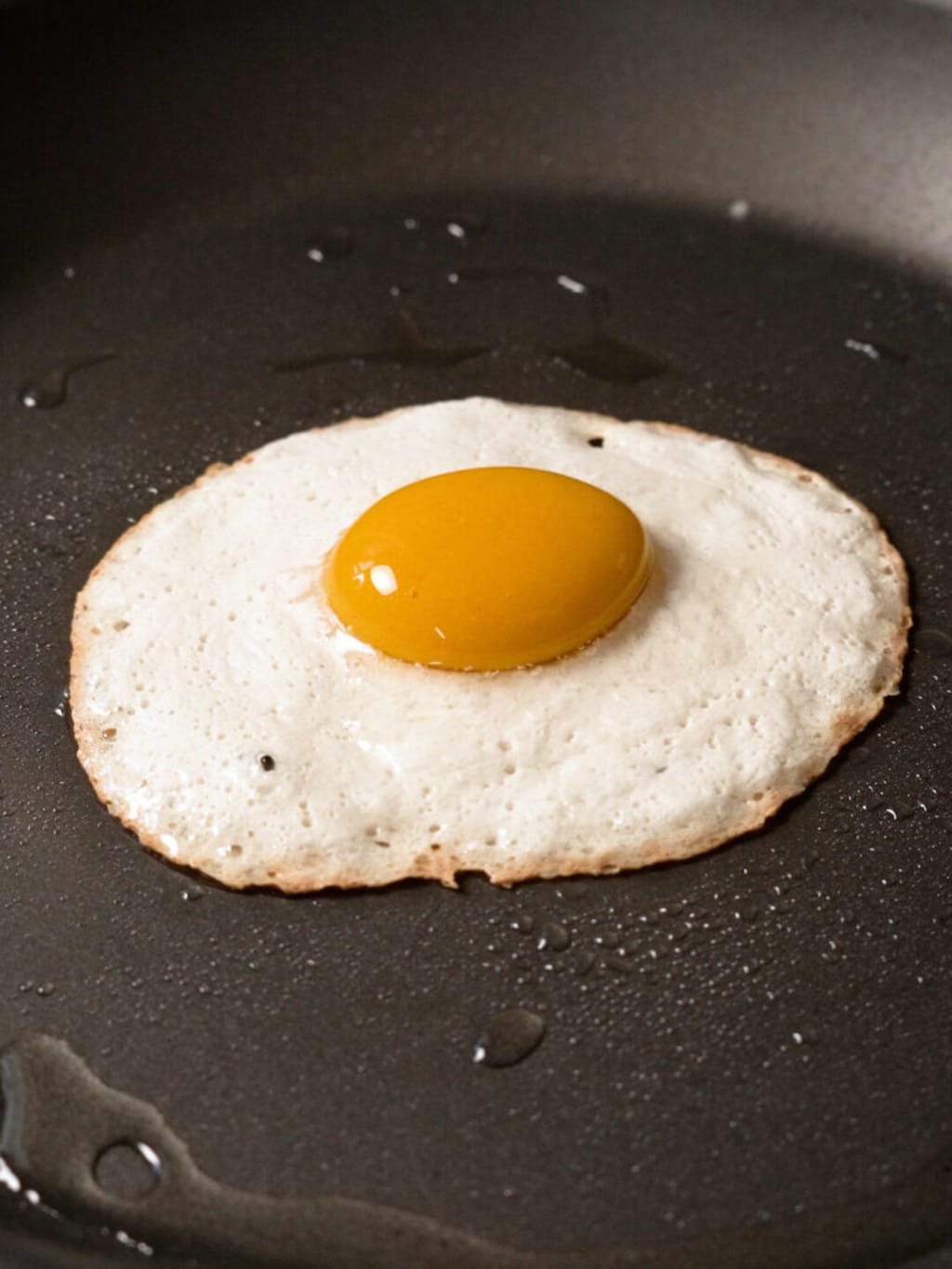
Lucille looked down at the cast iron skillet on top of her range. “Sunnyside up,” she whispered.
That is what her grandmother used to call fried eggs. I’ve never tasted a fried egg as good as my grandmother’s. And I’ve never been able to duplicate her technique.”
She leaned against the counter and thought about the moment the egg slid out of the pan on onto her plate. The white had a crispy line around the edge, and the yolk was a bright yellow mound. She would prick it with her fork, and it would ooze out, hot. She’d dip a piece of toast into it. Lift it to her mouth, and the yolk would drip down and dry on her chin.” She smiled at the memory.
The Culinary Academy’s final exam was not a surprise to the few students left in her class. More than half had dropped out during the pastry course. Tradition had it that you could not be bestowed the title “Chef” until you proved you knew how to cook a perfect egg.
Each classmate knew that after months of preparing gourmet dishes with precision, their future in the culinary world came down to one ingredient: the egg. What was not known: which preparations each novice would receive. Each would be given two out of five possibilities: boiled in the shell, baked, poached, fried, and omelet.
She knew others had been practicing for days, cracking dozens of eggs, recording their own wrist techniques. They watched intricate YouTube videos, trying to replicate them. Lucille however, had not cracked a single egg and had not looked beyond what her instructor had demonstrated for them in the academy’s kitchen.
Eggs had been a part of Lucille’s life, her entire life—she was born and raised on a chicken farm; well, and egg farm, actually.
The color of a hen’s feet and beak turn from pale to dark yellow when the hen quits laying eggs. Lucille was nine when her father began allowing her to select the hens with the darkest yellow feet for the family’s Sunday meals.
One day, she selected one chicken that was fatter and quieter than the others. Her mother had encouraged her to select it saying, “Lucille, that hen’s fat because the feed ain’t going to eggs. A hen that don’t lay, ain’t good for nothing but the fryin’ pan.”
Papa would take the hen by the feet with his left hand, hold it upside down, and shake it. Then, he would grab the hen’s head with his right hand, raise the bird to his mouth, and whistle into its ear.
“Why does Papa shake and whistle, Mama?”
“To scare the chicken, child. Makes her bleed better,” Mama replied.
After the whistle, Grant wrung the hen’s neck by holding it by the head and swinging it around above his head until the centrifugal force separated the head from the body. The headless chicken would land in the barnyard and immediately jump up and run in circles, its three-inch skinless, featherless red neck squirted blood in pattern less gouts as it danced around. Often, it would stumble hard against the fence, fall over, bound up, and run in circles again before finally collapsing.
“Mama, how come it can run around so long when it don’t have a head?” Sally asked.
“’Cause your papa knows how to scare it good.”
“Why does he scare it?” Lucille asked.
“When it’s scared and excited, its heart beats faster, pumping the blood out of the meat.”
“I don’t like it,” Lucille said.
“You’d like it less iffen you had to eat bloody chicken,” Mama said.
Her father wringing the chicken’s neck, wasn’t the worst part of the process. What was most disgusting to Lucille was the plucking. Once the strangled bird had hopped around like a vaudeville dancer and flopped to the ground, Papa would boil up the vat, so it was easier to remove the feathers. Lucille didn’t mind the smell of manure, or rotting vegetables, but she detested the smell of plucking chicken, it made her gag. She was grateful the chore had not come to her—yet. When she turned ten, the chore of plucking the headless chicken for Sunday dinner became her responsibility and her sister Sally would get to select the Sunday hen.
A year later, Papa’s chicken flock caught the Avian flu. He had to slaughter all two-thousand hens. It broke him financially, and he ended up selling his property to developers. They had two weeks to vacate the property. Lucille and Sally were sent to live with different relatives. Lucille was put on a train in Topeka, and four state borders later, found herself living with her maternal grandmother in Kentucky. During the day she attended school, evenings and weekends she worked in her grandmother’s diner.
I’ve never been able to duplicate her technique. I can get the white right, but the center is always cold, Lucille mused.
She turned the front left burner of the gas range to low and counted the seconds until the small cast iron pan was the right temperature. Meanwhile, she took two slices of white Wonder Bread and placed them in the toaster. she checked the setting, and pushed down the handle.
She got olive oil and kosher salt from the pantry and move the ingredients to the counter next to the stove. Then she got the two room temperature eggs from the bowl on the counter next to the sink. With an imperceptible move of her wrist, she cracked each egg on a flat surface, and then with one hand, let the white and yolk land in the hot oil.
She held her breath and listened, “Good, no hissing,” she said, “low and slow,”
A familiar scent made her take comforting breath. The bread popped up, jolting her from her reverie. She placed one slice on a white Corning ware plate, then turned the knob below the pan off.
“The moment of truth,” she whispered. Using potholders, she carefully lifted the skillet, let it hover for a moment over the toast, and then tilted it ever so slightly and watched the white egg and yellow yolk settle on top of the golden bread. She put the skillet back down on the range, set down the potholders, and took the now cool second piece of bread from the toaster.
She placed the small plate of perfection on the kitchen table, pulled out a chair, and sat down. She plunged an edge of toast into the yolk. As she lifted the saturated piece to her mouth, the gold liquid dripped onto her chin. “Her grandmother would wipe her chin and say, “You are just like your mother; you eat up to your elbows.”
*****
Lucille’s cell phone rang, and she answered it with the button on her steering wheel. “Lucy,” the voice on the other end announced. “Where have you been? We didn’t see you at the final exam. Are you okay?”
“I’m great,” Lucille responded. “I got the technique just right.”
“What?”
“The egg, it came out perfect.”
“But you weren’t there. Where are you?”
“Headed to Lexington. The perfect sunny side up, she’ll be proud of me.”
“What, who, Lucy, are you sure you’re okay.”
“Never been better,” she said and felt the little crust of yolk that had dried on her chin.
Recipe
Cook Prep Time: 4 min.
Cook Time: 2 min.
Utensils: 9- or 10-inch cast-iron (or non-stick skillet) with enough space to accommodate 2 eggs. Cast iron is best because it has a non-stick patina that develops over time, so the eggs will slide right off when done.
Ingredients:
• 2-3 tbsp vegetable olive oil (at least two or three tablespoons of oil for 2 eggs, enough to fry and baste the egg whites, speed up the cooking and achieve that covetable crispy edge).
• 2 eggs
• kosher salt or freshly ground salt
• freshly ground black pepper
Technique:
• Heating oil over medium-high heat until shimmering hot. Break eggs into the pan, one at a time, aiming just above the oil to prevent splattering.
• Crack each egg on a flat surface for a clean break (using a pan‘s edge will result in shell shards in the egg). Drop into pan from
• Cook until edges are brown, 1 to 2 minutes. Tilt the pan and spoon the fat over the whites until no longer translucent. Avoid the yolks to keep them runny, (they‘ll continue to cook as is.)
• Season with kosher salt and freshly ground black pepper and enjoy.
About the Creator
Mindy Reed
Mindy is an, editor, narrator, writer, librarian, and educator. The founder of The Authors Assistant published Women of a Certain Age: Stories of the Twentieth Century in 2018 and This is the Dawning: a Woodstock Love Story in June 2019.
Keep reading
More stories from Mindy Reed and writers in Feast and other communities.
My Tous les Jours Trip
As someone who lives in a rural area, I don't get the chance to visit fancy restaurants or bakeries that often. So, when a friend told me about a French-Asian bakery that's less than an hour away, I knew I had to check it out and grab some pictures for social media. Tous les Jours ended up providing an immersive experience that went above and beyond my expectations--although I did leave with a few reservations.
By Kaitlin Shanks16 days ago in Feast



Comments (2)
That I knew how to do, - cook an egg. It is interesting that you chose fiction. Good luck in the challenge.
Its fun how you wrote this as fiction. The recipe 'how to cook an egg" is an interesting choice.