teacher
All about teachers and the world of teaching; teachers sharing their best and worst interactions with students, best teaching practices, the path to becoming a teacher, and more.
Where Space Really Begins: The Kármán Line at 100 Kilometers
If you ask a child where space begins, you’ll probably get an answer like “above the clouds” or “where the stars are.” Adults may point vaguely upward and say something about satellites or rockets. But in reality, there is no physical border where Earth suddenly ends and space begins. Our atmosphere slowly fades into darkness, thinning layer by layer until it becomes indistinguishable from the vacuum of space.
By Holianyk Ihor2 months ago in Education
Lesson Plan for The Snowy Day by Ezra Jack Keats
The Snowy Day Lesson Plan Since I live in Georgia, my students have never seen snow. Reading something like The Snowy Day allows them to see the snow without the cold. The addition of a snowy video on the smartboard just helps the atmosphere.
By Reb Kreyling2 months ago in Education
Studying Abroad: A Journey Beyond Borders
The dream of studying abroad is one shared by millions of students around the world. It’s more than just earning a degree from a foreign university—it’s about discovering new cultures, gaining independence, and broadening one’s view of the world. Every year, young learners pack their bags and step into a new chapter of life in a country far from home, driven by curiosity, ambition, and the desire to make a meaningful difference in their future. Studying abroad opens doors to countless opportunities. It allows students to learn from world-class educators, experience advanced research facilities, and become part of an international community. But beyond academics, it teaches lessons that no textbook can cover—resilience, adaptability, and cross-cultural understanding. Living in a new country requires adjusting to different customs, languages, and lifestyles, which helps students grow both personally and professionally. One of the most remarkable benefits of studying abroad is cultural exposure. Students learn to appreciate diversity, understand global perspectives, and develop empathy for people from different backgrounds. Sharing classrooms, meals, and experiences with students from all over the world encourages open-mindedness. For many, this experience helps dissolve stereotypes and fosters respect for other traditions and beliefs. In today’s interconnected world, such global awareness is more valuable than ever. Language learning is another key advantage. Being immersed in a new environment naturally improves communication skills. Whether it’s mastering English in the UK or USA, learning French in Paris, or picking up Japanese in Tokyo, language becomes more than just a subject—it turns into a living experience. The ability to communicate across cultures is not only enriching but also highly valued in the global job market. Beyond academics and language, studying abroad nurtures independence and confidence. Students learn to manage their finances, cook their own meals, and make important decisions—skills that shape them into mature, responsible individuals. For many, it’s their first experience living away from home. The challenges they face, such as homesickness, cultural differences, or even navigating a new city, become stepping stones toward self-growth. Each obstacle overcome builds courage and character. Career opportunities also expand significantly. Employers value international experience because it demonstrates flexibility, problem-solving ability, and cultural awareness. A degree earned abroad can open doors to global companies and international networks. Many graduates find that their overseas education sets them apart from others in competitive job markets. It signals not just academic achievement, but also a readiness to embrace the world. Another inspiring aspect of studying abroad is how it fosters lifelong connections. Students form friendships that cross continents and time zones. These relationships often evolve into professional collaborations or simply remain cherished personal bonds. The sense of belonging to a global family stays long after graduation, reminding students that the world is vast but deeply connected. However, the journey isn’t always easy. Students often face challenges like financial pressure, homesickness, or adapting to new academic systems. But these experiences teach resilience and perseverance. Overcoming these hurdles gives students a sense of accomplishment and pride. In the end, these very challenges become the most memorable parts of the experience—the ones that build strength and gratitude. Studying abroad also broadens one’s perspective on global issues. Students witness how different societies approach topics like sustainability, equality, and innovation. This exposure encourages them to think critically and creatively about solving problems back home. They return not just with a degree, but with a renewed sense of purpose—to contribute meaningfully to their communities and the world. In essence, studying abroad is a journey of discovery—of the world, of knowledge, and of oneself. It transforms young minds into global citizens who think beyond borders and boundaries. Each experience abroad adds a new layer to one’s personality, making them more adaptable, confident, and compassionate. For those who dream of exploring the world through education, studying abroad is not just an option—it’s an opportunity of a lifetime. It’s where learning meets adventure, where classrooms expand into cultures, and where every challenge becomes a stepping stone toward success. So, if you ever get the chance to study abroad, take it with both hands. The world is waiting to teach you lessons that go far beyond books—and those lessons will stay with you forever.
By Muhammad Saad 2 months ago in Education
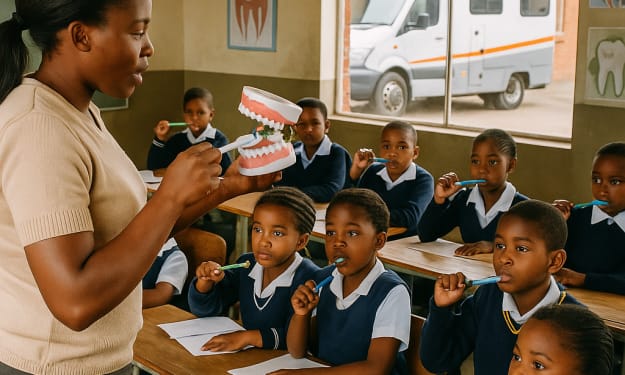
School Smiles Project: How Alfridah Kgabo Matsi Builds Healthier Classrooms. AI-Generated.
This classroom-first template turns oral-health talks into real appointments and lasting habits. Inspired by alfridah kgabo matsi, it’s designed for South Africa’s school realities—tight schedules, limited budgets, and big impact.
By Alfridah kgabo Matse2 months ago in Education
Determining the Age of the Universe: A Cosmic Journey
The Big Bang Theory At the core of our understanding of the universe's age is the Big Bang theory, which posits that the universe originated from an extremely hot and dense state around 13.8 billion years ago. This theory provides a framework for interpreting various astronomical observations. By studying the evolution of the universe since that initial event, scientists can estimate its age.
By shahkar jalal2 months ago in Education
The Future of Learning: How AI is Changing Education
Introduction: The Rise of AI in Education Artificial intelligence (AI) is already a huge disruptor in so many sectors, from healthcare to finance to entertainment. But perhaps the most dramatic place where AI is just beginning to leave its mark is in education. What was once science fiction is now a normal part of the classroom experience, shaping how students learn and how teachers teach.
By The Chaos Cabinet2 months ago in Education
The Energy Released in the Big Bang: An Exploration
The Nature of Energy in the Universe Energy can take many forms—kinetic, potential, thermal, electromagnetic, and more—and it is a fundamental concept in physics that describes the ability to perform work or produce change. In the context of the Big Bang, energy played a crucial role as the universe transitioned from an initial singular state into the vast cosmos we observe today.
By shahkar jalal2 months ago in Education
What Is the Edge of the Universe
The Observable Universe First, it’s essential to differentiate between the entire universe and the observable universe. The observable universe refers to the portion of the universe that we can see and study, limited by the finite speed of light and the age of the universe, approximately 13.8 billion years. This means that the farthest we can observe is about 46 billion light-years away, forming a sphere around us.As we look further into space, we see light that has traveled for billions of years, giving us a glimpse into the universe's history. However, this does not mean that we can see the "edge" of the universe; rather, it indicates a limit to our observations. Beyond this limit, the universe continues, potentially infinitely.
By shahkar jalal2 months ago in Education
AI is secretly changing your life faster than you realize
You might not notice it, but artificial intelligence is already part of your life. It works quietly in the background, learning from your habits, predicting your next move, and shaping the world around you. From the moment you wake up and check your phone, to the time you fall asleep scrolling through social media, AI is constantly at work.
By Wahdat Rauf2 months ago in Education
Was There Time Before the Big Bang?
Understanding the Big Bang The Big Bang theory is the leading explanation for the origin of the universe. It posits that approximately 13.8 billion years ago, the universe began as an incredibly hot, dense point and has been
By shahkar jalal2 months ago in Education