
The Energy Released in the Big Bang: An Exploration
The Big Bang theory is the prevailing cosmological model explaining the origins of the universe, positing that it began from an extremely hot and dense singularity approximately 13.8 billion years ago. Central to this theory is the concept of energy—the very fabric of the universe's creation. Understanding the amount of energy released during the Big Bang involves delving into various aspects of physics, cosmology, and the fundamental laws that govern the universe.


The Nature of Energy in the Universe Energy can take many forms—kinetic, potential, thermal, electromagnetic, and more—and it is a fundamental concept in physics that describes the ability to perform work or produce change. In the context of the Big Bang, energy played a crucial role as the universe transitioned from an initial singular state into the vast cosmos we observe today.
According to Einstein’s famous equation, E=mc2E=mc^2E=mc2, energy (EEE) and mass (mmm) are interchangeable, linked by the speed of light (ccc). This principle is significant when considering the energy released during the Big Bang, as mass-energy conversion is a fundamental aspect of high energy physics. Energy Density and the Early Universe
In the moments immediately following the Big Bang, the universe was incredibly hot and dense. Estimates suggest that within the first few moments, temperatures reached trillions of degrees Kelvin, leading to an extraordinarily high energy density. During this phase, fundamental particles such as quarks, electrons, and neutrinos were created in a rapid and chaotic expansion of energy. Calculating the total amount of energy released during the Big Bang involves considering the universe's volume and energy density. The energy density can be understood as the amount of energy contained within a specific volume of space. As the universe expanded, this energy density decreased, but it was significantly higher in the initial moments.
The Scale of Energy Released
Determining the exact amount of energy released in the Big Bang is challenging due to the extreme conditions and the lack of direct observational data. However, some estimates can provide a sense of scale.
1. Energy Density Calculations: Researchers estimate that shortly after the Big Bang, the energy density was on the order of 1093g/cm310^{93} \text{g/cm}^31093g/cm3. If we consider the observable universe, which has an estimated volume of around 4×1080m34 \times 10^{80} \ text{m}^34×1080m3, we can derive an approximate total energy value.
2. Total Energy Estimate: Using these figures, one can estimate the total energy of the observable universe as follows: Etotal=Energy Density×VolumeE_{\text{total}} = \text{Energy Density} \times \
text{Volume}Etotal=Energy Density×Volume
This rough calculation suggests that the total energy contained in the observable universe could be around 106910^{69}1069 joules. For context, this is equivalent to the energy produced by several billion nuclear power plants over their entire lifetimes.
Cosmic Microwave Background Radiation
One of the significant remnants of the Big Bang is the Cosmic Microwave Background (CMB) radiation, which fills the universe and provides evidence for the Big Bang theory. The CMB is a relic radiation that represents the thermal energy of the early universe, cooled down to just a few degrees above absolute zero. The study of the CMB provides insights into the energy distribution in the universe and helps refine estimates of the energy released during the Big Bang. The CMB has a blackbody spectrum corresponding to a temperature of about 2.7 Kelvin. The energy
density of this radiation today is approximately 0.25eV/cm30.25 \text{eV/cm}^30.25eV/cm3. When integrated over the entire universe, this contributes significantly to the total energy budget.
The Role of Dark Energy
In addition to the energy released during the Big Bang, we must consider dark energy, which constitutes about 68% of the total energy content of the universe today. Dark energy is thought to drive the accelerated expansion of the universe. While it plays a crucial role in the dynamics of the universe, its origins and relationship to the energy released during the Big Bang remain subjects of active research and debate.
Theoretical Implications and Models
Understanding the energy released in the Big Bang also leads to deeper theoretical implications.
Various models of cosmology, including inflationary theory, posit that the universe underwent rapid expansion due to high-energy processes. This phase, known as cosmic inflation, dramatically increased the size of the universe in a fraction of a second and is believed to have played a significant role in shaping the cosmos. These models involve energy transformations that further complicate our understanding of the initial conditions and energy distribution in the early universe.
Conclusion
In summary, the amount of energy released during the Big Bang is an immensely complex topic that intertwines the fields of cosmology, physics, and astrophysics. While estimates suggest a staggering total energy of around 106910^{69}1069 joules in the observable universe, this figure is merely approximation. The initial energy density, the remnants observable today, and the ongoing role of dark energy contribute to a deeper understanding of the universe's evolution.
As research continues, especially with advancements in observational technologies and theoretical models, our comprehension of the Big Bang's energy landscape will likely evolve. The quest to understand the universe's origins not only reveals the fundamental workings of nature but also invites profound philosophical questions about existence, creation, and the nature of reality itself.
About the Creator
Keep reading
More stories from shahkar jalal and writers in Education and other communities.
What Is the Edge of the Universe
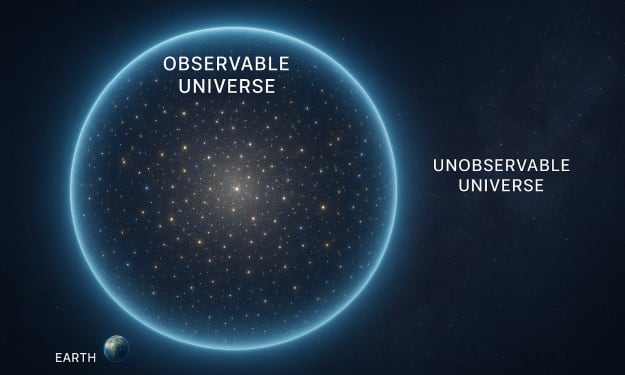
The Observable Universe First, it’s essential to differentiate between the entire universe and the observable universe. The observable universe refers to the portion of the universe that we can see and study, limited by the finite speed of light and the age of the universe, approximately 13.8 billion years. This means that the farthest we can observe is about 46 billion light-years away, forming a sphere around us.As we look further into space, we see light that has traveled for billions of years, giving us a glimpse into the universe's history. However, this does not mean that we can see the "edge" of the universe; rather, it indicates a limit to our observations. Beyond this limit, the universe continues, potentially infinitely.
By shahkar jalal4 months ago in Education
The 3 Biggest Slip-Ups Borrowers Make with Advanced Loans
Let’s talk honestly for a minute. Big loans can feel empowering at first. You secure the funding, the deal closes, and suddenly your business has room to grow. But when that loan comes with multiple conditions, layered repayment rules, and detailed reporting requirements, things can shift quickly. Many borrowers walk into a structured business financing plan feeling confident, only to realize later that they underestimated what they signed up for.
By Eric Kleiner3 days ago in Education
A Planetary Alignment will coincide with Mercury Retrograde
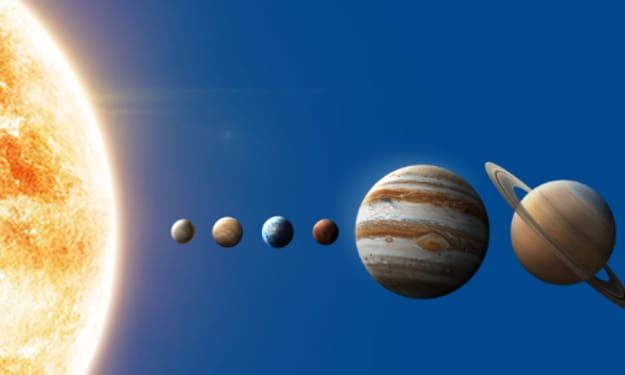
Double phenomena in the heavens Some people say in jest that the planets have aligned in their favor when life works the way they desire. Were you aware that there are seasons when things do line up in the heavens? There will be a planetary alignment AKA a planet parade, on February 28, 2026.
By Cheryl E Preston3 days ago in FYI


Comments
There are no comments for this story
Be the first to respond and start the conversation.