
Determining the Age of the Universe: A Cosmic Journey
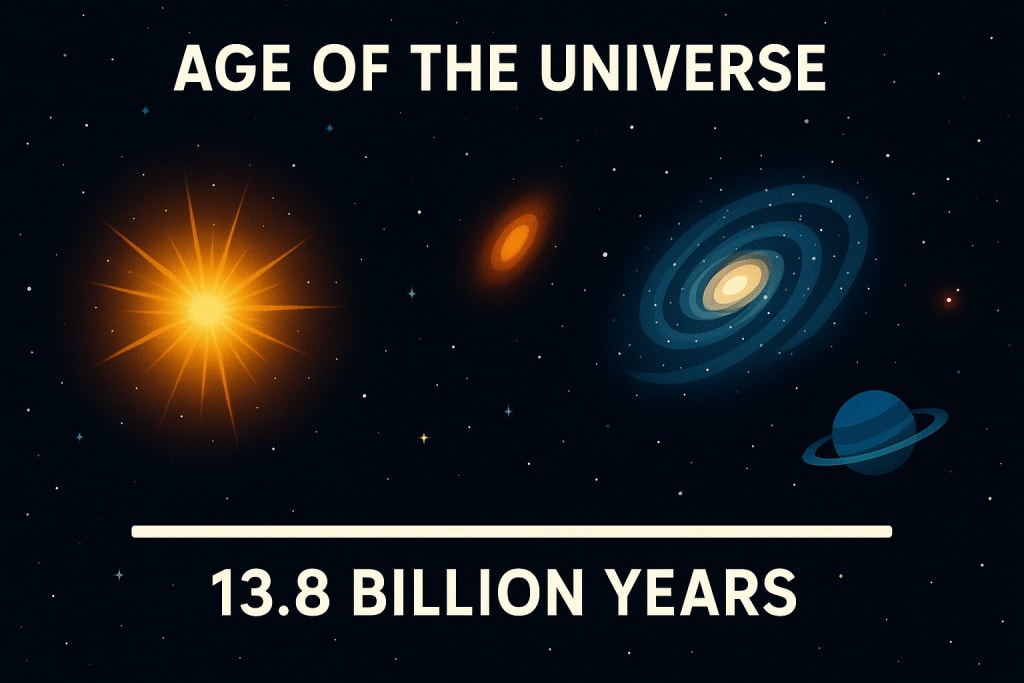
Understanding the age of the universe is a monumental achievement of modern cosmology, drawing on various scientific disciplines, including astronomy, physics, and mathematics. The current consensus places the age of the universe at approximately 13.8 billion years, a figure derived from multiple lines of evidence and sophisticated methods of analysis. This article will explore the key techniques and discoveries that have contributed to our understanding of the universe's age.

The Big Bang Theory
At the core of our understanding of the universe's age is the Big Bang theory, which posits that the universe originated from an extremely hot and dense state around 13.8 billion years ago. This theory provides a framework for interpreting various astronomical observations. By studying the evolution of the universe since that initial event, scientists can estimate its age.
Method 1: Observing Cosmic Microwave Background Radiation
One of the most significant pieces of evidence for determining the age of the universe comes from the Cosmic Microwave Background (CMB) radiation. The CMB is the remnant radiation from the Big Bang, filling the universe and providing a snapshot of its early state.
1. Discovery of the CMB: Discovered in 1965 by Arno Penzias and Robert Wilson, the CMB is crucial for cosmologists. It represents the thermal radiation that cooled as the universe expanded.
2. Temperature Fluctuations: The CMB is not uniform; it contains slight temperature fluctuations that reflect the density variations in the early universe. These fluctuations are essential for understanding how galaxies and large-scale structures formed.
3. Planck Satellite: Data from the European Space Agency's Planck satellite, launched in 2009, provided precise measurements of the CMB. By analyzing the temperature fluctuations, scientists can derive key cosmological parameters, such as the Hubble constant, which describes the rate of expansion of the universe.
Using these parameters, researchers have calculated the age of the universe at approximately 13.8 billion years.Method 2: The Expansion of the Universe
The second method for determining the age of the universe involves measuring its expansion rate, known as the Hubble constant.
1. Hubble's Discovery: In the 1920s, Edwin Hubble discovered that distant galaxies are receding from us, with their speed proportional to their distance. This observation led to the formulation of Hubble's Law, which states that the farther away a galaxy is, the faster it is moving away.
2. Calculating the Hubble Constant: By measuring the redshift of light from distant galaxies, astronomers can calculate their velocities and distances. The Hubble constant (usually expressed in kilometers per second per megaparsec) quantifies this relationship.
3. Age Calculation: To estimate the universe's age, scientists can reverse the expansion process.
By dividing the present size of the universe by the Hubble constant, they can estimate how long the universe has been expanding. This method, however, relies on precise measurements of the Hubble constant, which has proven to be a topic of ongoing research and debate.
Method 3: Stellar Evolution and Star Clusters
Another approach to determining the universe's age involves studying the life cycles of stars, particularly in globular clusters.
1. Globular Clusters: These are densely packed groups of stars, typically containing hundreds of
thousands of stars. They are among the oldest known objects in the universe, and their ages can
provide a lower limit on the universe's age.
2. Stellar Evolution Models: By studying the properties of stars within these clusters—such as their luminosity and temperature—astronomers can place them on the Hertzsprung-Russell diagram, a tool that relates stellar brightness and temperature. Using stellar evolution models,
scientists can estimate the ages of these stars.
3. Oldest Stars: The oldest globular clusters have been found to contain stars that are approximately 12 to 13 billion years old. This suggests that the universe must be at least this old, providing a lower bound for its age.
Method 4: Nucleocosmochronology
Nucleocosmochronology is a method that involves studying the abundances of certain radioactive isotopes in stars and other cosmic materials to estimate the age of the universe.
1. Radioactive Isotopes: Isotopes like uranium and thorium have long half-lives, allowing scientists to use their decay rates to determine the age of stellar material.
2. Cosmic Abundance: By measuring the relative abundances of these isotopes in old stars, researchers can infer how long these stars have been evolving since their formation.
3. Age Estimation: This method has provided age estimates that are consistent with those derived from globular clusters and CMB measurements, reinforcing the conclusion that the universe is approximately 13.8 billion years old.Challenges and Future Directions
While the current methods provide a robust estimate for the universe's age, challenges remain. For example, discrepancies in measuring the Hubble constant have led to differing estimates, highlighting the need for further observations and improved techniques.
New missions, such as the James Webb Space Telescope, promise to provide deeper insights into the early universe and potentially refine our understanding of its age. Observations of distant galaxies and the CMB will continue to play a vital role in this endeavor.
Conclusion
Determining the age of the universe is a complex but fascinating undertaking that combines observations of the cosmic microwave background, measurements of the universe's expansion, studies of stellar evolution, and isotopic analyses. The current estimate of approximately 13.8 billion years is a testament to the ingenuity of scientists and the sophisticated methods developed over the decades.
As technology advances and our understanding of the cosmos deepens, we may refine this estimate and unveil new insights into the universe's origins and its ultimate fate. The quest to determine the universe's age not only informs us about our cosmic timeline but also enriches our understanding of the fundamental laws that govern the universe itself.
About the Creator
Keep reading
More stories from shahkar jalal and writers in Education and other communities.
The Energy Released in the Big Bang: An Exploration
The Nature of Energy in the Universe Energy can take many forms—kinetic, potential, thermal, electromagnetic, and more—and it is a fundamental concept in physics that describes the ability to perform work or produce change. In the context of the Big Bang, energy played a crucial role as the universe transitioned from an initial singular state into the vast cosmos we observe today.
By shahkar jalal2 months ago in Education
The Future of Entrepreneurship: Key Trends Shaping the Next Decade
Entrepreneurship is entering an exciting new era. As technology advances and societal needs shift, business owners must stay adaptable to thrive. The next decade promises transformative change, and understanding the trends shaping entrepreneurship is crucial. Here are the key trends shaping the future of entrepreneurship and how they will impact entrepreneurs and their businesses.
By Greg Warnock2 days ago in Education



Comments
There are no comments for this story
Be the first to respond and start the conversation.