
The Last Images of Saturn Captured by NASA's Cassini Mission
In 2017, Cassini ended its mission by disintegrating in Saturn's atmosphere. What were the final images it ever took?

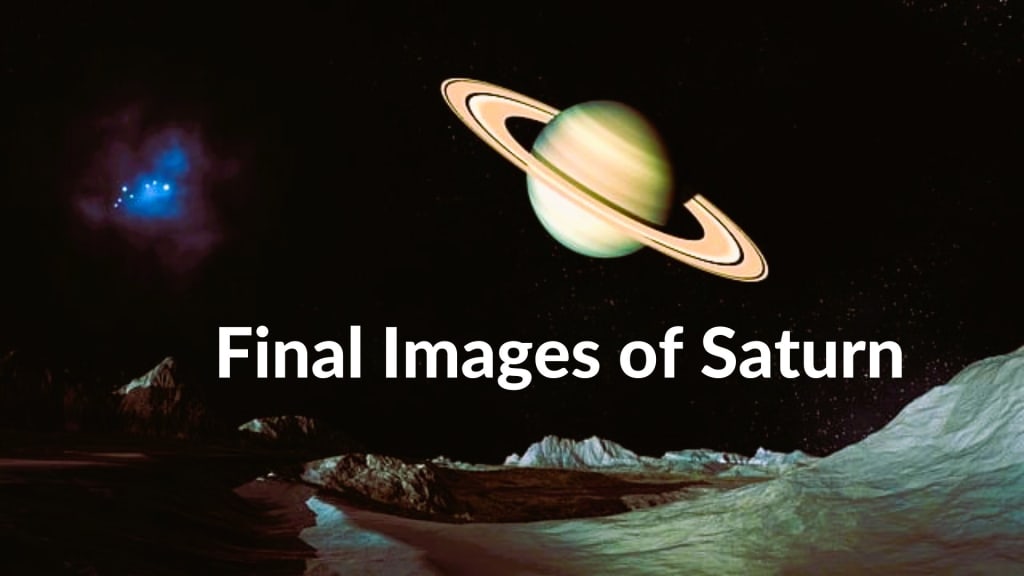
The Cassini spacecraft was a mission to explore Saturn and its moons. It was launched in 1997 and arrived at Saturn in 2004. The mission was a collaboration between NASA, the European Space Agency (ESA), and the Italian Space Agency (ASI). Cassini's objectives were to study Saturn's atmosphere, magnetic field, rings, and moons in detail. The spacecraft made numerous discoveries, including the identification of six new moons, confirmation of subsurface oceans on icy moons that could potentially support life, and the observation of Saturn's unique storms. Cassini's mission ended in September 15, 2017 when it was intentionally plunged into Saturn's atmosphere to avoid contaminating any potential life on Saturn's moons.
The Cassini mission to the Saturn system has captivated people worldwide. It was not only an impressive engineering feat but also an ambitious and highly successful mission. Over its 13-year journey around Saturn, Cassini transmitted a staggering 635 GB of data, leading to the publication of more than 4,000 scientific papers. It made remarkable discoveries, including the identification of six new moons and the confirmation of subsurface oceans on icy moons, which could potentially support life. Cassini even landed a probe on Titan and observed Saturn's unique storms. Throughout its mission, Cassini traveled over 7 billion kilometers.
The Cassini mission stands as one of the greatest space missions of all time. Many of you have expressed interest in seeing the final images captured before its descent into Saturn's atmosphere. Although Cassini couldn't capture real-time video, these images are truly remarkable and worth exploring.
The final phase of Cassini's mission, known as the Grand Finale, involved daring maneuvers. Cassini was sent into an eccentric orbit over Saturn's poles and even passed through gaps in its rings. During the last few orbits, Cassini approached closer to Saturn's surface than ever before, providing scientists with a unique perspective.
One notable time lapse captured on September 8, 2017, just a week before the mission's end, showcases Cassini's focus on the moon Enceladus. Enceladus is considered a prime candidate for hosting life due to its subsurface ocean. Cassini discovered over 100 water plumes erupting from Enceladus, which have formed the beautiful E ring around Saturn. This tenuous ring is only visible when backlit by the Sun and is possibly the bluest natural object in our solar system. The time lapse reveals Enceladus' effect on the densest part of the E ring as the plumes disturb and replenish it.
On September 11, when Cassini was near the furthest point of its final orbit, it captured a stunning mosaic image in natural light. This image displays Saturn's prominent rings (D, C, B, A, and F) with Saturn's shadow cast over them. The northern hemisphere of Saturn was experiencing summer at the time, allowing us to witness the magnificent hexagon storm and subtle bands on Saturn's surface. Interestingly, the nightside of Saturn is dimly illuminated due to light reflecting off the rings, making it less dark than one might expect.
As Cassini approached Saturn once again on September 12, it captured images of Saturn's atmosphere near the terminator line. The low position of the Sun in the sky reveals enormous cloud structures casting shadows that stretch for kilometers.
These final images from Cassini offer a captivating glimpse into the beauty and complexity of Saturn and its moons. The mission has undoubtedly left an indelible mark on our understanding of our solar system.
This scene may appear to be a close-up of Saturn, but in reality, it spans about 5,500km across. To put it into perspective, Saturn's moon Titan could easily fit within this shot. As Cassini approached Saturn, on September 13th, it took one last glimpse of Daphnis, a shepherd moon responsible for maintaining the stability of the A ring. The gravitational pull of Daphnis creates ripples in the ring, noticeable both in front of and behind the moon. These ripples result from the differing orbital speeds of the rings and the moon. The inner ring moves faster than Daphnis, causing the ripples to overtake the moon and exposing more ring material to its gravity. Conversely, the outer ring moves slower than Daphnis, causing the ripples to lag behind the moon. By the time the ring material reaches Daphnis on either side again, the ripples have smoothed out.
On the same day, Cassini captured a view of Titan, a moon that received significant attention throughout the mission. Titan is a remarkable world with a thick nitrogen atmosphere. The image also includes a glimpse of Saturn's rings, with the uneven F ring barely visible at the bottom. As Saturn loomed larger, Cassini took one final look at Enceladus over a 40-minute period before it disappeared behind Saturn's limb.
The last image ever taken by Cassini was a view of the region where it would plunge into Saturn's atmosphere. Taken during nighttime, Saturn is illuminated by light reflecting off its rings. On the final day, taking photos was not a priority for scientific purposes. While beautiful, they consumed valuable bandwidth, and scientists wanted to maximize real-time data collection before the spacecraft's destruction.
During its descent into Saturn's atmosphere, Cassini's thrusters deployed its remaining fuel to keep its antenna pointed towards Earth. At this point, Cassini was approximately 1,900km above Saturn's clouds and traveling at a speed of 123,000km/h. A minute later, the thrusters fired at maximum capacity to prevent Cassini from spinning out of control. However, the intense heat from Saturn's atmosphere overwhelmed the thrusters, causing Cassini to tumble and severing communication with Earth. Cassini's onboard computers would have attempted to identify and correct the issue, but within a minute or so, the spacecraft would have disintegrated entirely and burned up in Saturn's atmosphere.
Despite its demise, the Cassini mission was an incredible success. Data collected during the final phase included direct analysis of Saturn's atmosphere, ionosphere, dust particles, magnetic field measurements, and potentially more discoveries yet to be uncovered. The legacy of the Cassini mission continues as scientists analyze and reexamine the data, leading to further scientific papers and revelations.
Excitingly, missions to the Saturn system are not over. Dragonfly, a lander powered by a radioisotope thermoelectric generator, will explore Titan by flying across its surface and directly sampling various locations. This ongoing exploration ensures that Cassini's legacy lives on.
Lastly, spacecraft like Cassini rely on the Deep Space Network to communicate with mission controllers on Earth. These global communication facilities enable constant data transmission regardless of Earth's orientation. All the best, and see you next time.
About the Creator
Saomai2003
The universe is a vast and mysterious place that has fascinated humans for centuries. From the tiniest subatomic particles to the largest galaxies, the universe is full of wonders that challenge our understanding of the world around us.
Keep reading
More stories from Saomai2003 and writers in Earth and other communities.
Trump’s Greenland Threats Push Europe Toward Divorcing America
When you think of Greenland, the first things that probably come to mind are icebergs, polar bears, and maybe some adventurous explorers. But lately, Greenland has become the center of a major diplomatic drama — one that’s forcing Europe to question its long-standing relationship with the United States. And the spark? Donald Trump’s threats over Greenland. The Controversy: Trump’s Unusual Move Back in January 2026, Trump shocked the world again, not with an election campaign but with a bold — and many would say bizarre — plan to acquire Greenland. But he didn’t stop at just “expressing interest.” He threatened eight European nations with tariffs — starting at 10% and potentially climbing to 25% — unless Denmark agreed to sell Greenland to the U.S. Yes, you read that right: tariffs on allies to buy a remote Arctic island. For Europe, this was more than shocking — it felt like a betrayal from a partner they’ve relied on for decades. Europe’s Response: Outrage and Solidarity European leaders didn’t hold back. Germany, France, Norway, the UK, and others banded together to condemn Trump’s approach. The message was clear: Europe won’t be blackmailed. Even usually cautious leaders spoke up. Norway’s Prime Minister bluntly said, “Threats have no place among allies.” Meanwhile, European Commission President Ursula von der Leyen emphasized that tariffs between allies “have no place” and could undermine decades of cooperation. This isn’t just a political disagreement. Europe sees this as a test of trust, sovereignty, and alliance reliability. Why Greenland Matters At first glance, Greenland might seem like just a frozen island. But strategically, it’s a big deal: Location: Greenland sits between North America and Europe, controlling key air and sea routes. Military Importance: It hosts radar and U.S. military infrastructure critical to early-warning systems. Resources: Beneath the ice lie minerals and rare earth elements that the world desperately needs. For Europe, Greenland is also about principle. The island belongs to Denmark and the Greenlandic people, not Washington. Europe’s support for Denmark shows a broader commitment to respecting sovereignty — a principle that Trump’s threats directly challenged. The Bigger Picture: A Crisis of Trust Greenland may just be the tip of the iceberg. For years, European nations have felt frustrated by U.S. policies that seemed unpredictable — whether it’s climate agreements, trade deals, or security commitments. Trump’s Greenland threats amplified these frustrations. Suddenly, Europe is questioning something fundamental: Can the U.S. be trusted as a long-term partner? Some European leaders have even started talking about a kind of “divorce” from the U.S. — not literally leaving NATO, but rethinking how dependent they should be on America for security and strategic decisions. Europe’s Path Toward Strategic Independence This Greenland drama is accelerating discussions about European strategic autonomy. Basically, Europe is asking: Should we be able to protect our own interests without always relying on the U.S.? The EU has long talked about building stronger defense capabilities and investing more in its own military, but progress has been slow. Greenland might just be the wake-up call that finally pushes Europe to act. What’s Next? So, what happens from here? Europe isn’t just going to sit quietly. Leaders are looking at: Economic counter-measures like tariffs on U.S. goods Strengthening European defense and security collaboration Reasserting Europe’s role on the global stage, with less reliance on Washington Even if Europe doesn’t fully “divorce” America, Greenland is changing the terms of the transatlantic partnership. Europe will now demand more respect, clearer rules, and recognition of its sovereignty — and they’re not afraid to make that clear. Why This Matters to All of Us You might wonder why this matters if you’re not in Europe or the U.S. Greenland may seem remote, but this story is about alliances, trust, and how global power is shifting. The way Europe responds could reshape the world order, affect trade, military cooperation, and even the global economy. And for anyone following U.S.-European relations, it’s a reminder that sometimes the smallest places — even a frozen island — can have huge global consequences. Bottom line: Trump’s Greenland threats aren’t just a bizarre footnote in history. They’re a wake-up call for Europe, forcing the continent to rethink its ties with America and consider a future where it can act independently — strategically, economically, and politically. Greenland, icy as it is, might just melt the old rules of alliance forever.
By Muhammad Hassanabout 5 hours ago in Earth
High-Speed Train Crash in Southern Spain Leaves at Least 21 Dead
A devastating high-speed train crash in southern Spain has left at least 21 people dead and dozens injured, shocking the nation and triggering a major emergency response. The incident, which occurred on a busy rail route connecting key southern cities, has reignited concerns over railway safety, infrastructure maintenance, and emergency preparedness in one of Europe’s most advanced rail networks.
By Aarif Lashariabout 20 hours ago in Earth
Silver Screen Magic with Mae West
American actress and singer Mae West became a popular film actress during the Great Depression. She started entertaining in vaudeville, then performed on Broadway, and finally went to Hollywood. She signed up with Paramount Pictures and made her debut in the 1932 film “Night After Night.” She also starred in musicals, comedies, and crime dramas. The American Film Institute named her one of the best classic Hollywood actresses.
By Rasma Raisters6 days ago in Geeks


Comments
There are no comments for this story
Be the first to respond and start the conversation.