
Where is Pluto in the solar system? Secrets of Pluto
In 2015, NASA's New Horizons space probe whizzed by Pluto. It has sent back all of its data, what did it see and discover? Explores everything NASA's New Horizons. The Kuiper Belt around Pluto, Charon and Arrokoth (Ultima Thule)

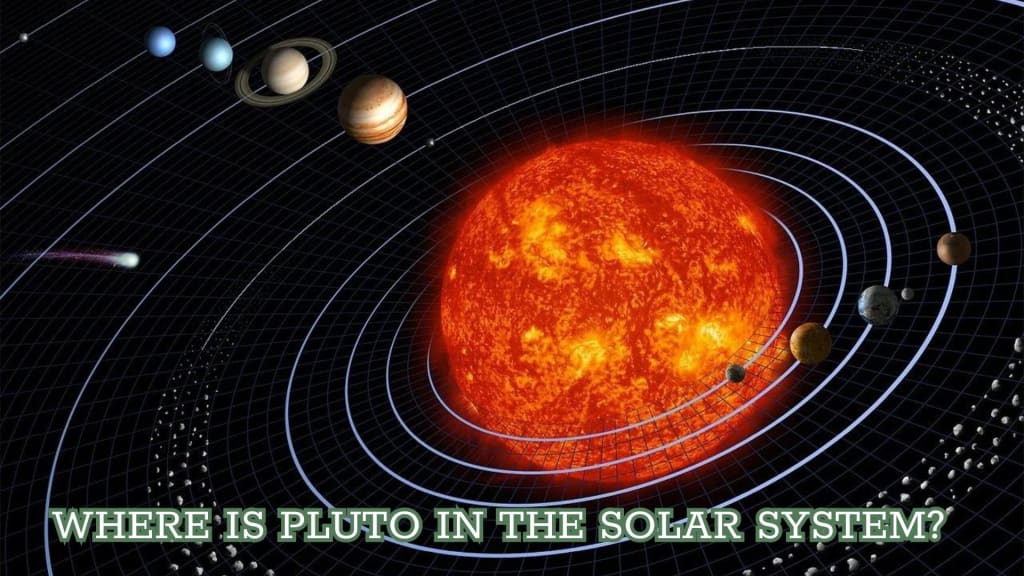
I showcase the journey New Horizons took in order to get to Pluto, its moons, geological features, and Pluto's atmosphere.
In 2015, the space community was abuzz with excitement as the New Horizons space probe flew by Pluto, providing us with unprecedented detail and fidelity of the dwarf planet and its moons. Prior to this, the best image we had of Pluto was a few blobs of color variation captured by the Hubble telescope. The New Horizons mission was part of NASA's New Frontiers program, and it was launched in 2006 with the goal of exploring Pluto as soon as possible. The spacecraft used Jupiter as a gravity assist to shave three years off its arrival time and also took remarkable videos and images of the planet and its moons during the trial run. After the successful trial, the spacecraft went into hibernation mode to prevent wear and tear of its instruments. Leading up to its approach in 2015, the team turned the systems back online, and every day, the spacecraft sent back images of the Pluto system. On July 14th, 2015, the New Horizons probe made its closest approach to Pluto at only 12,500 km from the surface of Pluto. The spacecraft sent back spectacular images of mountain ranges, ice plains, glaciers, and an atmosphere. One of the most interesting things observed was Pluto's unusual relationship with its moons. For example, Charon, Pluto's biggest moon, orbits very closely to Pluto and is also very big in comparison. This means that the barycentre of the two objects is outside of the primary object, and they both orbit around a point in space. Additionally, both objects are tidally locked to each other, which means that if you stand on one, the other won't move from that point in the sky.
The Pluto system is a fascinating subject of study, and the New Horizons mission provided us with a wealth of new information. One of the most interesting things observed is the unusual relationship between Pluto and its largest moon, Charon. Both objects are tidally locked to each other, and Charon orbits very closely to Pluto. Additionally, Charon is visually different from Pluto, being much darker, which suggests that the two objects are not from the same origin. The rest of Pluto's moons are very small and have exceptionally circular orbits that are coplanar with Pluto's orbit.
The geology of Pluto is also fascinating. The most prominent feature on Pluto is the giant heart-shaped Sputnik Planitia, which is a giant ice plain made up of nitrogen ice. In fact, 98% of Pluto's surface is comprised of nitrogen ice, which can flow as glaciers at the temperature on the surface of Pluto. The ice plains have polygon shapes and no craters, suggesting that they are a relatively new feature or one that is being continually renewed. The ice plains are surrounded by vast mountain ranges made of water ice, which can support heights of several kilometers at this temperature. Among the mountains found on Pluto, there might also be some which are cryovolcanoes, such as Wright Mons.
Another interesting feature of Pluto is the dark material that seems to be sprinkled on the surface in some areas, such as Cthulhu Macula. The dark color is thought to be a deposit of tholins, a kind of tar made up of hydrocarbons that have interacted with sunlight. The region on Pluto is much more heavily cratered than the heart, which implies that the surface there is much older. Tartarus Dorsa is another distinctive feature of Pluto's surface, consisting of an extensive set of 500-meter-high mountains that resemble snakeskin or tree bark.
Overall, the New Horizons mission provided us with a wealth of new information about Pluto and its moons, and there is still much to be learned from these fascinating objects.

It is believed that the tall, spiky formations on Pluto are Penitentes, which are a rare sight even on Earth. These formations cover a much vaster area on Pluto than on Earth, and we can only imagine what they look like up close. However, the most impressive discovery made by the New Horizons mission was that Pluto has an atmosphere. Despite its small size and weak gravity, the atmosphere extends high above the surface of Pluto. The atmospheric pressure is exceptionally low, roughly 10 microbars, or 100,000 to 1,000,000 times weaker than the surface pressure on Earth. The atmospheric density can vary greatly due to seasonal variations, and there are up to 20 haze layers consisting of nitrogen, methane, and carbon monoxide. The haze layers are not level across the planet and can be seen acting like layers of thin fog in some images.
In 2019, New Horizons flew by a small Kuiper Belt Object known as 2014 MU69, also known as Ultima Thule, and sent back images and data from the encounter. The spacecraft is currently on an extended mission to study other objects in the Kuiper Belt and beyond, and it is expected to continue sending back data for several more years. So while New Horizons has completed its primary mission of exploring Pluto and its moons, it is still actively sending back data and conducting scientific research.
About the Creator
Saomai2003
The universe is a vast and mysterious place that has fascinated humans for centuries. From the tiniest subatomic particles to the largest galaxies, the universe is full of wonders that challenge our understanding of the world around us.
Keep reading
More stories from Saomai2003 and writers in Earth and other communities.
Why Do Scientists Believe Most of the Universe Is Hidden?
The universe is full of mysteries, and one of the greatest is the nature of dark energy. The scientific explanation for the origin of the universe begins with the Big Bang, an explosion that caused space to expand. About 15 billion years ago, all the matter and energy that make up the observable universe today were packed into a space smaller than the head of a pin. The universe then exploded in a colossal event, and everything started expanding in all directions. However, scientists have discovered that the expansion of the universe is not uniform, with matter moving away from us more rapidly the farther it is. This unusual behavior is believed to be caused by dark energy, which remains a mystery. In this article, we will explore the concept of dark energy, including what it is, why scientists believe it exists, and what it means for our understanding of the universe. Our universe is more complex than it appears at first glance, and we have only begun to comprehend its structure in the last century. Before that, we thought the universe was just a single galaxy filled with stars, but astronomers began to suspect that there were other galaxies beyond our own. In the 1920s, American astronomer Edwin Hubble confirmed this idea by studying the Andromeda galaxy and measuring the distance to a Cepheid variable star within it. He discovered that the universe was expanding, which challenged even Einstein's understanding of physics. In this episode, we will delve deeper into these discoveries and explore some of the ways scientists are studying dark energy to unravel its secrets.
By Saomai20032 years ago in Earth
New Study Issues Dire Warning About Worsening Conditions in Major US River: ‘The Outlook … Does Not Look Good’
A recent study examining one of the United States’ most critical waterways has raised alarm bells for environmentalists, policymakers, and communities that rely on it for drinking water, agriculture, and commerce. The research, conducted by a consortium of scientists from leading universities and federal agencies, indicates that the river’s health is deteriorating at an unprecedented pace, and without immediate intervention, the consequences could be catastrophic.
By Fiazahmedbrohi about 12 hours ago in Earth




Comments
There are no comments for this story
Be the first to respond and start the conversation.